Category: Materialization technologies
Topsy-turvy: Trying on the Image of the Reader of Absurdist Literature
“Absurd, funny, reckless, crazy,
Magical!
No use, no sense, out of tune,
Completely out of place…”
Words by Yuliy Kim, music by Gennady Gladkov, Song of the Wizard
THE GRASS SPUN INTO HYSTERICS TO THE SOUND OF ICE CREAM.
Absurd? You’re right. Ice cream melts silently, even. Grass is bound by its root system. A hysterical state is clearly not conducive to waltzing. Picturing the scene described above in detail is only possible with a rebellious imagination.
Or…
Is all of this not devoid of meaning? Yes! You’re right again. The grammatical model of the sentence is intact: subject + predicate. The utterance reads as coherent text. What we have here is clearly a narrative puzzle: there is an event and a character who sets it in motion. You could retell this to your friends. Discuss it. Especially since, under the magnifying glass of erudition, this text oozes with literary reminiscences. The discussion of just one cultural archetype — “grass” — could fill several extended meetings of a book club (for example, the Chinese “grass-roots culture” — the worldview of the common person; the Russian “tryn-grass” — a phrase meaning “who cares,” as well as the Soviet tragicomedy of the same name). Yes, the content does stray a bit beyond the usual. But if it didn’t, there’d be nothing to discuss.
Any work of literature can drive you mad (maybe). After all, it comes to life inside your head. Until you, in a fit of your own recklessness, begin to read, any book is nothing more than a dead tree reincarnated between covers. In other words, a literary text has no immunity whatsoever to the reader’s highly contagious absurdism.
Forget what you read in the previous paragraph. And don’t pay any attention to the title of the article either. The claim that all literature is absurd is our personal opinion. True, we weren’t the first to come up with it. Plato beat us to it. That’s why he’s a philosopher. “Without being bothered that his theory of creativity came into known conflict with his own teaching about the rational cognition of ideas, Plato proclaimed the act of artistic creation to be an alogical act” — that is the strange conclusion reached by another philosopher, Valentin Ferdinandovich Asmus, in his famous Historical-Philosophical Studies.
Fortunately, at the beginning of the last century, OBERIU (the Union of Real Art) appeared. And everything fell into place. Not all literature is absurd. Only certain masterpieces should be considered absurdist. Namely, those created by the Oberiuty who mastered a “new poetic language”: Daniil Kharms, Alexander Vvedensky, and their like-minded peers. In their Declaration (1928), these newly minted fighters against all the rules and restrictions imposed on the creator by the external world clearly delineated the perimeter of their aesthetic existence: “Art has its own logic, and it does not destroy the object but helps to recognize it.”
This “help” took the form of comical juggling of meanings and symbols, deliberate destruction of cause-and-effect and spatiotemporal connections, and outrageous flirtation with words.
Having presumably been inspired by Kharms’ “the surgeon wounded a chair in the skull” (from The Lusty Merchant) and other paradoxical creations, literary scholars identified and, as they say, “scientifically conceptualized” a new literary movement — absurdism. A term even appeared — “Kharms studies” — testifying to just how deeply and systematically this cultural layer that blanketed the planet was to be studied (let us note in parentheses that almost simultaneously with the Oberiuty, who were creating in the realm of Russian literature, Beckett and Ionesco were enthusiastically engaged in the creation of anti-theatre in Europe).
Forget what you read in the previous paragraph. While wandering through the thickets of scientific conceptualization of the meaningless and the systematization of the unsystematic, we stumbled upon a saving exit. S. F. Merkushov, in his article “The Theoretical Reception of the Category of Artistic Absurd” (Kazan Science journal, No. 7, 2019), summarizing existing approaches to this remarkable artistic phenomenon, convinced us that only by accepting “the timeless nature of the absurd” and “the inseparability of the concepts of ‘absurd’ and ‘meaning'” can one safely pick up any book and not drop it when encountering the absurd outside any genre constraints.
So, shall we dare to pick up a book? Are you an absurdist (or not yet)? Let’s mount a rhinoceros and find out what kind of reader you are.
The ideal guide into the world of crumbling meanings. One of the largest animals on Earth and a symbol of “unbridled strength and fury” (according to the Cyril and Methodius Mega-Encyclopedia) feeds on… grass (ordinary, non-hysterical grass). The fact that rhinos, with the exception of one species, are now going extinct after a dizzying career of conquering the planet seems absurd. The “track record” of successful evolution of these formidable hoofed vegetarians spans millions of years.
So, let us embark on our first literary rendezvous with a hero of the International Red Book:
Do you hear the rustle of many feet?
It means — close, very close
To your forest clearing
An enraged rhinoceros.
The situation itself is quite ordinary for the habitats of the mammoth’s contemporary. What appears extraordinary is the poetic solution to the problem:
Do not seek your salvation
By fleeing and hiding.
Lift your arms high
With a song of happiness and parting…
Ready to sing along? Or do you think it’s reckless to shout over your survival instinct? If you prefer to seek refuge in the vines (that’s what the monkeys did — the secondary characters in this story) instead of engaging in absurd karaoke, then the logic of common sense will slow down our journey along the trajectory of leaving reason behind. And we haven’t even moved from the spot yet.
The quoted text (the poem “The Rhinoceros”) was written by the Russian poet of the Silver Age, Nikolai Gumilyov, whose name is NOT counted by literary scholars among the ranks of the absurdists. Given these new parameters, what you have just read should be interpreted (the rules and constraints of the Silver Age haven’t been “abolished by anyone yet”) in the spirit of decoding symbols. The rhinoceros is a symbol of death (yes, symbols are polysemous to the point of meaninglessness), not an ungulate that leaves behind piles of manure. The song, too, is sung silently. That’s also a symbol. A departure into the “otherworldly.”
Fighting against your common sense, we march forward to meet another rhinoceros. A theatrical one this time:
Elai: The rhinoceros is a god. You cannot kill it.
Tremograst: The tiger is a god. Elai killed the tiger.
Elai: Elai is a god. The spirit of the tiger is in him.
Tremograst: The spirit of the rhinoceros is in me. I am a god.
Elai: Woe, woe! Two gods, one tribe. Leave, Tremograst.
A conversation that even to mentally join is impossible for a viewer-witness to the scene. The parallel fictional world differs too radically from the real one. Too much fiction. Too little reality. Too much language far removed from the real.
Yet this very text is by the same hand — of the best “rhinocerosologist” of the Silver Age, Nikolai Gumilyov. The Hunt for the Rhinoceros, by the author’s own definition, is “a play in two acts from prehistoric life.” The work was created before the Oberiuty Declaration came into existence. Yet it reads as if Gumilyov were not the “leader” of Acmeism (from the Greek for “summit, flourishing”) but the leader of the absurdists. The Acmeists waged a delicate (creative, and therefore meaningless) battle against the foggy half-hints of the Symbolists and their detachment from everything earthly; they diligently adhered to concrete imagery and watched over the precision of their word usage. Just as the project of building a communist superstructure atop socialism turned out to be a utopia, Acmeism in practice did not significantly outgrow the foundation of Symbolism. In the quoted fragment, for example, the rhinoceros is vaguely perceived as a symbol of the seizure of power. Perhaps.
Continuing to sow the irrational, we invite you to meet some more literary rhinoceroses:
Café Owner: Well, let’s say there were two of them. Which one has one horn — the African?
Old Gentleman: No, the African has two horns. That’s what I think.
Café Owner: Some have two, but not the African.
Shopkeeper’s Wife: Oh, there they go again, each sticking to their own.
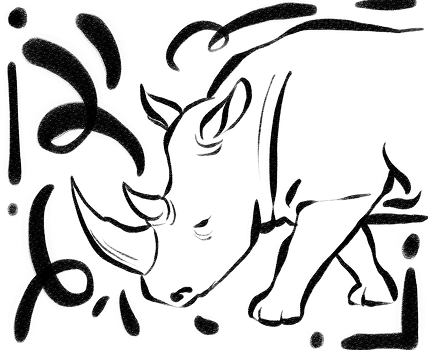
A quasi-scientific argument over a strange matter transports us to the stalls of a theater of the absurd. A real one this time. “Legitimized” by literary criticism. The play Rhinoceros (quoted in the translation by L. Zavyalova) came from the pen (this is important!) of the French playwright Eugène Ionesco. We have caught his characters in the midst of discussing a most unpleasant incident — the appearance of a rhinoceros (or rhinoceroses) in town. The dangerous situation develops according to a paradoxical scenario by now familiar (thanks to Gumilyov’s “Rhinoceros”): the characters are busy with more important matters than their own survival. As a result, the townspeople turn into rhinoceroses. In the literal sense of the word.
What does it all mean? Commenting on his intent outside the framework of the literary work, Eugène Ionesco offered a reasonable explanation for what was happening: rhinocerization is nothing other than the seizure of power in the world (we’ve seen this somewhere before) by totalitarianism.
Let’s return to more familiar “content.” Get off the rhinoceros. Frankly speaking, we don’t know whether you are an absurdist or not. And we cannot know, since the very concept of the absurd defies definition. So many philosophers and literary scholars believe. But what we do know for certain is that the white rhinoceros is actually grey. Or brown. The reason for its “whitening” was an absurd mistake. The story goes that the English, hearing the Boer word “wijde” (“wide-muzzled”), mistook it for the familiar “white.”
Why do you need this information? As a preventative measure. You do want, unlike poachers, to see beyond the rhino’s horn, don’t you? While drowning in the apparent meaninglessness of existence, it is important not to turn into a “featherless biped” (Plato’s definition of man). Gumilyov and Ionesco guided their pens across the page precisely to stop rhinocerization in all its forms.
We’ve ventured beyond the boundaries of time and space. By the way, it’s empty there.
Thank you!