Category: Materialization technologies
The Cryptography of Knowledge: How and Why We Encrypt Meaning
Oh, you learned folk, you readers wise,
Devotees of our humble enterprise!
Let me tell you a tale both strange and true,
Of the tricks that the scribblers of now pursue,
Of dark writings and ghostly sense,
Of nonsense dressed in eloquence.
We live, by God, in a joyful age,
In a world where info is all the rage —
It’s gold, it’s silver, it’s platinum bright,
They mine it, sell it, steal it at night,
They hide it from eyes with passwords and locks.
But meaning? Just crumbs in a broken box.
For a secret kept is a secret dead —
What matters is words that are spoken and read.
People want to be heard, you see,
They crave attention and dignity.
So they encrypt their thoughts, their pleas,
In long, pretentious, obscure degrees,
Stacked triple-high, like battle lines,
So you whistle and gasp: “By God, that shines!”
Implementation. Verification.
Marginalia. Valorization.
Contamination. Propaedeutics.
What the hell is this gobbledygook?
Have I gone stupid? My brain mistook
The path to sense? Am I all alone?
Should I play the fool, pretend I’ve known,
Lest I’m cast from the halls of the enlightened zone?
Brathe. Arete. Entelechy.
What strange spells are these you cast on me?
Coopetition. Synecdoche. Vetrilo —
Are you doing this on purpose? Dude, take it slow!
Why not say it simply, plain and clear,
If you’ve got something to say worth a damn to hear?
But no, they won’t be simple — perish the thought.
They’d rather ride their hobbled horses, caught
In a thousand dusty, pompous terms,
To raise a cloud, to make the thunder squirm,
So the crowd bows down in trembling awe,
Afraid to speak a word against the law.
Yet behind all that roaring, raging fuss,
There’s no meaning, no knowledge, no golden thus,
No grain of wisdom, no spark of light.
Only hermeneutics of the night —
“I didn’t get what I wrote, that’s true,
But damn, it looks solid. How about you?”
A Cipher Everyone Sees But No One Can Read
What you read: When on the distant edge of light, the sun’s gold chariot sinks from sight, I go again to love’s great feast. But you sit there, your cheeks blue-grey, your eyes in crimson (what can I say?), on your long lashes, ice that rings, and down your shoulder, a wasp that clings.
What it actually means: The author tried to write something beautiful, but it turned out weird. Possibly he confused the Russian poet Fet with Apollo. Cheeks are only blue on corpses. Eyes in crimson? Conjunctivitis. Ice can’t ring. And why a wasp? “I said nothing profound, but I pretended I did. My poetry collection costs $60.”
What you read: This study aims to identify correlations between the cognitive representation of subjective experience and neurodynamic patterns under conditions of uncertainty.
What it actually means: We watched what the brain does when a person doesn’t know what comes next. Conclusion: the brain doesn’t know either. Defended the dissertation anyway.
What you read: We offer a comprehensive transformation of business processes using a client-centric approach and the synergistic effect of interdepartmental collaboration.
What it actually means: We’ll help you work better by focusing on the client and improving communication between teams. If you pay us. If not — nothing will transform.
What you read: Developing competencies in academic mobility and an inclusive environment, taking into account individual educational trajectories.
What it actually means: Students will still study wherever and whatever they want. How exactly will you check that?
What you read: Our product features a unique formula that activates the body’s endogenous resources and promotes natural cellular-level detoxification.
What it actually means: We’re selling supplements. We have no idea what this nonsense means, but it sounds smart. And yes — there’s sugar in it. Lots of sugar.
What you read: We intend to consolidate the efforts of all stakeholders within a constructive dialogue to develop balanced solutions that meet contemporary challenges.
What it actually means: We’ll meet, we’ll talk, and we probably won’t solve anything. But we’ll write a nice press release. Elections are coming up.
What you read: Experts note that the current situation is characterized by a high degree of uncertainty, creating additional risks for all market participants.
What it actually means: We wrote “experts note” because no one actually knows anything — but we had to write something.
What you read: The user hereby confirms that they have read the Terms and Conditions and accept them in full without any reservations or exceptions.
What it actually means: You clicked “I accept” without reading a single word. We warned you — your data is now ours. That kidney, too.
What you read: The client is advised to work through unconscious behavioral patterns stemming from early childhood experiences and integrate them into a coherent self-concept.
What it actually means: You have bad habits that go back to childhood. Well, where else would they come from? Your parents are probably to blame. Or school. Someone has to be responsible, right?
What you read: It is necessary to decompose key tasks into operational elements and build an effective KPI control system at all levels of the vertical hierarchy.
What it actually means: We divided the tasks, but in reality, everything will fall on you — because the strategy was written by someone who has never done your job.
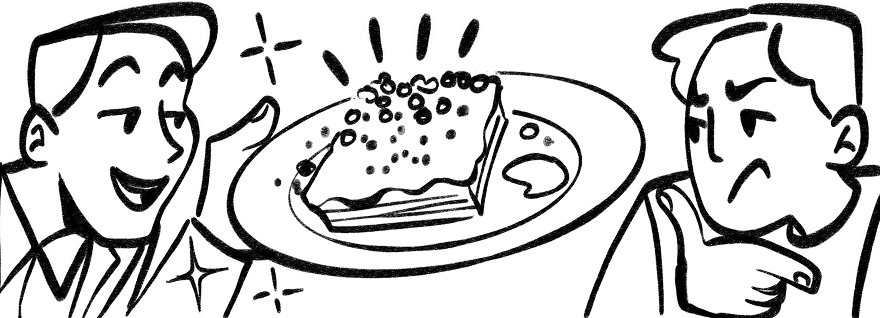
What you read: Artisanal dessert using low-temperature processing, textured fruit pastillage made from local berries, and emulsion of house-toasted nuts.
What it actually means: A pastry with jam and nuts. What did you expect? But you’re paying for the “experience,” aren’t you?
What you read: The ideal candidate must have a proactive attitude, stress resistance, and multitasking skills in a fast-changing environment.
What it actually means: We’ve been thinking for a while and can’t figure it out. We need someone with ideas, who can do the work of three people on a “yesterday” deadline — and not complain. Knowing how to make coffee is a plus.
What you read: The financial instrument demonstrates positive dynamics adjusted for inflation expectations and geopolitical risks.
What it actually means: The return is barely above zero, but we don’t want to admit it. Inflation will eat it anyway.
Jargon as a Membership Pass
Ever read a bank contract? Or listened to economists or doctors talk? “The system failed validation on several technical parameters.” “We conducted an analysis of the current paradigm and identified the need for business process re-engineering.”
The thing is, certain professionals use their own jargon because they simply need to — industry slang saves time and nerves inside the guild. Problems begin when jargon stops being a marker of insider/outsider and becomes a tool behind which one can hide from answering questions — or even hide one’s own incompetence.
What you read: “We aggregated user experience data and discovered a dissonance between the expected and actual conversion funnel.”
What it actually means: We asked people. They didn’t like it.
There are three signs that jargon is being used to deliberately complicate things:
- The complex term can be replaced with a simple word, and the meaning doesn’t suffer.
- The jargon word is used only in reports and contracts — no one uses it in spoken conversation.
- After decoding the jargon word, it turns out that nothing new has been said.
Try it yourself: take any professional text and try to translate every unclear word into plain, human language. If the meaning doesn’t change, the jargon was unnecessary.
What you read: “The bank has the right to unilaterally change the interest rate on the loan in the event of a deterioration in the borrower’s financial situation, expressed as a decrease in their solvency, confirmed by relevant documents.”
What it actually means:
“deterioration in financial situation” → “less money”
“decrease in solvency” → “can’t pay the bills”
“confirmed by relevant documents” → “there’s a paper proving there’s no money”
Translation: “The bank can raise the rate if the borrower has less money and can’t pay the bills — and if there’s a paper to prove it.”
No meaning lost. The jargon was unnecessary.
What you read: “Cut the mayor’s legs off and push him under the hat. Remove the brick from the monologue!”
What it actually means: This is how people in printing talk. It means: crop the mayor’s photo to a portrait, place it under the headline (the “hat”), and remove the “brick” — a solid block of text from an article.
Here, the jargon is in its rightful place. Instead of long explanations — “please crop the photo to a portrait and place it under the front-page headline…” — the worker gets three short words.
What you read: “So, the fleas have arrived: we need to bold the text and curve the font.”
What it actually means: This is how editors talk. It means that small corrections have just come in, so we need to make the text bold and convert the font to curves (vector).
In this case, the jargon is also appropriate, because it allows commands to be given quickly under tight deadlines when laying out a book or newspaper.
What you read: “The square’s gone to the stripper — there’s a crack along its entire length. The round’s stuck at the ultrasonic — the sensor’s rejecting it for an internal defect. Get the rejection report ready. The slab’s hot — don’t flip it — send it straight to the roughing stand, and watch the pressure so it doesn’t spike.”
What it actually means: This is how shift supervisors talk on a hot rolling mill at a steel plant (they’re called rollermen). It means: the square billet has gone to the scarfing machine, which has caused a crack along its entire length. The round billet is stuck at ultrasonic inspection — the sensor is rejecting it due to an internal defect, so a rejection report needs to be prepared. The hot cast slab shouldn’t be flipped; it needs to be sent directly to the first rolling stand, and the pressure needs to be monitored so it doesn’t jump.
In a noisy workshop where every second counts and workers operate in hazardous conditions, every long term wastes precious time. The jargon is in its rightful place.
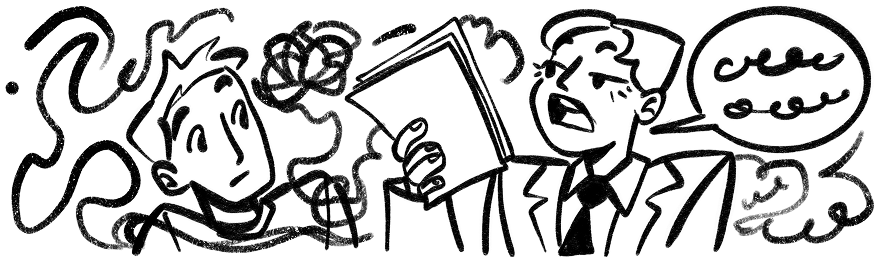
The Dunning-Kruger Effect in Reverse, or Why Smart People Write in Complicated Ways
The Dunning-Kruger effect states that incompetent people overestimate themselves, while competent people underestimate themselves. But there’s also a flip side to this effect: educated people sometimes write in complicated ways not because they can’t write simply, but because they’re afraid of being seen as not deep enough, not professional enough.
And so they start encrypting: instead of “I think this” — they write “my cognitive representation of this phenomenon is as follows.” Instead of “we tested this” — they write “empirical verification confirmed the validity of the hypothesis.” Instead of “this works” — they write “the tool demonstrates high efficiency within the specified range of conditions.”
Take Richard Feynman, for example — the American physicist who explained physics so clearly that even a fifth-grader could understand him. But that doesn’t mean a fifth-grader could have written the Feynman Lectures. Simplicity is the result of hard work — not the absence of it.
How to recognize false complexity?
1. You can replace a long word with a short one, and the meaning doesn’t suffer.
What you read: “It is not recommended to operate a motor vehicle during the nighttime hours due to insufficient visibility.”
What it actually means: “It’s better not to drive at night because you can’t see well.”
2. The author uses three abstract words in a single sentence.
“Optimization of communication processes.” “Verification of methodological approaches.” “Diversification of the resource base.”
If you can’t picture what’s being talked about, it’s probably just empty space.
3. After reading it, you can’t paraphrase the author’s point in your own words.
This is the most accurate test. Read a paragraph — then close the text. What was it about? If you only remember isolated words — or nothing at all — then the author wasn’t writing for you.
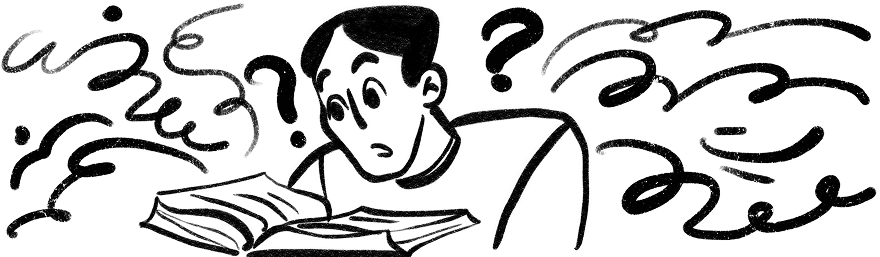
Lie detector for complex texts: how to tell if you’re looking at a dummy
You’ve read the text several times, but it doesn’t make sense anymore. There are several practical signs that will help distinguish the real complexity of the text from the assumed one.
Sign №1. The text is full of words ending in “-tion,” “-ism,” “-ity,” or their abstract cousins.
“The transformation of communication patterns within the digital ecosystem leads to a reconfiguration of cognitive structures.”
But if you ask, “What exactly are ‘communication patterns’?” — the author will look at you with bewilderment. Isn’t it obvious?
Genuine complexity always provides definitions, or at least context from which the meaning can be inferred. An empty shell handles terms like candy wrappers — shiny, but with nothing inside.
Sign №2. The text contains no examples at all — that’s suspicious. Very suspicious.
Any complex idea can be illustrated. Einstein imagined himself riding a beam of light. Darwin studied the beaks of finches.
If you’ve read about “the diffusion of responsibility within horizontal structures” and understood nothing — ask the author to give an example from real life. Someone who truly understands the topic can easily provide a million examples, and your conversation will likely stretch for hours. Someone who just memorized the fancy terms will freeze on the spot.
Sign №3. You ask a clarifying question about the material, but the author looks at you sideways and pulls out canned phrases from their sleeve: “I’ve already written that,” “You just don’t understand,” “It’s complicated — it’s not for everyone” — or writes another equally incomprehensible text in response. That means the empty shell is protecting its emptiness.
A real expert will explain again, give another example, draw a diagram, and ask you to explain where exactly you got stuck.
Sign №4. The text has no structure. Empty text flows like a river — one sentence hooks onto the next, but it’s unclear why each paragraph is there.
Genuine complexity always has a skeleton. You can identify: here’s the introduction, here’s the first argument, here’s the second argument, here’s an example, here’s the conclusion. If you can’t see the structure, it probably doesn’t exist.
Signs of Genuine Depth
1. Clarity. You can paraphrase the text in your own words. Even if it’s complex, you can explain it to a fifth-grader — maybe not entirely, but at least the core idea.
2. Structure. The text has logic. Each paragraph answers the question: “Why is this here?”
3. The ability to explain complex things in simple, accessible words. The author is not afraid of examples, not afraid of analogies, not afraid of looking silly.
4. The author answers questions. You ask — they explain. Just like that. They simply explain.
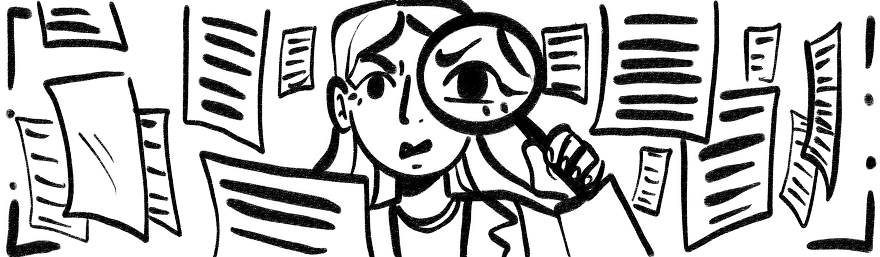
Why We’re Afraid to Ask Questions
You’re sitting in a meeting, a lecture, a conference, or some other less-than-serious event. Someone is saying that “you need to synchronize shared competencies within cross-functional interaction. It is necessary to aggregate user experience and verify hypotheses through iterative feedback cycles. Only then can you achieve a synergistic effect.”
Naturally, you don’t understand a word. But everyone around you is striking an expert pose and nodding. You have no choice but to nod along too.
Congratulations. You’ve fallen into a system where everyone thinks that everyone except them understands the fancy terms — so everyone is afraid to break the silent conspiracy. The one who asks questions is a rare beast, because they break the rule: “Everyone pretends they understood, and nobody disrupts the workflow.”
And yet, one simple question could clarify everything. But we’re afraid to ask it. Why?
Fear of exclusion. Since childhood, we’ve been evaluated by a large number of people. Ask a “stupid” question — get laughed at. In adult life, in addition to ridicule, you can lose the respect of colleagues, clients, or your boss. And that fear outweighs any desire to clarify meaning.
Then there’s the false consensus effect: “If I didn’t understand, but everyone else is silent — that means they understood. I’m worse.”
Plus, asking questions might break the magic of words. So what if you find out that “abyss” means a deep, vast emptiness? What are you going to do with that information?
People like mysterious words. They lend weight.
Complexity becomes a currency: the harder your writing is to understand, the higher your status. The more afraid people are to ask, the more securely your power holds. This works in science (the longer the paper, the “deeper” the research), in business (the more complex the presentation, the more expensive the consultation), in education (the more jargon in a lecture, the “cooler” the professor).
The paradox: the less people understand, the more highly they rate a complex text. Experiments confirm — if you insert meaningless but academic-sounding phrases into an essay, readers will call it “profound.” Because no one wants to look stupid.
How to overcome this fear?
First: Understand that you are not alone. If you didn’t understand something, half the audience didn’t either.
Second: Ask clarifying questions. “Could you explain that with an example?” “If I understand you correctly, do you mean…?” It’s not shameful — it’s professional.
Finally: Change your role. Don’t be a passive receiver of complexity. Become the one who clarifies. Ask a question — and you’ll see a wave of relief around you. People will start thanking you, because they wanted to ask too, but were afraid.
Practice. Start small.
And if you’re the author of a complex text, and someone asks you a question:
Thank them. “Thank you for asking. I really wasn’t very clear. Let me try again.”
The person who asked the question just saved you from emptiness. If no one ever asks, you’ll never know that your texts are just noise.
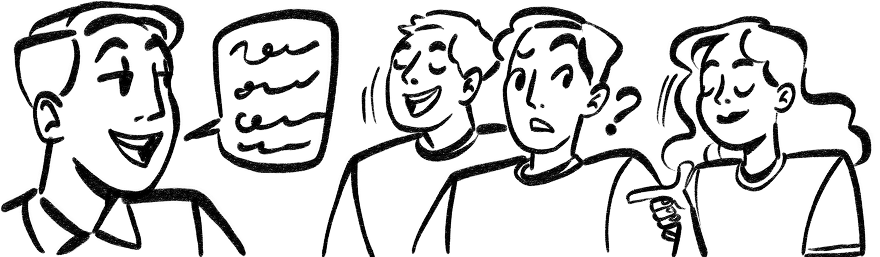
The Ethics of Decryption: When to Spend Time on a Text — and When to Tell the Author to Get Lost
Signs that a text is worth deciphering:
1. The text is important for your life, work, or health.
For example: a bank contract, medication instructions, a technical specification you’ll be working from. If your well-being depends on understanding the text — you’ll have to sweat it out.
2. The author respects the reader.
Even if the text is complex, you can feel that the author is trying to help you understand: they provide definitions, give examples, structure their thoughts. They want you to grasp the meaning — they just don’t yet know how to make the text even more accessible.
This kind of text is worth the effort.
3. The text contains new knowledge you won’t find anywhere else.
A unique study. A rare methodology. An original solution to a problem. Sometimes complexity is simply the price you pay for depth.
Signs That You Can Safely Tell the Author to Get Lost
1. The author deliberately complicates the text. They throw around terms without definitions. They write long, meaningless sentences. They conjure empty abstractions.
2. The text has a normal version. You’re reading a 50-page contract, but the information in it could fit on one page. You’re watching a one-hour presentation, but everything in it could be said in five minutes.
3. The text was written by “experts” nobody knows. If the author isn’t willing to stand behind their words, why should you waste your time on them?
4. After three attempts to understand the meaning, you feel yourself getting dumber.
This is an important marker. A genuinely complex text may be intimidating at first — but then it starts working for the reader. If you’re regressing, walk away.
How to Read a Complex Text Without Losing Your Mind
You already understand that the problem isn’t you. But what if you still need to read that complex text? Then you’ll have to master the skill of decryption.
The Decryption Algorithm
Step 1. Find the definitions in the text.
The author used the word “representation”? “Synergy”? “Dissonance”?
Stop.
Do not read further until you understand what it means.
Look for clues:
- Maybe the author gave a definition in parentheses? (“representation” — meaning “depiction”)
- Maybe the meaning is clear from context? (“the representation of the hero in the film” — that’s how they’re shown)
- Can you replace the complex word with a simple one? (“representation” could be “image,” “portrayal,” “depiction”)
Step 2. Paraphrase the text in your own words.
Close the text and try to retell what you understood from it.
What you read: “The transformation of the educational paradigm involves a shift from knowledge transmission to competency building.”
What it actually means: “School should teach you how to do things, not just memorize facts.”
Step 3. Find a relevant example from real life.
Any example is a bridge between abstraction and reality. If the author doesn’t provide examples in the text, come up with your own.
What you read: “Management decisions must be adaptive to changing conditions.”
What it actually means: “If it starts raining, the driver turns on the windshield wipers.”
Step 4. Ask questions.
Write them down. Ask yourself. Ask the author. Ask someone who knows more than you. Questions are not a sign of weakness — they are the engine of understanding.
Step 5. Seek the truth.
One author writes that “cryptocurrency is a financial bubble.” Another writes that it is “an instrument of financial freedom.” Who is right?
Always use two or three sources. Look for opposing viewpoints. Find examples from real life.
What if the text still doesn’t give in?
Option A. You’ve genuinely come across a bad text. Yes, that happens. If you can ask for clarifications — ask. If you can’t — just move on.
Option B. You lack context. You’re trying to read quantum physics without any basic understanding of the subject. Or trying to get through a contract without any legal background.
Try to decipher the unfamiliar terms on your own — or consult an expert to help you decode them.
How to politely tell the author to get lost?
For work situations:
“I’m sorry, I’m not ready to comment on this because I didn’t understand the text. Could you outline the main points in plain language?”
For colleagues and partners:
“This text is complex. Let’s have a 15-minute call, and you can tell me what’s important here. Then I’ll read it again.”
For an author who deliberately complicates the obvious:
“I’ve already spent time on this. I won’t be doing that again.”
Cryptography as a Challenge
We cannot abolish complexity — nor should we. Quantum physics is complex. Surgery is complex. A programming language is complex. A Beethoven symphony is complex. But this complexity was not invented artificially. It is the price of depth. And once you decipher it, you grow.
Reading is not passive consumption. It is active work. You are not a bucket into which information is poured. Become a detective, searching for meaning. Become a translator, converting bureaucratic nonsense into human language. Become an archaeologist, brushing the dirt off a bone to reveal the skeleton.
Practice. Ask questions. Paraphrase. Don’t let the authors of empty shells dictate to you what matters. Don’t let fear make you stay silent instead of asking questions. Don’t waste your life deciphering what has no meaning.
And one day you’ll notice: texts that once frightened you have become just texts. And some — even interesting.
The micro world makes particles dance to the melody of probability.
Thank you!