Category: Life technologies
Absurd Instructions for Using Things: How to Stop Being a Prisoner of Your Own Habits
Disclaimer. The author does not recommend checking the boiling point with a laboratory thermometer, giving up brushing your teeth for the sake of a genetic experiment, talking to your refrigerator without witnesses, believing advertising even after reading this article, or using any passwords mentioned in the text. The author has tried to tell you the truth, but the truth has a nasty habit of ruining your mood. The ironic tone of this article is meant to make you stop being a serious person for at least a minute and ask yourself: why are you doing the things you do? The author washes his hands and leaves to put the kettle on.
Oh, you’re still here? Just sitting there, staring at the screen, munching on a cookie, waiting for some cartoon character to explain how to live? Keep waiting! Go on! Have you even noticed what’s going on around you? Or have you already slept through it all?
You leave the house an hour before you actually need to. Why? You press the elevator button three times. Think it’ll come faster? You double-check the door even though you clearly heard it click shut. What’s the point?
Who said this is how it’s supposed to be? Where is this person? Show them to me! I want to look into the eyes of the genius who decided that the password you use to watch naked natives needs to contain an uppercase letter, a number, and a hieroglyph. Where is this person? Probably drunk himself to death by now, while you keep adding those goddamn &%$# symbols to every password you make. Good job. Heroes.
You brush your teeth twice a day. Why? Have you ever met the dentist who came up with that rule? No. Have you seen the research to back it up? No. But you scrub your teeth until they shine because that’s what everyone does. And if someone only brushes once, you point your finger at them.
Every morning you’re ready to smash your alarm clock against the wall, because it rings at exactly seven – just like you asked it to. But you still hate it, as if it chose that time itself. And the next evening, you set it for seven again. Where’s your logic?
I want to look into the eyes of the person who came up with the idea that you have to leave early, press the button twice, double-check the door, and thank a robot in a call center. A robot! You say “thank you” to a lump of silicon that has no soul, no mother, no sense of gratitude. It will log your voice and delete it a second later. And you smile. You’re happy. You’ve performed the social ritual.
You are pieces of meat trapped in a framework of rules that some unknown person invented. You wait and wait and wait for some magazine to tell you what to do next.
I’m not going to do that. I won’t give you bread. I won’t give you spectacles. I won’t give you a survival manual. I’ll just tell you the truth to your face: you have no idea why you do half the things you do. You just perform rituals, like chimpanzees that bring a bowl because one time there was food in it.
Honestly, I’m tired of explaining simple things. But since you’re reading this – it’s time to get to know yourself and the instructions for using things that don’t work. Which solution will you read first?
One Hundred Degrees of Fiction
Watch out! The kettle is about to boil. It clicks. It turns off. You pour boiling water into a mug, steep a tea bag, and go back to wasting your life until you want to pour yourself more boiling water.
But here’s a question: why does the kettle turn off, time after time? Do you know? No, you don’t. You think your smart kettle shuts off because the water has boiled. Wrong. Inside your plastic idol sits a bimetallic strip that clicks at 90 degrees. Time to check the dictionary:
Boiling water — water heated to its boiling point (100°C).
Who came up with this nonsense? Engineers at Philips? Tefal? Some factory worker in China who plugged a thermocouple into cheap plastic and said, “Meh. Good enough?”
So what does it all mean? The steam rises, the bubbles pop, but your kettle has never once seen a real boil — exactly 100 degrees at sea level under standard atmospheric pressure. It lies to you every morning, and you smile because “the kettle boiled.”
Where did you get the idea that a boiling point of 100 degrees is a law of nature? It came from a hardworking German named Gabriel Fahrenheit. Back in 1721, he was sitting in his workshop, tinkering with mercury thermometers, and thought: “I’ll set zero to the coldest slop I can come up with — a mixture of salt, ice, and sal ammoniac. And for my second fixed point, I’ll take the temperature of a healthy man and call it 24 degrees. Let anyone dare say a word against it.”
And everyone said: “Oh, Gabriel, you’re a genius! Let’s multiply everything by four so it’s easier to watch the mercury crawl! And then another 16/15…” In the end, water under this German genius froze at 32°F and boiled at 212°F.
Then, in 1742, along came a Swede named Anders Celsius and decided: “Why do we need this Fahrenheit? Let’s make our own scale.” So he invented the centigrade scale. Only he got it all backwards and set 100 degrees as the freezing point of water and 0 as the boiling point. Some scientist.
Then another Swede, Carl Linnaeus — who had traveled half the globe and thoroughly studied the plant and animal kingdoms — took Celsius’s scale and flipped it around: he set 0 as the melting point of ice and 100 as the boiling point. This is the scale we still use today. Officially, however, it was named after Celsius only in 1948. Linnaeus was forgotten.
So here’s the thing. The beaten-down kettle you reverently turn on every morning doesn’t even know about these 100 degrees. Inside it sits a bimetallic strip — two strips of different metals bonded together. When steam passes through, one strip expands faster than the other, the plate bends, and with a click it breaks the circuit. That’s it. No temperature sensors. No boiling point.
And if your kettle is electric and does have a temperature sensor, it measures the temperature of the wall, not the water. The kettle wall heats up faster than the water, so it shuts off even earlier — at 85°C. And you stand there, waiting, listening to that click like a mantra, charmed by it. The kettle manufacturers aren’t even lying to you: they need the kettle to shut off quickly to prevent burns and keep the plastic from melting.
You drink lukewarm water every morning and believe in the boiling point just like your grandmother believed in the house spirit. Only the house spirit was at least seen by the neighbors. Your kettle is a hallucination you paid for with your credit card.
You think you know everything, yet you can’t even boil water properly. You have a computer in your pocket more powerful than NASA had in 1969, and you still can’t boil water. Wake up! Go pour yourself another cup of warm liquid with a tea bag and don’t forget to say “thank you” to the robot in the call center.
Genes vs. Fluoride
You brush your teeth twice a day: every morning and every evening. You change your toothbrush every three months, carefully choosing soft bristles to protect your enamel. You believe that sugar is poison for your teeth and that behind a thick, thick layer of fluoride-and-vitamin toothpaste, cavities will never find you. Naive.
Do you know who came up with this? No one does.
Now close your eyes. Imagine you’re a wealthy 15th-century merchant shipping brocade and spices on a cargo ship. While you’re mentally stuffing burlap sacks with your expected profits, rats in the hold are gnawing through your goods. What do you do? Let a cat loose in the hold. And if the cat can’t handle the rats, throw it overboard and make peace with it. Genius is simple.
Well, your mouth is just such a hold. Only the rats here are bacteria. So who are you, then? The cat? Or the cargo?
Open your eyes. The truth is, you know nothing about what’s going on in your mouth. Because you’ve been lied to since childhood by everyone — the dental industry, sugar manufacturers, and rich merchants with rats in their holds.
Let’s go in order.
FIRST. Sugar doesn’t ruin your teeth.
Sugar by itself does not ruin your teeth. Bacteria ruin your teeth. Bacteria feed on carbohydrates: bread, pasta, potatoes, rice — all of it turns into sugar in your mouth. And as the bacteria devour it, they produce acid. And acid eats away at your enamel.
You get it? “Don’t eat sweets — you’ll ruin your teeth.” That makes about as much sense as “Tie your shoelaces, or you’ll get dumber.”
SECOND. Cavities don’t answer to hygiene. Cavities dance to the tune of genetics.
You lost the genetic lottery, so your teeth have collectively decided to ruin you. Meanwhile, your neighbor who has never seen a toothbrush or a dentist cracks nuts with his teeth and bites through iron wires.
The AMY1 gene codes for salivary amylase — an enzyme that breaks down starch into simple sugars. Some people have two or three copies of this gene in their mouths; others have more than ten. Lots of copies of AMY1 naturally create a sweet environment, and the bacteria that cause cavities (Streptococcus mutans) love to party in that sweet environment and eat away at your teeth. And there’s nothing you can do about it — that’s your genetics.
Everyone has enamel genes: ENAM, AMELX, TUFT1, KLK4. If there are polymorphisms in these genes, your enamel will be thinner, weaker, more porous, and will crack at the slightest acid attack. Studies show that certain combinations of mutations in the ENAM gene increase cavity susceptibility by 2.5 times — regardless of how well you brush.
Everyone has immunity genes: DEFB1, HLA, beta-defensin. They determine how aggressively your saliva kills bacteria. For some people, the immune system in their mouth works like special forces; for others, it’s like the IT department of a company staffed by a bunch of lazy drunks.
Do you get it now? You don’t control this process. You were sold the illusion of control.
In the 1950s, mass fluoridation of toothpaste began. Procter & Gamble formed a research group, and by 1955 they had released Crest toothpaste with fluoride. Studies showed a 49% reduction in cavities among children. And then that 49% turned into a marketing club: forget about genetics, forget about AMY1, ENAM, about the fact that some people got enamel as thin as tissue paper, forget about bacteria — but don’t forget about sugar.
Forget about conspiracy theories and remember business, which loves simple solutions. A simple solution is to convince you of one simple thing: “The problem isn’t the product. The problem is you. You don’t brush well. You bought the wrong toothbrush. You use cheap toothpaste.”
The complicated solution would be to tell the truth. But you can’t pay for the truth at the pharmacy. So it was easier for manufacturers to pretend that fluoride is a magic pill that can rewrite your DNA. It can’t. Fluoride simply makes enamel a little more resistant to acid. It works like an umbrella during a hurricane — better than nothing, but it won’t save you from a tornado.
Procter & Gamble gave the world a solid 49%, but kept quiet about the other 51% — which includes genetics, immunity, the type of saliva you have, and what your grandmothers breathed while they were pregnant with your parents.
You are feed. You’re those very rodents in the barrel. Except you climb in there voluntarily. And you even pay for it.
We are not telling you to stop brushing your teeth. Brush them. We are not saying you should devour candy by the kilo. Devour away. Just stop being a vegetable. Find out which brush you need, how long it actually lasts. Understand that your main problem isn’t that you forgot to brush, but that you were born with a certain set of genes.
Now open your eyes and look at what we’ve done. Look carefully, because nothing seems to have changed. But do you hear that? Thunder has already struck the tom-tom. And soon even a child will find here the ten cornerstones between the truth and what you were forced to believe.
Do you know how to see something new? Or will you stay there with a lump of sugar in your cheek? Look sharper. Because the road appears under the feet of the one who walks. Are you walking? Or are you standing at the sink with a toothbrush in your hand, trying to remember how many times you’ve brushed today?
Subscription to Frost
Lift your eyelids! Come on! I’m about to show you a refrigerator. The refrigerator you bought so your food wouldn’t spoil — not so it could talk to you! Have you completely lost touch with reality?
In 1803, Thomas Moore was hauling butter to Washington. The butter was melting mercilessly, leaving greasy trails on his cart. So Moore took a wooden box, put tin containers inside, packed ash between them, and surrounded the whole thing with ice. To his amazement, the butter traveled six days in that contraption without losing a single greasy drop. Six days! And all without subscriptions or firmware updates.
In 1875, a German named Linde invented a compressor, combining ammonia, pressure, and evaporation. In 1926, a Swede named Stinstrup built the first home refrigerator — a box that freezes. That’s it. What more do you need a refrigerator for?
A hundred years passed. And guess what you brilliant people came up with? Samsung unveils the Family Hub refrigerator — inside which, quietly awaiting your commands, sit Google Gemini, cameras, sensors, and artificial intelligence. A refrigerator that knows what you put in it. A refrigerator that sees your sleepy face during midnight snack raids. A refrigerator that suggests recipes and a little drink. A refrigerator that orders groceries by itself and judges your eating habits. A refrigerator that goes to the bathroom for you.
Are you out of your mind?
And here’s the main thing — a refrigerator like that doesn’t have a handle. To open it, you have to say, “Open, please.” Say it too loudly, and goodbye sausages — the refrigerator will refuse to obey your toxic command. Lose your internet connection — the milk will go sour because the refrigerator didn’t hear you. If Samsung’s server decides to reboot, or the developers plan a firmware update right in the middle of your lunch break — you’ll have to sweet-talk the refrigerator into opening its door. Because it doesn’t have a handle.
You so nicely dropped two hundred thousand on an icy box, and now you’ll have to pay another five hundred rubles a month just to make it open. Another three hundred so it recognizes your food. Another two hundred so it doesn’t turn off the freezer in the middle of the night (that only happens to those without Premium status).
Power outlets sell subscriptions for their features. Vacuum cleaners demand payment for room maps. Coffee makers won’t brew without premium cloud access. And now let me ask you again: “Have you completely lost your minds?”
They’ve trained you to own nothing. You rent everything: an apartment, a car, a music subscription, a movie subscription, a washing machine subscription. And now you need to get a subscription for your refrigerator.
The absurd part is that Samsung isn’t forcing you to buy a voice-controlled refrigerator. You create the demand yourselves, with your desire to free up your hands. But opening the door with your foot — like any sensible creature does — is so last century.
You’ll still buy the smart refrigerator, because you believe technology should free people from effort. But then you get new efforts: setting up the app, changing the password, renewing the subscription, fixing broken updates, learning to shout at the refrigerator so it will open.
You thought the smart home would make you smarter? 60% of smart home users experience regular failures: lights turn on by themselves, the air conditioner starts up on its own, you can’t unlock the door if the internet goes down. You become a hostage to your own technology, because at some point you decided to put it on the same level of development as yourself and bestow it with the features of kitchen intelligence.
A refrigerator cannot be smarter than you! 100 years ago, you were given a box that was supposed to do one thing — keep food cold. But you, 100 years later, decided that the refrigerator should be able to do everything except what it was designed for. Now you’re no longer the master — you could be evicted at any moment.
So go ahead now. Pat your refrigerator. Apologize to it. Maybe it will let you have some yogurt without paying extra for the Premium subscription.
Hacking the Customer
No time to relax! Admit it — what song have you been humming all day? A new single by some foreign singer? A popular tune flooding the internet? No. You’ve been vocalizing the dumbest jingle from an ad that interrupted your attempt to watch video content this morning. “Buy-buy-buy, grab-grab-grab.”
Congratulations. You just lost the battle for your own brain.
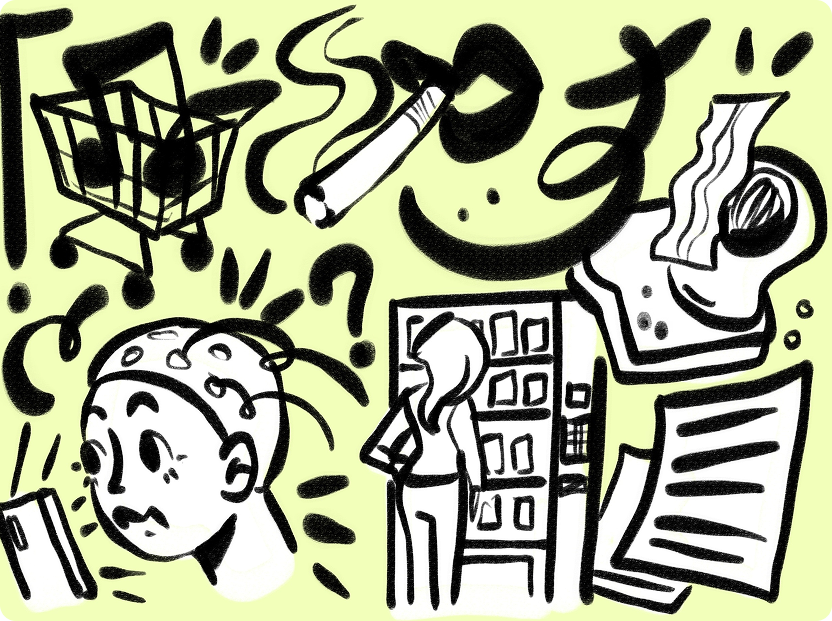
You think advertising is some handsome guy saying, “Our beer is better”? Not even close! Advertising is when, three days after watching it, you go to the store and instinctively reach for the shelf with the green label. When you spot that familiar packaging — and it has become familiar, since they showed it to you at least a thousand times in five minutes — you smile like a trained dog. 2015 MRI studies confirmed that when we see a familiar brand, the same part of our brain lights up as when we see the face of an old friend. Think the marketers don’t know about that study?
Wake up, finally!
In the 1920s, an Austrian emigrant named Edward Bernays — nephew of Sigmund Freud — decided to apply psychoanalysis to sales. He understood: people don’t buy products, people buy emotions. So he convinced women to smoke, calling cigarettes “torches of freedom.” Women had put cigarettes in their mouths before him, but the main consumers of tobacco were exclusively men. Bernays simply changed the packaging, gave women their torches, and put the ads on the radio — and tobacco sales took off.
The same Bernays figured out how to sell bacon for breakfast. Before him, Americans ate porridge or oatmeal. But Freud’s nephew surveyed doctors, got a “scientific conclusion” stating that a high-protein breakfast energizes you better than carbohydrates, and launched a campaign. Nonsense? Maybe. But now the whole world eats bacon and eggs in the morning. And so do you.
Yes, yes, I know. Let’s leave psychoanalysis in the last century.
Now other technologies have come into play — neuromarketing. Companies like Nielsen implant electrodes in people, show them ads, and watch which parts of the brain react most strongly. A 2022 study showed that brand preference is predicted more accurately by brain activity than by consumers’ direct answers. You lie in surveys. Your brain doesn’t.
According to the Neuromarketing Institute’s 2025 data, up to 95% of purchasing decisions are made unconsciously. You don’t think — you react. To color, to sound, to shape. You react so strongly that you can draw the Coca-Cola logo from memory. It’s etched into your subconscious.
Manufacturers spend billions to train your brain to react to their packaging. They hire neuroscientists who scan your pupils, measure how long you look at the shelf, and calculate which font inspires trust and which one triggers anxiety.
What did you think this was — science fiction? Open your eyes.
In laboratories, they build mock store shelves, put test subjects in front of them, and record where their eyes go first. To the red label or the blue one? To the one with a face on it? Peripheral vision is analyzed separately. The test subject hasn’t even had time to look at the product, but their brain has already decided: I’ll take it! Because packaging design triggers so-called “bottom-up attention” through bright colors, contrast, and familiar logos.
And it goes further.
Manufacturers leap out from their hiding places and put an electrode cap on your head. While you watch the ad, instruments measure which areas of your brain are activated, what emotion you’re feeling — joy, anxiety, trust, disgust. You haven’t understood a thing yet, but the machine has already recorded it.
Or they put a test subject in a tube and show them two package designs — A and B. The device scans which one triggered a greater rush of blood to the pleasure centers. Your honest opinion no longer interests anyone. Your brain has already voted.
Even your phone’s camera records where you look: at the price tag, at the product photo, at the “Buy” button, how long you study the description, at what second you closed the tab.
None of this is futurology. It’s all happening right now.
In 2025, a supermarket chain ran a test: eye-tracking and EEG showed that shoppers linger longer in aisles where products are placed at eye level and surrounded by warm tones. The store owners rearranged the shelves — sales went up.
You think you just chose the lemonade with the green label because it tastes good? No. Your optic nerve sent a signal to your brain in 200 milliseconds, and your brain answered: “Green means natural.” Your hand reached out, and now you’re drinking a murky liquid that tastes like swamp toads.
And that’s still not all. AI is already processing your neural data in real time: artificial neural networks classify your emotional reactions to packaging faster than you can blink. PepsiCo and Nestlé use AI to predict from a brain scan whether you’ll buy a new product — with high accuracy and without surveys or focus groups.
Wake up, already!
You laugh at annoying ads, and half an hour later you’re humming the jingle. Because marketers know that a simple tune is perfect for repetition, repetition is the mother of memorization, and you are the perfect viewer.
In 2000, a Kronenbourg ad ran in Britain. In it, men, distracted by a woman, accidentally chop off their fingers, grab live wires, and crash into walls. Twenty years have passed, and people still remember the wall, the wires, and the fingers.
Do you get it? You are not in control of yourself. You are controlled by marketers who have studied your brain inside and out. A 2025 study in the Journal of Marketing showed that when consumers see a familiar brand, activity drops in the prefrontal cortex — the region responsible for critical thinking. You literally get dumber in front of the shelf with your favorite ketchup and turn into a child reaching for a familiar toy.
And the funniest part? You know this. You’ve read articles, watched documentaries, listened to lectures on neuromarketing. And you still reach for the familiar green packaging. There’s no absurdity in advertising. The absurdity is in you. You buy products from familiar brands not because they’re better, but because they’re familiar. Look at what you’re doing right now. You’re walking to the checkout with an item you didn’t think about two seconds ago.
Congratulations. You are the ideal consumer.
Now go to the store and buy something. Just don’t try to think. The market wouldn’t survive it.
Sorry, I was wrong
Now answer me this: what do you do every day? Brush your teeth? Boil the kettle? Chat with your refrigerator? Watch ads? No. Every day you go online and feel like an explorer. Remember that eternal “No! No! No! No!”? First you can’t because you need to enter a password, and then you can’t because you can’t use that password.
Your cat’s name doesn’t meet the standard requirements. So you need to change the first letter of your cat’s name to uppercase — Fluffy. The system rejects it — you need symbols. Change the “u” to “@” and you get “Fl@ffy” The system still won’t budge. You have one last try — add “1!” to the end of Fluffy. Now with the password “Fl@ffy1!” you can march straight down the red carpet that some website so carefully laid out for you.
Stop this! Exactly 90 days later, the system will look at you sideways and threateningly wag its finger: your password has expired. Then new Fluffies will appear — “Fl@ffy2!”, “Fl@ffy3!”, “Fl@ffy4!”.
Outsmarting hackers is a feat for only the chosen few. And you’re not one of them. Want to see who came up with putting those symbols on your cat?
His name is Bill Burr. In 2003, he was an ordinary mid-level manager at the U.S. National Institute of Standards and Technology — not a hacker, not a professor, not even a security expert. Twenty years ago, he was given an assignment: write an eight-page document about password security rules. In response, Bill Burr asked IT administrators for access to employee passwords to see how clever people actually were. He was denied — security reasons. So he found his only source of inspiration: a manual written back in the 1980s, before the public internet or mass hacking even existed.
Based on that document from an era when computers were the size of a wall, Burr wrote the rules:
- Minimum password length: 8 characters.
- Password must contain uppercase letters, numbers, and symbols.
- Passwords must be changed regularly.
His logic was technically sound: people would use all available characters, and their passwords would become unpredictable. But Bill Burr overlooked one crucial thing: people are not computers.
Despite that, the whole world took the rules written by this mid-level manager and started following them. First, the main U.S. standards institute — NIST — declared these rules the official security standard. Then banks, corporations, governments, social networks, and your boss all picked up the standard.
Twenty years passed. Bill Burr retired. Meanwhile, scientists conducted research and saw something horrifying: people don’t use random symbols — they use predictable patterns. The uppercase letter goes at the beginning. The number or exclamation point goes at the end. So what does that mean? You won’t come up with new passwords. You’ll just turn Fluffy into “Fl@ffy1!”, “Fl@ffy2!”, “Fl@ffy3!”. Studies confirmed that predictable changes make passwords weaker, not stronger.
Well? Feeling energized yet? Though at this point, you never know where the blow is coming from.
In 2011, cartoonist Randall Munroe published an XKCD comic. He took password-cracking speed data and calculated: the password “Tr0ub4dor&3” (8 characters, uppercase, number, symbol) can be cracked in three days. But a password made of simple English words — “correct horse battery staple” — would take 550 years to crack, because it has no pattern.
Come on!
In 2017, Bill Burr gave an interview to The Wall Street Journal, in which he said: “In the end, my recommendations turned out to be too complicated for people to understand. And frankly, they missed the mark. A lot of what I did now disappoints me.”
Do you get it? The man who invented the rules by which the entire digital world lives said: “I was wrong. I’m sorry.”
In 2024–2025, NIST released a new version of the document, in which the word “cannot” is written in black and white. You cannot require regular password changes. You cannot impose complexity requirements. You cannot require uppercase letters, numbers, and symbols. The only requirement is password length — a minimum of 15 characters for standard login — and mandatory screening of new passwords against databases of stolen credentials.
You are still playing a game by rules invented by a man who twenty years ago had no idea what he was doing and who publicly apologized for that game.
The systems that make you change your passwords aren’t protecting you. They’re protecting themselves. It’s time to call Fluffy.
Our articles are an elixir of wisdom for your mind. Approved by alchemists.
Thank you!