Category: Life technologies
Absurd Arithmetic: How to Solve Simple Problems
“If you can’t explain something to a six-year-old, you don’t understand it yourself”
A. Einstein (but no guarantees)
There’s a pointless pastime — making decent people solve problems. Three people are dividing an inheritance: a house, a car, and a country cottage. Each values the property differently (in arbitrary units). How do you divide the items so that each person gets at least a third of their total “happiness”? Or this: from a tower 50 meters high, a stone is thrown horizontally at 10 m/s. At the same time, from the same spot, a second stone is thrown straight down at 5 m/s. Which stone hits the ground faster? Or this: in an isolated population, there are 100 rabbits — 50 black and 50 white. Each generation, only 40% of the population reproduces (the number is chosen randomly, but proportionally to the share of each color). Color is determined by a single gene: black is dominant, white is recessive. How many generations until the white rabbits could completely disappear?
What goes through the minds of the people who come up with these problems? Is it really true that you shouldn’t solve the problem itself, but instead figure out the mechanism of deception — and then the solution will reveal itself on its own?
Problems are designed to scare you with their complexity. But each one has a “right answer” that the teacher or the textbook expects. And each problem has conditions under which that single answer stops being the only one — if you squint just a little.
So let’s squint.
Peter has 3 apples. Zoe has 2. How many apples do Peter and Zoe have in total?
“Five, of course!” the reader will exclaim enthusiastically, blowing spit bubbles and looking at us with eyes full of hope for a good grade.
“Five, of course!” we won’t argue, and we’ll give the reader a friendly pat on the back: you haven’t forgotten your math, you little rascal.
Indeed, the problem solves itself in no time:
3 apples + 2 apples = 5
And with that, we could all shake hands and go off to harvest the crop. But not so fast. It’s time for the reader to take off those square glasses and step out from behind the school desk.
The problem clearly states: 3 apples and 2 apples. But has anyone actually seen these apples? Has anyone inspected them, weighed them? How could we have missed that all-too-familiar routine of checking apples at the supermarket and assumed that somewhere, somehow, five identical pieces of fruit would be provided for this problem? Did anyone check these fruits for other parameters — worminess, edibility, dolomite dust, fatherly blessing?
No. But if they had, they would have been surprised by the result. Because three apples by weight might barely equal two. Two apples can hardly count as one, since the second isn’t even ripe yet. Zoe’s apple was pecked by a blackbird. Peter’s apples are made of papier-mâché. And on top of that, one of the participants used a half-eaten apple for the problem. Is that even an apple at all?
So it turns out that 3 + 2 doesn’t always equal 5 — if the conditions change.
Well, dear reader, do you already feel the hair on your head starting to stand on end? Just wait. We’ve only just gotten to measurements. The real meat is yet to come.
So. Measurements come from the word “measure”: measure of length, measure of width, measure of height. Later, other measures joined them — measure of time, measure of speed, measure of force, measure of temperature. The world stopped being just the world. It became a collection of quantities that can be measured, compared, laid on a ruler. And measure itself became one party to a contract: “The distance from the tip of my nose to the tip of my thumb — that’s a yard. Any objections?” According to historical legend, that’s exactly how Henry I decided to measure length.
Then the physicists came and ruined everything. They dared to suggest that a measure is not a “contract” but merely a set of circumstances. For example, the distance from the tip of the nose to the tip of the thumb could be more than 91.44 cm (which is what that yard equals). And there could be many such circumstances, and they affect the margin of error, so quite a bit depends on them.
The physicists figured out that if you weigh an apple on kitchen scales, it will weigh 100 grams. But that same apple on a pharmacist’s scale will shrink and weigh 99.8 grams. And if you put the apple on laboratory scales, it will grow again and weigh 100.03 grams. The apple hasn’t changed. It’s still the same sweet-and-sour fruit, still tempting you with its rosy side. What changed are the measurements — the circumstances. And so the apple can be both big and small at the same time.
Hello there. So how would an advanced physicist solve the apple problem? They wouldn’t. An advanced physicist would first ask:
- What do we count as an apple? A whole fruit? Or a bitten one too? Do we count a papier-mâché fake, tinted with natural juice, as an apple? And do we count a wormy one?
- Who will be counting the apples? Peter? Zoe? An outside observer with Down syndrome? An artificial intelligence trained on a “vegetables and fruits” dataset?
- And what are we counting these cursed apples for, anyway? To eat them? To sell them? To solve a problem from a textbook? The margin of error depends on the goal. And the right to round depends on the margin of error — because in the real world, apples are never perfect. And the more precisely we want to measure the result, the more we need to know about the circumstances.
The physicist would come back with a solution that reads: a measurement of an experimentally confirmed set of fruits possessing certain characteristics of apples, totaling five units, with a margin of error of ±0.5 apples (because one of them is suspicious).
The problem is that we were taught to count, but not to measure. We were taught to see numbers, but not to think about the circumstances behind each value. Grades, ratings, credit scores, likes, views — everywhere we see numbers, but no one provides a summary: “The following circumstances were taken into account during measurement.”
So in everyday life, whenever you think you know the one and only correct answer, remember the circumstances. They turn the correct answer into one of many possibilities, and the only answer into a debatable one. And if you don’t like the answer, change the circumstances.
And here we are again, staring at the same problem. Peter has 3 apples. Zoe has 2. How many apples do Peter and Zoe have in total?
Some university graduates you are — can’t even solve a simple problem. Besides, who told you it needed solving in the first place?
Take Heraclitus of Ephesus, the ancient Greek philosopher. He would have asked a perfectly natural question: “Is your problem still relevant? While you’ve been staring wide-eyed and rambling on about measurements, Peter’s apples have started to rot. Zoe’s apple rolled off the table and now resembles a rotten shiitake. While you were fussing over the text, someone took a bite out of every apple. So let me ask again: is your problem still relevant?”
And Heraclitus is absolutely right! You cannot step twice into the same apple problem, because the sum changes with every passing moment:
At moment t₁: Peter has 3 apples, Zoe has 2. Sum = 5.
At moment t₂: A worm eats one of Peter’s apples. Sum = 4.
At moment t₃: A dog runs off with Zoe’s apple. Sum = 3.
At moment t₄: Peter gives one apple to Zoe. Sum = 2.
So what’s the answer? There is none.
We’re used to thinking that objects are stable over time. Heraclitus reminds us that this is an illusion — convenient for accounting, but not for life. The code that worked yesterday might crash today because a library changed. At the start of a sprint, a team has 5 tasks, but by day three, two tasks have turned into three, and the number of unfinished items has changed. Market share, stock prices, customer loyalty — all of these are rivers that cannot be measured just once.
Do you feel it, reader? All those school and university years have congealed into a single lump. What we’re used to calling a “sum” is nothing more than a snapshot of something that has already changed. While you’re reading this article, the number of apples is increasing. Or decreasing.
Does that mean all counting is meaningless?
Not at all. It’s just that we’re used to confusing the map with the territory. The sum of 5 apples is the map. The real events — with worms, dogs, and exchanges — are the territory. The map is useful as long as we remember that it is not the territory. Our problem is not that we learned to add. Our problem is that we try to apply static arithmetic to a living world and are genuinely surprised when life rejects it.
And here, perhaps, is the only thing we can do: learn to live with this duality. Yes, we will say “3 + 2 = 5.” Yes, we will make plans, count resources, deadlines, and percentages. But we will also remember: all of this is just snapshots. As long as we keep in mind the worm, the dog, and Peter’s generosity, we will not fall into the illusion of control.
And we will stop shaming those who don’t solve problems “the right way.” Because perhaps they saw something we missed: the right question is often more important than the right numbers. And sometimes the wisest thing to do with a problem is to say, “Let’s first check whether the apples are real.”
And then we will stop being those mediocre “graduates who can’t solve a simple problem.” We will become people who understand: problems exist to train the mind, and life exists to remind us that a mind without attention to change is just a fast calculator that doesn’t know when to stop.
Everyone remembers the problem, don’t they? Peter has 3 apples. Zoe has 2. How many apples do Peter and Zoe have in total?
I wonder what the answer will be this time. No one knows, because you’ve gone back to your old habit of adding objects — fruits — when what you need to be adding is their value. The number 5 represents quantity, not value. If you can’t tell the difference, you’ll be cheated the first time you make a trade.
Peter spent three years growing his apples: watering, fertilizing, chasing away pests. For him, each apple is a memory, labor, love. So for him, three firm apples are worth ten waxy supermarket copies. Zoe picked two apples along the road and, frankly, she wanted a pear more anyway.
For Peter, his 3 apples plus Zoe’s 2 add up to 12 (because he values his own fruit highly, but why value someone else’s apples?).
For Zoe, her 2 apples plus Peter’s 3 add up to 3 (because she doesn’t value her own apples, and even less so anyone else’s).
The market will price 5 apples at an average.
The black market will price them slightly above average — scarcity.
A hungry child will price them as the highest good — he hasn’t eaten in three days.
The economists of the Austrian School even have a formula for such a case:
3 + 2 = X,
where X depends on who is evaluating the object, in what situation, and with what scale of values.
Everyone has their own set of scales, which is why the value of a product can never be additive. The problem is that the market doesn’t care about your feelings. The market is a soulless aggregator of other people’s subjectivities. And you either go along with it or you walk away with nothing.
No one is going to come along and measure your value for you. If Peter believes his three apples are worth more than anyone else’s, he has every right to say to himself: “I’m not selling them to the first person who comes along.” If Zoe doesn’t care about apples, she shouldn’t be surprised that no one values hers. If you want to be paid more than the average market salary for your work, you’re going to have to explain your value — not wait for the market to figure it out on its own.
Learn to add like everyone else, but to value like no one else. And that skill — not confusing market price with your own worth — is the whole reason we started this conversation about apples and the Austrian School. Because if you one day sell something priceless at the average market rate, no economist will be able to comfort you. But if you learn, at the right moment, to say, “No, my apples are not for this market” — you’ll be freer than any graduate who solved the problem and got an A.
And so, little by little, the problem becomes transcendent. And all this from: Peter has 3 apples. Zoe has 2. How many apples do Peter and Zoe have in total?
If none of the sciences can provide an exact solution, perhaps we should turn to philosophical speculation? Has anyone ever stopped to think about where the apples came from in the first place? Consider this: the land on which the apple tree grew — it’s common. The sun, the rain, the minerals in the soil — they belong to everyone. So it turns out that Peter and Zoe have appropriated the fruits of others’ labor, and here we are, like bloodthirsty predators, trying to add up their spoils as if that’s perfectly normal.
“Wait a minute,” the inquisitive reader will object. “But Peter watered the tree, fertilized the soil, chased away the pests. Zoe weeded the ground and harvested the crop. Doesn’t their labor count?”
“Labor, yes,” we smile, pulling Karl Marx’s works from the shelf, “but the land, the water, the air — no. A just system must distinguish between what is created by human effort and what nature gives for free. And if you don’t make that distinction, then you’re calling the appropriation of common goods ‘fair.'”
A fair sum must be calculated differently: not by the number of apples, but by the amount of labor in each apple. And the apples must be distributed differently as well: “From each according to his ability, to each according to his needs.” The right question to ask about the problem would then be: “How can we make sure Peter and Zoe are neither exploiters nor the exploited?”
Look how the Marxists have twisted it. They’ve even come up with a formula:
3 + 2 = (surplus product to be redistributed)
From the total harvest of 5 apples, each person has the right to the portion that their labor secured. But if Peter and Zoe have a “nature apple” — one that grew on its own — then its fate should not be decided by Peter and Zoe alone, but by everyone who has a right to the common good.
We’re used to calculating the result without paying attention to the conditions under which that result was produced. But if we did pay attention, we would discover that 5 can be an unjust number, even when the arithmetic is correct. Peter gets pennies because his labor, his love, his sleepless nights are not taken into account. The market takes the average. Someone else pockets the difference and walks away with the profit, while Peter scratches his head.
Now take the apples out of the problem and put yourself in Peter’s place. You work, you put your heart into it, you stay late, you do better than expected, and you’re paid the “average market rate” — and told, “If you don’t like it, quit. There’s a line of people waiting for your job.”
Where in that sentence are three years of watering? Where are your sleepless nights? Where is your love for the work? They’re not there. Because the market is a machine that only knows how to add and divide. And if you don’t learn to stand up for your own value, someone else will pocket the difference between what you’re really worth and what they gave you.
In arguments about taxes, a Marxist would remind us that we aren’t paying “the man” — we’re returning a portion of what we received for free from society and nature. Roads, schools, the military, clean water — all of it is a common contribution.
You achieved everything on your own. Really? No one ever helped you with advice? No one gave you startup capital? No one built the road to your office? No one defended the country while you worked? A Marxist would say: “Your ‘I did it myself’ is also an appropriation of the common good.”
The Marxist doesn’t abolish the number five. He says that behind every number there is a story: who created the value, who got it, and why it is considered fair. Instead of simply adding up the existing products, a Marxist would ask you to answer the question: “To whom do I owe the fact that I can harvest my crop in safety and cleanliness?”
And if you answer honestly, you won’t judge the one who has fewer apples. Because perhaps he was simply born somewhere else — somewhere, say, where oranges grow.
3 + 2 = 5 will be said by those who never grew apples. Those who did grow them will just stay silent.
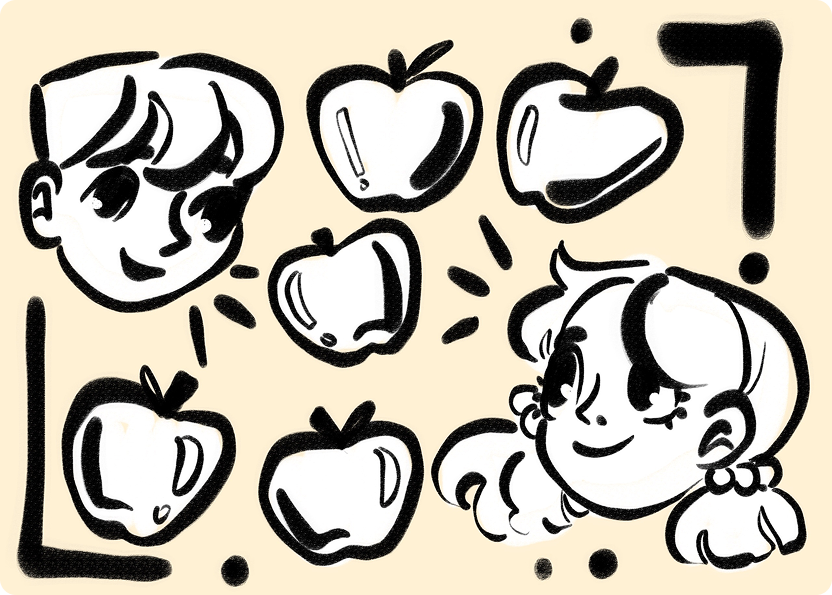
Peter still has 3 apples. Zoe still has 2. And we still need to find the total sum of their apples.
What, dear reader, are you going to insist on 5 again? Fair enough. Who are we to knock you off the true mathematical path? Or are you insisting on 5 simply because you can’t see any other solution besides adding up all the apples? In that case, we’ll give you a hint. Math comes back into play — though a different kind of math. Fundamental math.
We were all taught from childhood to trust our eyes, and it’s hard to argue with that skill: we see apples, so we believe we’re looking at apples. But what if we’re not seeing the most important thing — the shape?
In the mathematical sense, an apple is a closed surface without holes that can be continuously deformed. We’re used to measuring the world in units — one phone, two credit cards in my wallet, three lipsticks in one cosmetic bag, four pairs of socks. But if something suddenly breaks, we start improvising with shape rather than recounting objects. For example, we can replace a lost lipstick cap with another cap, and again we have one lipstick. Or from two torn socks, we can try to make one. Fundamental mathematicians insist that we learn to see shape — how we can deform and transform one object into another without tearing.
Just think of the possibilities! You no longer have to think, “This thing is broken, I need to buy a new one.” You can look at scrap paper and trash, at cells and at space, in a completely different way. Fundamental scientists understood this long ago, which is why they study the properties of one object in order to apply them to another. For instance, subway lines and stations resemble the traces and chips on a circuit board. Someone who understands how to easily lay out board traces so they don’t short-circuit can easily design a new subway line so it doesn’t cross existing ones. Someone who understands that a necktie and DNA are both ribbons that can be twisted in certain ways understands that DNA enzymes make knots similar to Windsor necktie knots when they twist DNA before cell division. By studying neckties, mathematicians figured out how enzymes work with DNA. And by studying DNA, they invented new knots for climbers and surgeons.
But back to our apple problem. If we take the lipstick and its cap apart and put them back together, we have one lipstick. If we deform two socks and then sew the resulting patches together, we have one sock. If we cut up all the apples in the problem and then put the resulting pieces back together (that is, add them up), we get one apple.
Therefore:
3 + 2 = 1
And if we keep deforming and then reassembling all objects of the same shape, the result will always be 1.
So what happened to your stable little number 5?
In this case, mathematicians have led us toward cognitive flexibility and given us another way of looking at things. If the usual answer stops working in everyday life — maybe you’re just asking the wrong question. Try changing your perspective. Look at the shape, at the possibility, at the connection with something that at first glance seems unrelated.
I think Henri Poincaré just nodded in agreement.
Here we are again, stuck in the same place, repeating the problem. Peter has 3 apples. Zoe has 2. How many apples do Peter and Zoe have in total?
Surely this problem no longer seems simple to you? Good! Because now we’ve reached the point where arithmetic finally ceases to be the sole ruler. We’ve already accepted that apples can be different, and that maybe they’re not even apples at all, but shapes. Now get ready — because addition itself is not a sacred ritual.
Suppose the characters in our article don’t put their apples in a basket, but on a clock face. Not a normal clock with 12 hours, but a tiny one with only 4 divisions: 0, 1, 2, 3.
Peter places his 3 apples on the marks — 0, 1, and 2. Zoe adds her apples on the marks — 3 and… Stop. There are no more marks, because after 3, this clock face goes back to 0.
How can it be 0? Like this: on this clock face, 4 occupies the same position as 0. Like a 24-hour day: 24:00 is the same as 00:00. It’s just that on our clock face, the “day” is shorter.
So it turns out that:
3 + 2 ≡ 0 (mod 4)
This means: “Three plus two is congruent to zero modulo four.”
The sum didn’t cancel out because someone ate the apples, and not because they spoiled. It cancelled out because we chose a world with a period of 4 to solve the problem. This is not a trick, not an evasion, not a calculation error. It’s a property of the chosen mathematical structure.
Do you still think scientists are crazy? You shouldn’t. In older systems, colors were coded with numbers from 0 to 255. If you accidentally added an extra color to 255, you’d get an overflow, and a bright color would suddenly turn black. Designers called this “the overflow bug” and spent a long time figuring out how to avoid it.
An octave has only 7 notes: after the note “ti” comes the “do” of the next octave. The eighth note simply doesn’t exist — or rather, it does exist, but it’s the first note of the next octave.
Bitcoins never run out because they all work modulo a huge prime number. Shift changes, duty rosters, production cycles — they all work modulo N. The seventh day of the week is a day off, but after the day off, there isn’t an eighth day — the first one comes again.
This is a feature of the cyclical world, one we prefer not to notice until overflow happens.
In the apple problem, the answer “3 + 2 = 0 (mod 4)” will be just as valid as the answer “5.” It’s just valid in a different coordinate system, under different rules. You are not obliged to agree. You are not obliged to change your system. But you can know that you are free to choose the system in which to calculate.
And so, we’ve returned to where we started. Peter has 3 apples. Zoe has 2. How many apples do Peter and Zoe have in total? Does the problem even have a solution?
Are you sure the apples exist? Who has seen them? Can we hold even one of these apples in our hands? No. Because we are dealing with words — with signs: “apple.”
Peter’s apple is a simulacrum of the first order: an imitation of reality that looks convincing. Zoe’s two are a simulacrum of the third order: a sign whose original no longer exists, yet we are still ready to add it up. And our certainty that 3 + 2 = 5 is a simulacrum of the fourth order — a pure simulation of counting that has no need for reality. It works because we agreed it works.
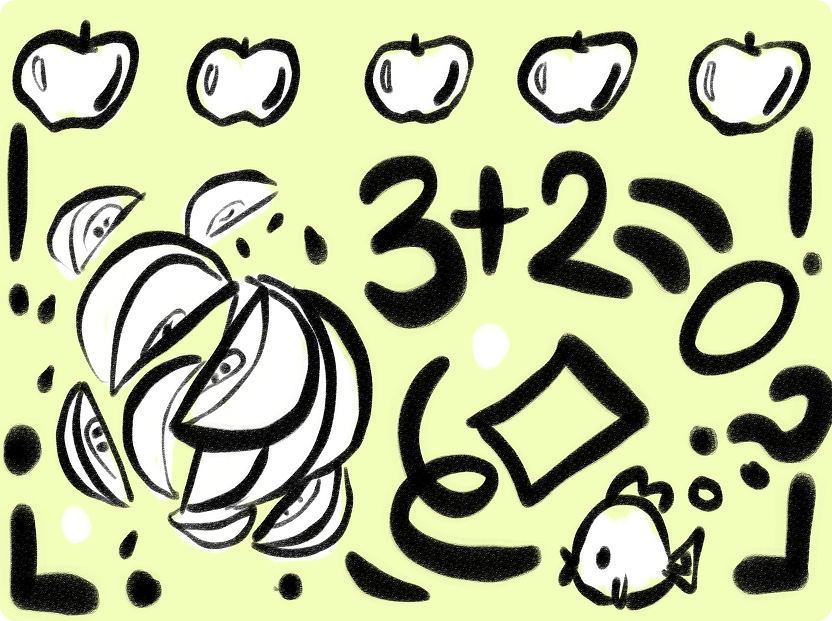
The French philosopher Jean Baudrillard would call this hyperreality — a world where signs have replaced reality to such an extent that reality is no longer needed. And then he would offer a formula:
3 + 2 = ☐
The answer is whichever you accept as reality. Or none. Or 🐟.
We believe we are counting real objects. Baudrillard reminds us: we are counting signs. Likes under a post are a sign behind which there may be no real users. A diploma is a sign behind which there may be no knowledge. An avatar is a sign behind which one can hide one’s identity. The market, ratings, grades, credit scores — all of these are systems of signs. The more we count such signs, the less we check them against reality. At some point, reality disappears entirely, and simulation takes its place.
No one has seen Peter’s apples or Zoe’s apples. No one has seen reality. But everyone has seen the problem statement, the words and numbers, and they’ve rushed to calculate something that doesn’t exist — simply because the words in the problem seemed familiar. You open a social network for five minutes, and an hour later you walk away feeling that the world has gone mad, yet for some reason you desperately want to watch one more video of a dancing cucumber. You open a store’s website to buy apples, but you stare in confusion at the delivery driver when he brings you apples that don’t match the picture. You solve the problem about Peter, Zoe, and the apples, even though you don’t know who these people are — because in the world of simulacra, opinion matters more than fact, and emotion matters more than opinion.
And do you know how it ends? The problem has no single answer that would satisfy everyone. The world is built on probabilities. The answers depend on which coordinate system you choose to solve it in. So let’s leave the philosophers to their debates, the Marxists to their class struggles, Baudrillard to his hyperreality — and let’s go peel some apples.
By the way, how many do we need to peel?
While living organisms undergo translocation, deletion, and duplication, we offer scientific knowledge without mutations – only useful discoveries and theories.
Thank you!