Category: Materialization technologies
Graffiti on a Fence as the Ideal Dissertation: An Essay in Comparative Necrology
“Improving the literacy rate in the country. Thank you for your participation”
From a collection of street texts, author unknown
Before you are two texts. The first is scratched with a nail into a rusty garage fence: short, anonymous, illiterate. The second is bound in leather, weighs a kilo, contains four hundred pages, eighty of which are a bibliography, and is adorned with the stamp of a dissertation committee. What these two texts have in common is this: they both try to assert something about the world and, to do so, leave a mark in it. It seems the rusty fence handles this task more honestly. Or does it? Let’s take a closer look.
A quick warning: we are deliberately taking two extremes — graffiti that is genius in its simplicity, and a dissertation that is a caricature, stuffed with academic verbiage. We are not comparing actual practices, but their archetypes. What we want to show is that the potential for depth and philosophical insight in a rusty fence is greater — precisely to the extent that living speech is greater than a protocol of intentions. Let’s go.
Who Has the Right to Speak, or The Democracy of Paint vs. The Aristocracy of Footnotes
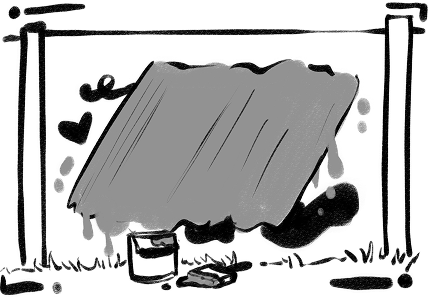
The fence is a space of absolute anarchy. There is no editorial board. The graffiti is reviewed by the janitor, and his verdict is harsh and concise: a bucket of gray paint, twice a year. Before this judgment, everyone is equal: the drunk passerby scribbling something obscene with a marker, the street artist with a stencil, the lovestruck teenager whose “Dave ❤️ Sarah” will live exactly until the next whitewashing. There is no privilege of permanence. Every text is mortal. And it is precisely in this mortality that its pulse beats.
Now let’s shift our gaze to the dissertation. Its reviewers are immortal, but the text itself is born dead — and it knows it. To write “I was” in a dissertation, you need a supervisor, an opponent, a host institution, access to Scopus and Web of Science, an approved topic, a plan, a schedule, and a dozen peer reviews. And that’s just the ticket to get in.
A dissertation has no right to be short. This is its sacred dogma and its original sin. A hundred pages is condescendingly called “an article.” Anything under eighty is dismissed as an “essay.” The law here is the “accumulation of meaning through volume”: the longer and more incomprehensible the sentence, the deeper it is considered. Take this typical example of academic prose:
“We must problematize the hegemonic discourse of late-capitalist subjectivity within the context of post-non-classical rationality.”
Many words. Not a single concrete noun. Not a single testable hypothesis. A fence would never allow itself such luxury — it is forced to economize.
Entropy and Its Victims
Now let’s take a sharper tool. Claude Shannon, the father of information theory, proposed measuring the amount of information through entropy. The formula is complex, but the idea is simple: the more unpredictable the next character, the more information you receive. If the next word can be guessed with 90% probability, the informational density of the text is nearly zero. If each successive character surprises you — you are witnessing an explosion of meaning (though not necessarily of sense).
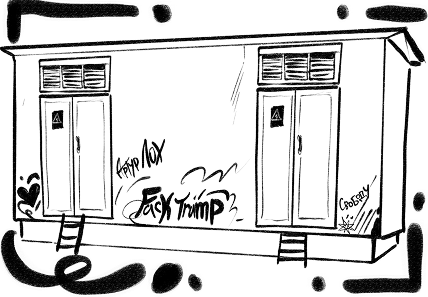
Take a typical piece of graffiti from an old transformer box:
“Dave is a loser. Fuck Trump. Heart 5 cm ❤️. Freedom! ✡️”
Entropy here goes through the roof. Each successive character is completely unpredictable. After a name comes an insult, then a political slogan, then a cardiological diagnosis with a drawing, then a mystical symbol. The text jumps from an existential statement to abuse, from abuse to intimacy, from intimacy to a call to action. You have no idea what is coming next. You are engaged. You are disoriented. You keep reading. Entropy peaks at about 7.2 bits per character — almost the maximum for the English and Russian alphabets.
Now let’s open a random philosophical dissertation. We read:
“In the context of post-non-classical rationality, the existential mode of being-toward-death is actualized, which, in turn, requires a rethinking of the subject-object dichotomy…”
Entropy drops like a stone. After the words “thus,” there is a 90% probability of “it should be noted.” After the word “ontological,” there is an 80% chance of the word “turn.” The text is stuck. You know what comes next. Entropy is around 3.5 bits. That’s the level of a weather forecast or a state news broadcast.
7.2 versus 3.5 — that’s a difference of just over two. Scribbles on fences are roughly twice as information-dense as dissertations. Think about that. Two spray cans and a concrete wall produce a more vibrant text than two years in the archives and a hundred and seventy pages of refined emptiness.
Semiotics of the Phallus, or The Signifier Set Free
Ferdinand de Saussure taught that a sign consists of a signifier (the form) and a signified (the meaning). In an ideal world, they are tied together by a rope. In the world of dissertations, that rope has long since rotted to the thickness of a cobweb. But in the world of the fence, there is no rope at all — and that is genius. Let us examine two cases.
Case One.
On the fence of a car repair shop, the word “REPAIR” is proudly displayed, and next to it, a phallus has been diligently drawn. What does it mean? Options:
A) A threat: “Fix it badly, and you’ll get it.”
B) A greeting: “Greetings to fellow plumbers.”
C) A philosophical category: the masculine principle in the act of creation, the penetration of a problem.
D) A critique of work quality: “This repair looks just like a male organ.”
E) All of the above simultaneously.
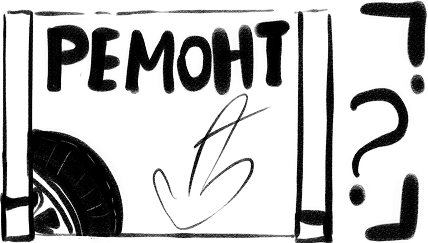
One signifier — yet there are five, ten, an infinite number of signifieds. This is pure polysemy. Saussure would have been both delighted and horrified. A dissertation, by contrast, fights ambiguity as if it were the plague. Every term is locked in the cage of a glossary. Every concept is wrapped in the cotton wool of definitions. Every word is afraid to say too much. The result is that the dissertation is sterile and safe. The phallus on the fence, however, is dangerous, polyvalent, and indecently alive.
Case Two.
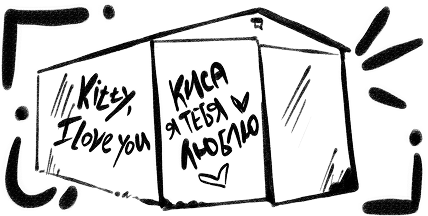
On the wall of an abandoned garage, someone has written: “Kitty, I love you.” To whom is the message addressed? A girl? The world? Himself? No one? John Austin, the creator of speech act theory, would call this a pure performative: the words do not describe reality — they create it. To write “I love you” on a wall means to make that love just a little bit more real.
A dissertation also pretends to be an action. It speaks of analysis, critique, deconstruction, but it is not itself an action. You cannot close a dissertation and say, “Oh, now something in the world has changed.” Nothing has changed. There is simply one more dissertation in the world.
Gödel at the Fence, or The Honesty of Incompleteness
Kurt Gödel proved that any sufficiently complex formal system contains true statements that cannot be proven within the system itself. Mathematics hit the ceiling of its own incompleteness. But with your permission, we will use this elegant logical nightmare as a metaphor — nothing more, but nothing less.
Take the inscription: “Alex was here.” What does it assert? That some subject X performed the action “was” at point Y at time T. Is this assertion provable within the system of “fence plus inscription”? No. Because: (a) John could have made the inscription, (b) Alex might never have existed, (c) the paint and handwriting guarantee nothing. The only way to verify it is to step outside the system: take a DNA sample of the paint, pull up the security cameras, question witnesses. But the moment you step outside, you admit: within the system, the truth is unprovable. This is the Gödelian hole, gaping right there on the concrete wall.
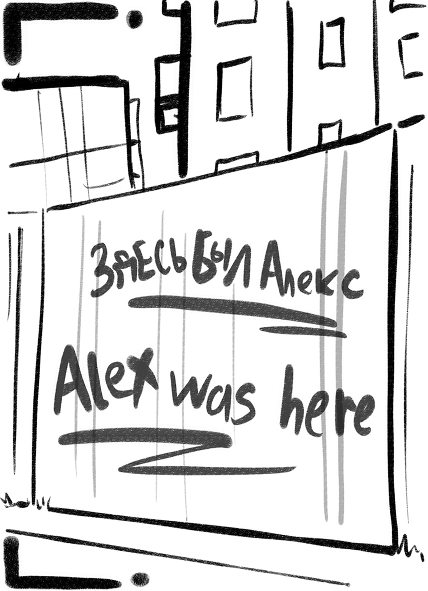
And here is the crucial point: the inscription “Alex was here” is an unconscious Gödelian statement, acknowledging its own incompleteness. It honestly says: “I was here, but you will never prove it by looking only at me. You must believe me — or step outside the wall.” This points to something transcendent: to the Great Observer — the policeman who will lift fingerprints, the God who sees everything, the future archaeologist who will find Alex’s bones and understand that he really was. Graffiti admits its vulnerability. It stands with its visor lifted.
A dissertation, by contrast, builds a two-hundred-page system and claims completeness. “I have proven,” it says, “that being-toward-death constitutes the subject within the space of post-non-classical rationality.”
And Gödel stands nearby, smiling. Because there is a hole here too. It is just camouflaged with long sentences, footnotes to authorities, ritual citations, and appendices. This is an attempt to build a building without a foundation and then declare that it stands. If the inscription on the fence points to God, the dissertation points to another dissertation. A closed system, in which everyone quotes their neighbor, no one has ever seen reality, and yet everyone pretends to know what they are writing about.
A Necrology Instead of a Verdict
Let’s settle the score. A short, anonymous inscription on a fence satisfies the criteria of “authentic philosophical utterance” far better than a two-hundred-page work that the author labored over for years. Why?
First, it acts with Occam’s razor: not a single superfluous word. A dissertation multiplies entities at the same rate that it loses its essence.
Second, it tackles eternal problems head-on: existence, identity, trace, mortality. Heidegger wrote Being and Time to explain that a human being is a being that relates to its own death. Kilroy wrote “Kilroy was here” and said the same thing in three seconds. “Was” means that later he will not be — otherwise he would have written “Kilroy is here.” The whole existential drama in three words.
Third, it is honest in its contradictoriness. Kilroy is here (the trace, the paint, the letters). And he is already gone (he left, he is not at point X). This is apophatic theology on a concrete wall: presence affirmed through absence.
Therefore, our half-serious, but bitterly truthful recommendation is this: The Higher Attestation Commission should consider counting one genuinely good piece of graffiti toward the candidate’s minimum in ontology. This would save trees, increase the readability of scholarly works, and finally return to philosophy what it lost somewhere between Kant and postmodernism: the courage to be brief, honest, and just a little bit mischievous.
It seems we’ve found a way to decode Einstein’s unknown equation.
Thank you!