Category: Global minds
"We Built the Impossible". Global Confession of Global People
We’re used to thinking that miracles only happen in fairy tales. That in real life, everything comes down to budgets, deadlines, permits, functionality, technical specifications, and loans. That grown adults can’t just go and do something insane — because it’s not respectable, not prestigious, it’s scary, it’s complicated, and besides, who needs all that recklessness anyway?
“Man is born for happiness, as a bird is born for flight.”
But what if life itself whispers every day that happiness is only accessible to those who can lift off the ground? What if it arrives the moment we stop controlling ourselves? When we let go of fear, when we trust the flow — of air, of water, of life itself — and it carries us somewhere we never would have dared to go? What if happiness and flight are the same thing?
In the center of Moscow, amid the exhausting chaos, traffic jams, deadlines, and endless hustle, there’s a place where adults — armored in responsibility — lift off the ground and feel genuinely happy. Here, you can test yourself. Close your eyes and take a step into the void. Do something that takes your breath away. Trust something you can’t see. Discover that your body is smarter than your thoughts. Realize you’re capable of more than you ever imagined. And simply glide.
This place is called Flow Moscow.
Today, we spoke with the team that, by every technical, operational, aesthetic, and emotional measure, has built a true Eighth Wonder of the World — a sports and entertainment center featuring Russia’s largest vertical wind tunnel and a replica of an ocean wave.
We talked about physics that works more precisely than any instruction manual. About safety that begins with human responsibility. About engineering solutions that make flight feel like a natural state of being. About scale — the kind that makes you feel like you’re at the center of the universe. About real sport. About how symmetrical effort gives symmetrical joy. About the motivation to learn. And about the challenges that everyone who builds large-scale projects for people has to face.
Answering the editors’ questions:
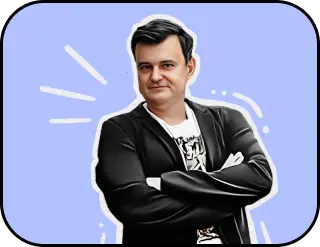
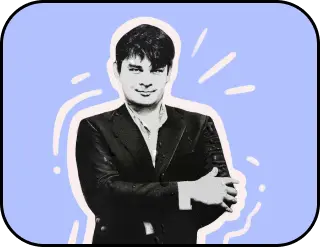
Sergey Makeev — creator and visionary behind the Flow Moscow sports and entertainment complex.
Valentina Makeeva — founder of the Flow Moscow sports and entertainment complex.
Alexander Denisov — general director of the Flow Moscow sports and entertainment complex.
Olesya Ishutina — head of marketing at the Flow Moscow sports and entertainment complex.
— Sergey, first question for you. They say that to build a place where people experience unexpected emotions, you have to stay a bit of a child yourself. Do you agree?

— I started doing extreme sports as a child. Before getting into big-league sports, I was jumping from one car to another on a moving train. Though when I grew up, I never did end up building any railroads.
The first part of my childhood was spent in the Soviet Union. I couldn’t even dream of something like a wind tunnel back then. But when I got a bit older, I felt the need to move — and that was already an adult desire.
— Behind every large-scale project there’s a personal story. What’s the story behind the union of the two elements — air and water?
— I bought a plot of land from a bank. Actually, the bank came to me and said: “Take this car service center.” There was an old, run-down Zhiguli center there. But on that property, I spotted a power substation — and remembered that I’d been looking for a site in Moscow to build a sports complex for a long time. I wanted a change of direction.
The thing is, our sport is directly tied to large amounts of electricity. For an entire basketball complex, 100 kilowatts is enough. But we need much more: the wind tunnel consumes one and a half megawatts, the wave consumes half a megawatt. So at least 2 to 2.5 megawatts total.
I started working out how to build, arrange, and fit everything in. That’s how the story began — a car service center turned into a sports center.
I’ve spent my whole life doing oddball sports: wakeboarding, wakesurfing, kitesurfing, parachuting… The first time I went to a wind tunnel simulator was in America, with my daughter, and I wanted to recreate something like that in Russia. There was already one tunnel in Russia, but it was very far away. I wanted to do something in Moscow.

— I’d guess that family history played a big part here. Sergey is a parachutist himself, and his children are wakeboarding champions, masters of sport. So the father has the air, the children have the water. And he decided to bring those two elements together. Two interests. Two worlds. He’d never say it directly, but why else would a man who’s spent his whole life flying suddenly decide to build a wave? Only for his children.
And here’s the interesting thing: after we built this complex, similar ones started popping up elsewhere — first in the Moscow region, then in other regions. Wind tunnel plus wave is now the standard. But we were the first in Russia.
— You’ve told us how the idea of uniting air and water came about. Now we’re curious: how did a training device — essentially a vertical cylindrical structure with powerful fans — become a symbol of freedom and self-overcoming?

— Originally, the free-fall simulator was designed as a military training tool. It wasn’t even a tunnel back then — just an air stream blown through nets, helping paratroopers learn to control their bodies in the air. The thing is, an actual skydive is very short — a minute and a half, sometimes less — so it’s far more efficient to train in a tunnel first, learning to control the air stream and your body before you ever leave a plane.
The military invented this as a training device for soldiers. Later, sport parachutists started using it. Then the tunnel began to evolve: glass walls appeared, and the entertainment function was added to the training one. Eventually, wind tunnel flying became its own sport.
Today, there are many disciplines. Athletes can fly solo, in pairs, in groups of four — they’ve even started trying groups of six. Dance couples have appeared; choreographed routines are being developed and performed. The key thing is that everyone can find their own direction. Those who love communication and teamwork go for pairs, fours, or static figures. Those who prefer flying solo stick to individual routines. Separate federations have formed, and now you don’t need to be a skydiver to fly in a wind tunnel.
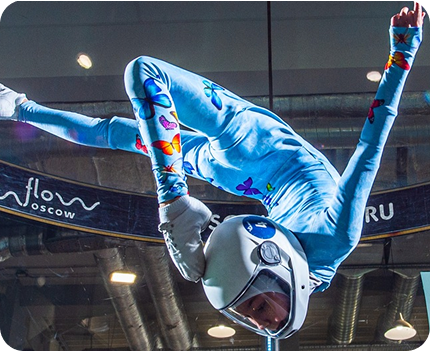
I’ve done wakeboarding professionally my whole life, so surfing was always closer to my heart. At first, I thought the wind tunnel wasn’t as fun or lively as the wave — because when you go to ride the wave, you can come with a group. Surfers are like that: sociable, talkative, relaxed, positive. It’s a very social kind of extreme sport.
At first, I didn’t feel that social side in the tunnel. But then I found a partner to fly in pairs. Then I started flying with my husband. Then I learned to fly in groups of four. And I realized: in flight, even when you’re not speaking, you’re still sharing emotions. And when you come out, you understand what it means to be part of a team. When you find a common language with your own body — that’s when this sport really grabs you.
— What are the benefits of flying in a wind tunnel?
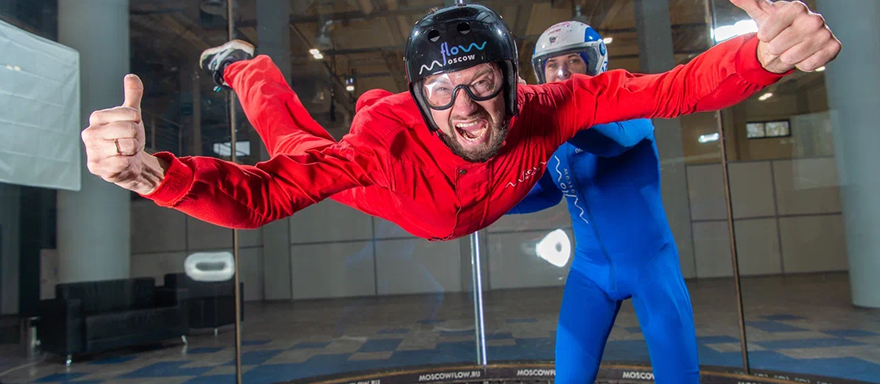
— The wind tunnel is the kind of sport that makes a powerful, exciting impression all on its own. And it’s also incredibly beneficial, because it works out all your muscle groups symmetrically — even the deep, internal ones you can’t engage even in the most functional fitness training. That’s because you’re pushing against the air stream with your whole body.
What’s more, you don’t feel the discomfort of repeating the same exercise over and over. You’re flying, you’re enjoying yourself, and your muscles are working the whole time.
I’m in pretty good shape, but when I first flew for ten minutes, my arms and legs turned red — because every muscle group was engaged. At the moment, though, I didn’t feel a thing. Isn’t that amazing? You’re flying, you’re having a great time, you’re in a good mood — and your body is putting in serious work the whole time.
Many of our instructors have undergone special training to work with people who have injuries, as well as with children who have cerebral palsy or developmental conditions. They do special exercises, turning the kids this way and that, rotating them — all to engage as many muscles as possible and give them maximum joy.
And here’s the most incredible part: a child in the air is having fun, enjoying the feeling of flying, and at the same time their muscles are working — rehab is happening.
We’ve already worked with about three different organizations, providing rehabilitation sessions for people injured in the war.
— When you look at your complex today, it feels like nothing else ever stood on that site. How much time passed from the initial idea to the moment the first client stepped into the tunnel?
— Our first client actually appeared before construction was even finished. Athletes knew we were building it, and they started flying when all that surrounded them was bare concrete. The tunnel was already blowing, but the building itself wasn’t properly finished yet — no fencing, no finishing touches — and still, athletes were lining up for a chance to fly.
Those who wanted to ride the artificial wave had to wait, because that technology is different — more complex. But with the wind tunnel, it all started like this: first the flights, then the walls.
— What makes your wind tunnel and wave technically unique for Moscow?
— The wind tunnel at Flow Moscow is rightfully considered the largest in Moscow. Its flight chamber has a diameter of 4.5 meters and a height of 20 meters. Beyond its size, it’s also nearly silent, which makes flying a much more comfortable experience. And it’s safe: even in the event of a sudden power outage, the landing is soft.
The portal entry-and-exit system allows athletes and amateurs to move in and out without shutting the tunnel down — a clear convenience for both staff and clients.
As for the wave, its uniqueness lies in the very fact of its construction. At the time it opened, it was the first and only simulator of its kind in Russia.
— Be honest: in the first month of operation, did you have any equipment failures that you couldn’t have predicted at the design stage?
— Without false modesty, we can say that all our equipment operates at the highest level. So we managed to avoid any surprises.
— The technology behind your wind tunnel and wave — whose pride is it? Yours, the engineers’, or the supplier company’s?
— Our complex contains two independent installations.
The artificial wave was built using German City Wave technology. Before us, a large number of artificial waves had already been opened across Europe and America using the same system. So we never had to question whether our wave was “right.” We were confident it was the most perfect one possible.
We can confidently say that we operate the only professional wave simulator of its kind — a specially designed pool in which a water stream is forced through. The wave it produces maintains a constant amplitude. It doesn’t grow, curl, or disappear, the way waves do in the sea or ocean. The crest height reaches 1.4 meters, the wave width is 7.5 meters, and its length is 15 meters. Eight 55 kW pumps from Sulzer keep the wave running.
With the wind tunnel, the situation is more interesting. There’s a Russian company called Tunnel Technologies, and Sergey effectively gave them the opportunity to develop. Our tunnel was their first project — from start to finish, from the paper to the metal. Now, similar tunnels are being built all around the world.
Even though our complex has been operating successfully for many years, the team is still looking for ways to improve the air stream. They ask athletes to fly, and then they make adjustments if needed. It’s a long process — but a living one. So we can confidently say that the wind tunnel with the most perfect air stream in Russia today is right here.
— What kind of fan is installed in the tunnel?
— The wind tunnel has four air stream blowers with carbon blades from Krupp. Each unit weighs 5 tons, has a diameter of 2.5 meters, and consumes 400 kW/h of electricity. Originally, these blowers were designed for ventilating skyscrapers. The startup equipment — frequency converters used to start the blowers — comes from Siemens and weighs an additional 2 tons.
— Who monitors all this equipment in real time?
— The wind tunnel equipment is monitored in real time by specialists from the developer company. The artificial wave simulator is maintained by a contractor on a scheduled basis. To ensure water quality, we’ve installed special equipment that automatically analyzes the water and adds the necessary components in accordance with sanitary standards.
— The size of your tunnel isn’t just a technical specification. What does it change about the experience of flying?

— Our tunnel is large, and because of that, it looks incredibly impressive. It’s also far more comfortable and enjoyable to fly in — even if you’ve never flown before. And I won’t even mention the athletes — they absolutely love big tunnels, because they allow room to perform far more elements, to have more space.
When guests come for the first time, they take enormous pleasure in watching what happens inside the wind tunnel. You can simply come to the complex, sit in the café on the ground floor, have coffee, and watch the professionals fly. We have many athletes, and even just spending two or three hours here, you can see several training sessions. It’s actually quite common for guests to come to surf with someone, grab a coffee, and then go watch the tunnel instead.
On the wave, there are pro riders. They perform all kinds of tricks — ollies, carving, 360s, and countless complex moves whose names I don’t even remember. And everything together — the flights in the tunnel, the tricks on the wave, the coffee, the atmosphere — creates a feeling that you’re already part of the action. You can simply sit, drink your favorite beverage, watch, soak it all in, and then decide: do you want to try it yourself or not? I call it “emotional vampirism” — in the good sense.
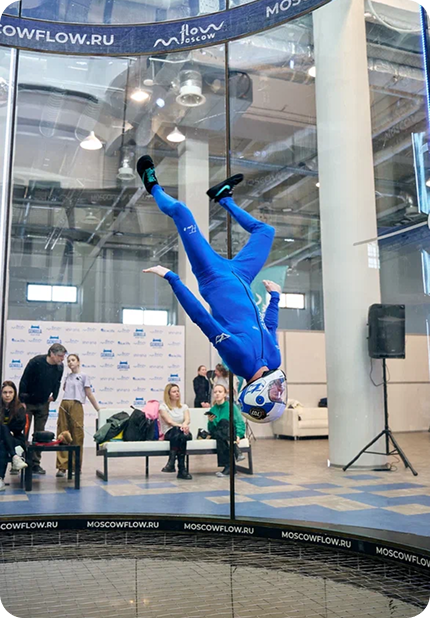
— Flow Moscow has an open-air pool that operates year-round. From a heat loss perspective, that seems insane.
— That pool operates on a constant circulation system — there’s continuous water exchange with the main wave pool. The water is heated by the heat given off by the electric motors, which are submerged and responsible for supplying water to the wave simulator.
— The wind tunnel is a colossal structure. It looks like the kind of thing that could only be controlled by a specially trained superhuman in a white coat, someone who spent years learning the craft in a secret facility. Who actually controls all that power?
— You really had that thought?
— Yes.
— No, there’s no separate engineer sitting at the control panel. The controls are actually quite simple: a large tablet and a dial. That’s it. The instructor on duty sets the speed and adjusts the louvers to maintain the right temperature. In winter, we close the louvers; later, we open them — because the motors themselves generate a strong stream of hot air. That’s all.
Operating a wind tunnel really isn’t difficult, because the controls themselves are made very well — very simply. Safety and flight quality are ensured by a thoughtfully designed automation system, combined with an instructor who, in any case, is right next to each guest every second. After all, the simpler the controls, the fewer mistakes you can make.
— You claim that your wind tunnel has the smoothest, most correct air stream in Moscow — unlike anywhere else in the city. That’s a bold statement. What’s it based on?
— This is based solely on the experience of athletes who fly, because only someone who has flown in different wind tunnels can truly feel the airflow. An athlete steps into the vertical wind tunnel and within a second says, “The airflow here is smooth,” or “The airflow here is loose,” or “There are holes here.” But we, ordinary people, don’t even understand what they’re talking about. You can’t feel it with your hands. You can’t measure it with an instrument in a way that an ordinary person would understand. It’s pure professional intuition.
Moreover, athletes back up their opinions financially and choose to train at clubs where flying is easier and more pleasant, where the airflow doesn’t hit hard, doesn’t spin them, and doesn’t drop them.

— Everything about our setup is smooth. The easiest way to feel this is to imagine driving a car. When the road is smooth, without bumps or potholes, you can accelerate calmly and enjoy the ride. When there are potholes, you have to slow down and drive very carefully, to avoid hurting yourself or your car.
It’s the same here. When you’re flying, you expect everything to behave the way it always does — and then suddenly, bam, something throws you off. For guests flying on their stomachs at low speed for the first time, this isn’t so critical. But for athletes competing in tournaments, it’s make-or-break. It’s no coincidence that our tunnel has been chosen to host the Russian and Moscow championships for years. That’s a sign that our stream is smooth — and that smoothness keeps flights safe. The size of the tunnel matters for competitions, too.
— Our free-fall simulator and our wave simulator have already evolved into independent sports. There’s now an official Federation, and Russian championships are held regularly. The wind tunnel has affiliated itself with the Parachuting Federation. Our surfers have competed in Moscow championships and even in Chinese championships. In other words, a simulator where you learn and have fun has grown into a fully separate sport.
— What disciplines exist in this sport?
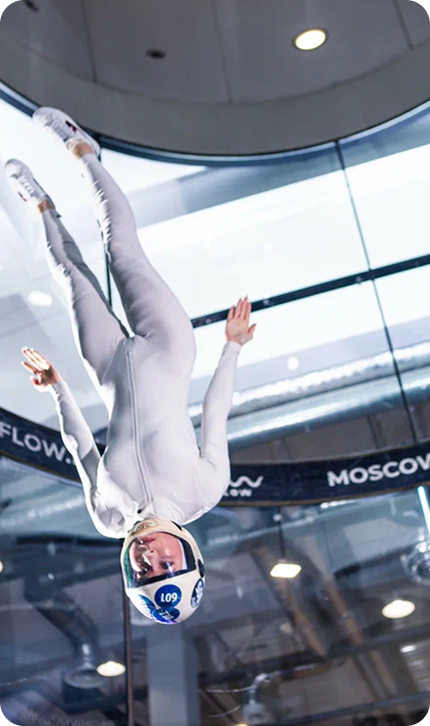
— We have separate, incredibly spectacular competition categories. For example, dance couples perform elements right in the air, to music. There are also solo acrobatic routines — involving splits, spins, and all kinds of complex moves. These athletes perform “baskets,” “swallows,” bend their bodies, change height and direction. All of it happens mid-flight, and it’s truly striking and beautiful.
And every New Year, we put on a circus in the wind tunnel — a holiday show for children. We act out fairy tales while athletes fly through the tunnel in special costumes, then come out to greet their young audience. We’ve already delighted the kids with Cinderella, Aladdin’s Lamp, and other fun productions.
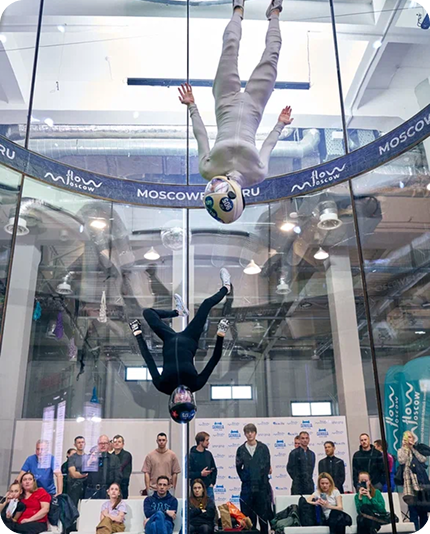

— At Flow Moscow, we use our own judging system for wind tunnel disciplines — a development that covers the entire tournament cycle, from local fun events all the way up to the Russian Championships.
The system records exercise performance with maximum precision, down to thousandths of a second — no deliberate distortions, no arguments, no delays. The tournament bracket is maintained, results are updated instantly, and the entire judging process becomes transparent and manageable. What usually requires a large number of people, endless spreadsheets, and manual labor now operates as a single, seamless mechanism.
And here again, we stay true to ourselves: if you’re going to do something, you do it at a level that sets the standard. Because that’s what the future of sport looks like.
— When it comes to competition and professional training: in rock climbing or mountaineering, a single mistake can be fatal, even though there’s almost no speed involved. Yet in a wind tunnel, at speeds approaching 200 km/h, injuries are practically unheard of. How is that possible?
— The wind tunnel really is one of the least injury-prone sports out there. When you’re learning to do something on a wakeboard, you’re constantly hitting the water. When you learn gymnastics elements, you’re constantly falling. Almost any other sport has far more injuries than wind tunnel flying.
What’s more, the tunnel works your body symmetrically, while many other sports are asymmetrical. Even surfing: you ride either on your left side or your right, and over time you develop spinal curvature. Skateboards, snowboards — same story. I used to do competitive rock‑and‑roll dancing, and even there, lifts are often performed on just one side.
That doesn’t happen in a wind tunnel: you fly both directions. It’s physically impossible to do everything only one way. Even if you never plan to become a professional athlete, flying in the tunnel is pure benefit — a foundation, a support for your entire body. And I’m not even talking about the emotions and the sheer pleasure of it.
— Is there anything about your project that will always be relevant, no matter how much new technology gets invented?
— The physics inside a wind tunnel are so simple and clear that I’m afraid we won’t live to see the day when air‑delivery technology changes. I simply can’t imagine how you could fundamentally alter this system.
They’re building new tunnels now. In Dubai, for instance, there’s the largest wind tunnel in the world — enormous, five times bigger than ours… madness. But the operating principle is exactly the same: just more blowers. No super‑modern turbines — the same blowers as always.
Originally, those blowers were designed for ventilating skyscrapers. Later, someone simply took them and assembled them into a tunnel. And nothing has changed since then: the same blowers — slightly larger, slightly more powerful, but fundamentally the same.
So I’m not afraid that laser or quantum accelerators will come along tomorrow and make our facility obsolete. The physics of air doesn’t age. You can make a tunnel bigger, add more motors, replace the instructors with robots — but the way air lifts a human body will remain exactly the same ten, twenty, even fifty years from now.
— The air‑delivery technology will stay the same. But flight isn’t just about air and speed. It’s also a personal story — one you want to experience again and again, to live through and revisit. And that’s where modern technology comes in. For example, our complex is equipped with the FitNicely system, which records every session and produces a finished video on the spot. It was developed specially for us by Nordavind. Thanks to FitNicely, every flight in the tunnel and every wave ride is automatically turned into a stylish video, ready in just a few minutes. It’s wonderful: you finish flying, and as you step out of the tunnel, a clip of your flight is already waiting for you — even if there was no one there to film it. Instructors use the system to review sessions and analyze technique frame by frame, but that’s for those who want to improve. For everyone else, after a flight or a surf session, you can simply select your best moments, pay, and share them with friends.
And by the way, FitNicely isn’t limited to tunnels and waves. It can be used anywhere there’s movement and emotion — climbing walls, go‑kart tracks — any place where you want to not just try something, but also preserve the memory.
— We’ve already talked about the history, the physics, the technology. Now let’s talk about the people — the ones all of this exists for. What happens to a person when they first step into the air stream?

— Most of our guests get an incredible reset from the flight. You could even say they walk out as different people. Some say, “Everything is different now.” Others can’t find the words at all. Still others just have a grin from ear to ear — nothing more.
Little children come to fly. Elderly people come, too. And both leave saying the same thing: “That was the best moment of my life.”
— I went to America three or four times. Then to Hawaii three times. I never really learned anything there. A simulator gives you the chance to arrive at a place where there’s extreme sports already as a prepared athlete — someone who can actually do something on a wave. The same goes for the sky. In the past, to gain skill, a person had to jump with a parachute many times every single day. But with a wind tunnel, they come to the sky already ready.
— You know, even now — flying professionally — I still catch myself thinking: “This is just so wonderful.” Every flight still fills me with admiration and surprise.
Often, guests coming for their first flight watch the athletes — watching them fly upside down, turn, spin, do all kinds of incredible things — and they don’t understand how it’s possible. But the secret is simple: it all comes down to your body. You turn your hand slightly left or right, even tilt your head — and the direction of the air stream changes immediately, letting you perform all kinds of spins and figures.
The girls often do splits, swallows… I don’t know how to explain it, but this is the kind of thing that never gets old. Every time, you’re amazed: “Wow — I’m actually doing this! I’m flying!”
— Could you describe your guest in just a few words?
— We have several categories of guests. All of them are bright, dynamic, energetic — and what definitely unites them is a desire to spend their time in unusual and varied ways, a love of adrenaline, freedom, and, of course, sport.
— I think our client is someone ready to take on something unusual, something unfamiliar. There are people who will never dare to get on a motorcycle or a snowboard, even though they might admire the speed and energy. And then there are people who want to try everything — who need to test themselves again and again, who like to stay active when they rest. As a rule, that spark is in children: they want to try everything, climb, jump, fly. Probably, as we age, that reckless child inside each of us slowly dies off a little. But the adults who stay children — they’re our clients. People who want to try things, who aren’t afraid to get wet, who aren’t afraid of tangling their hair during a flight. People who want to add a bit of spice to their lives — a spice of well‑being and vigor.
— Suppose a guest buys a ticket and then freezes at the entrance. What happens in that moment — between you and the guest?
— Look, if someone has already come to us and booked a time, it means they’ve already made a decision. They want to try flying in the wind tunnel or surfing. Everyone perceives us differently, and we position ourselves differently for different groups of guests. But the fact remains: the ticket is bought, the time is booked — the person has decided.
But when people arrive and see where they’ve come, some become intrigued — and some become simply scared. And here’s where our instructors step up. Even during the pre‑flight briefing, they can already see who might have trouble. So they explain everything, walk through everything, prepare the guest for what they’re going to feel, and go over the safety rules. In the wind tunnel, the instructor stays right beside the guest the whole time. The flight is always under control.
I myself am a huge coward. I have a genuine fear of heights. But I went into the wind tunnel anyway, even though I was very scared. I flew at arm’s length from the net, so I could reach down and feel it under my hand — maybe 40-50 centimeters off the ground, I guess.
There are many people like me — people who want to discover something new but are afraid. I never became an athlete, but I set a personal record: I did it. I stepped over my phobia. I’m proud of myself. And it makes me feel good — joyful.
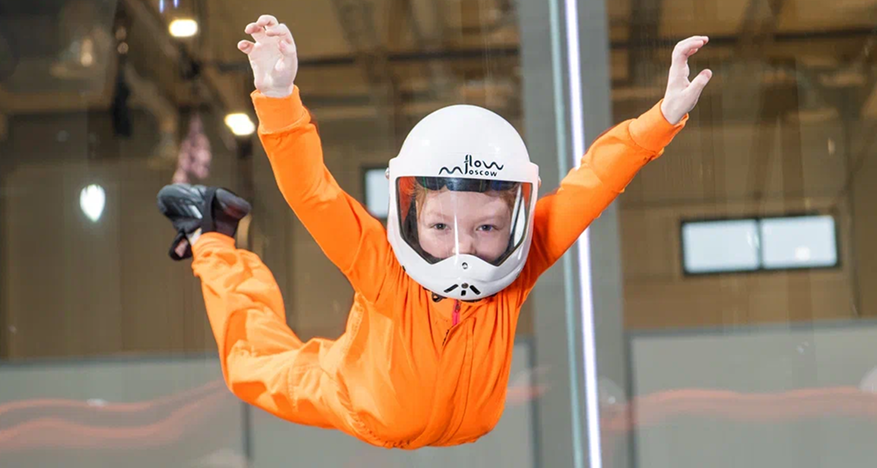
Children, on the other hand, are fearless. They want to fly. They find it intensely interesting, so they get immense pleasure out of everything that happens in the tunnel.
And there are also those who come, try it, and realize they want to do it professionally. For some, flying becomes a secondary passion. We have all kinds of examples. Everyone comes with their own fears, their own interests, their own story. We just help people take that step.
— You can ask to be lifted higher. But the instructor won’t take children or anyone else who’s afraid up high. They’ll fly close to the net, at the instructor’s height, so they can be caught at any moment.
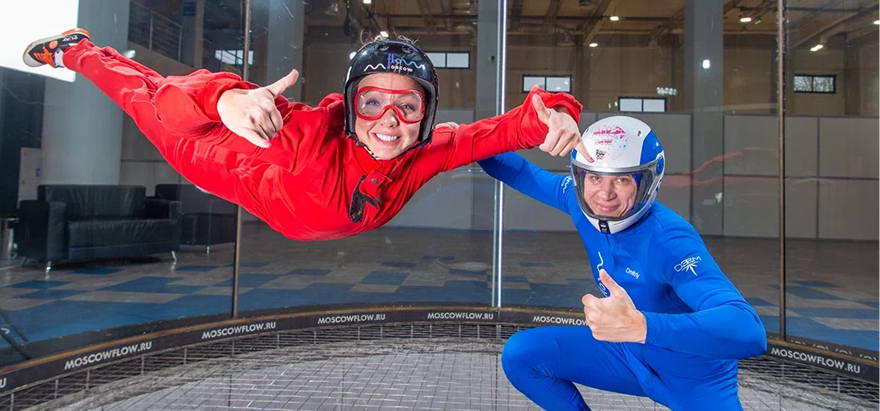
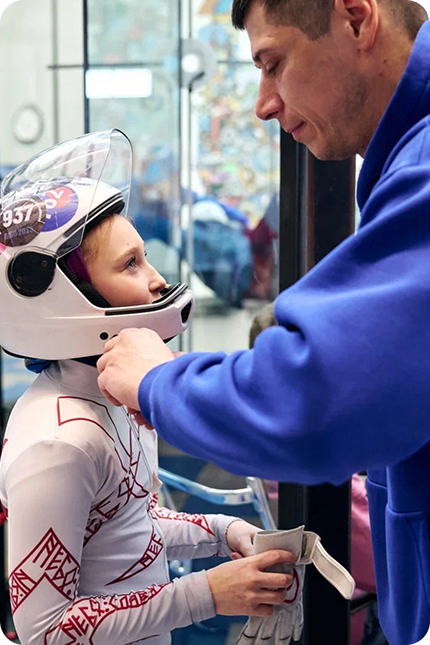
Your first flight will always be quite safe, because it’s monitored by two instructors at once. One conducts the pre‑flight briefing — handing out flight suits and shoes, explaining safety, showing you how to hold your hands and head so that even a first‑timer can get it right. This same instructor then goes into the tunnel with you, stays close, and spots you. When they feel you’re getting it, they gradually let you go, so you can start feeling your body in the air stream. You bend your arms a little — you move forward. You stretch your legs a little — you glide backward.
The second instructor sits at the control dial. He watches over everything and manages the air speed. Beginners fly at around 120–150 km/h, depending on their build. We explain it like this: if you were driving a car and stuck your hand out the window, you’d feel the pressure on your arm. In the tunnel, that same air speed pushes against your whole body — and that’s what lifts you. Athletes fly even faster — 200 km/h or more. With their tight‑fitting flight suits and a little physics, they can perform complex elements at those higher speeds.
Adults, especially when they approach it thoughtfully, are simply delighted — at how cool it is to feel their own body in a completely new way, in a completely new element.
— Does it ever happen that a person simply can’t bring themselves to fly? Or is that more the exception?
— Of course, anything can happen. Sometimes a person is already standing in the pre‑flight zone and then says: “No. That’s it. I can’t do this.” Sometimes they just freeze up, and there’s no talking them out of it. No — and that’s it.
So we just stand there beside them. We don’t say anything. We don’t push. We wait for them to exhale and finally say, “Okay, let’s go.” Or they don’t — and that’s fine, too.
— You know how they sometimes show it in movies? They push someone out of a plane even though they’re not ready to jump, and they yell: “Go on, you’ll love it, catch the thrill!” And then the person walks away with gray hair — they’ve “caught” adrenaline, so to speak.
You should never force anyone. Everything has to be enjoyable. If someone wants to do it, you just support them. If they’re not ready yet, you can show them that it’s safe, that it’s fun. They can stay nearby, sit, watch others doing it — and let themselves get inspired, catch the spark.
Many children nowadays are already quite athletic, and they’re not afraid to swim or fly. Of course, there are some who are afraid of the noise or of heights. But in all my time working here, I remember only four cases where children got scared and didn’t fly — either their parents flew in their place, or we refunded them.
Usually, parents know their own child. Still, I strongly recommend: let your children watch others fly first. Many who didn’t want to fly — once they see it, they get inspired and ask to try it themselves. And some just marvel and say, “I’m not ready for this yet, but I’d love to watch.” And that’s perfectly normal. It’s important to understand what you’re getting into.
— Have you ever had the opposite situation — a guest who wanted so badly to experience the element that they were ready to do anything for it?
— Oh yes — there was a wonderful story, just before New Year’s, when we had first opened. There were very few staff then, and everyone had to juggle several roles. I was greeting guests at the front desk when suddenly a young man ran in and said, “Hello, do you have surfing here?” I said yes. He immediately beamed with joy: “Please let me do it. I’ve never surfed before — it’s been my dream. I really want to try. What do I need to do?”
He paid for a session, went into the locker room, and started changing right there — he didn’t even make it to the actual changing area. He hadn’t booked anything in advance; he was just driving by and saw us. And because it was just before New Year’s, he decided that our center appearing along his route was a sign — that his dream should come true right then and there. And it did.
— We’ve talked about how people change through your work. Over the years your complex has been operating, have there been any stories that changed you personally?
— Absolutely. An elderly woman once flew with us — she was about eighty. The instructors told me she came out of the tunnel in tears — the emotional impact was that strong. She loved it so much that she said it was the most powerful emotional surge of her entire life.
Do you understand? An eighty-year‑old person crying — not because she was afraid, but because for a moment she forgot about her aches and pains, forgot her age.
— There have been other touching moments, too — like a marriage proposal right inside the tunnel. The girl is flying calmly, while the guy waits for her below with a bouquet. Then the instructors turn her around, and she sees the most important person in her life. It’s incredibly moving.
We don’t actually offer this as a service. People just come, talk with the instructors, and at the right moment the instructors turn the person in the flight circle. Free of charge. Because that’s love — not business.
— We also organize flights for children with disabilities. Mostly children with cerebral palsy. And when you see something different in their eyes — something beyond that ordinary bright spark with which they’re carried out of the tunnel… it’s hard. But it’s something you never forget.
Almost everyone who comes out of the tunnel shouts, “Wow, that was awesome!” These children often can’t shout. They just look at you. And in that look, you can see a whole life — a life that became a little lighter, if only for a minute.
We’re all professionals here, of course. But at times like that, you don’t know whether to cry or smile. What you do know is that everything we’ve built — we built for a reason.
— I have a daughter, Daria. She started surfing at five, just for fun. When she got a bit older, she wanted to ride at another sports center wearing a skirt and a top — like a schoolgirl on the first day of school, with a little bell. But after she finished, the staff came over and said, “You can’t ride dressed like that here. You’re done.” The child started crying, and we left.
I thought hard about how to support her, and I think I did the right thing when I told her: “Dasha, to keep this from happening again, you need to learn to surf so well that they’ll beg you to perform. We have two choices: get upset and quit, or keep going and get to the point where people look at us and plead with us to ride — not throw us out.” I never imagined she’d get so fired up by those words. Over the next two years, my daughter’s surfing level shot up. Now she’s my little surf star.
— Do you feel you’ve managed to build a place people want to come back to?
— Places like ours aren’t common — surfing and a wind tunnel on the same site.
On one hand, that might not sound like much. On the other, we try to provide our guests with a full infrastructure: our own large, free parking; good changing rooms; a wonderful café where you can have good coffee or a meal; saunas; an open‑air pool with warm water, open year‑round. That’s more than our competitors can offer.
What’s more, we’re a big, friendly family. We have a huge number of regular guests who come almost every day, and naturally we know them by name — all those who’ve been with us for a long time. We talk with them, greet them, ask how they’re doing, get feedback on what we could change, improve, make more comfortable.
I think that’s the main thing — the one thing you can’t copy. You can say “we’re a family” as much as you like, but family means they greet you not by some script but by your name. It means the café knows you take black coffee, not cappuccino. It means they smile at you not because the manual tells them to, but because they’re genuinely happy to see you.
— We didn’t build an “entertainment center” for some special category of citizen. We built a place for people. For people who want to fly, swim, fall into a snowbank after a sauna — and feel at home while they’re doing it. You can’t sell a home. A home is where they know you — where you don’t have to explain what size helmet you need, where the instructor remembers that last time you couldn’t keep your balance, and tells you what to do before you fall.
That’s what you can’t copy. You can build an identical wind tunnel, an identical wave. But to be greeted a year later with a smile and the words, “Hi, we’ve been waiting for you” — that doesn’t require technology. It just requires remembering that we built all of this for living people. Not for profit. For you.
— I’m glad we opened a center like this — one that brings people so many emotions and so many opportunities to discover themselves. I mean, what surfing do we have in Moscow? We have a river, but there are no ocean waves on it. And here, in the center of the city, you can immerse yourself in a whole new atmosphere, meet instructors who are genuinely passionate about their sport, and even travel with them to the ocean later. Just recently, we went to China with some of our students — our regular clients. I used to make homemade gingerbread cookies for our guests for New Year’s.
All our front‑desk staff genuinely want guests to be on time and to arrive in a good mood. Even if something happens, we never just let their session time expire. You know how upsetting that can be: three visits you couldn’t use — poof, gone. With us, sessions will always wait for you. We want clients to come, have an emotional experience, and then share it with their friends.
— Tell me honestly: do you read reviews? What do people write that they wouldn’t write to your competitors?
— Most reviews say “thank you.” People say they want to come back and recommend us — naturally, that’s what we like to see. Saying that our competitors don’t get the same would be untrue. Our colleagues also receive many wonderful reviews.
When a negative review comes in, we see it as an opportunity — a chance to uncover a weak spot we might have missed ourselves. We never just say, “Thanks for the info, we’ll look into it maybe someday.” Either we ask for more feedback to understand the issue more deeply, or we explain why something is the way it is.
That’s probably what sets us apart from our competitors — not having “perfect reviews,” but working with people who were unhappy with something. Perfect places don’t exist. But places that care — those do. And we’re one of them.
— We also get many foreign guests. Agencies reach out to us and specifically include our center in their tour programs. They pick up guests, show them Red Square and the museums, and then bring them here to unwind and show them the “Eighth Wonder of the World” — our wind tunnel. Because such a large, high‑tech, state‑of‑the‑art marvel isn’t found in every country.
A wave like ours isn’t found everywhere either. There’s flowriding, for example — a popular water attraction and sport that simulates surfing on an artificial standing wave, but it uses a thin layer of water. Flowriders are usually placed in water parks; it’s a cheaper solution both for customers and for installation. Our wave, however, is designed to be more like an ocean wave: we have a thick water layer, and we use surfboards with fins — those small plates on the bottom of the board that prevent sideways sliding, making the ride stable and controllable. And besides, the speed is completely different — a powerful, fast wave.
Even guests who are used to surfing behind a boat come to us and say, “Your wave is so much more powerful — it’s actually scarier.” But then they start riding and realize it’s not as frightening as it first seemed, and they enjoy training here.
Our wind tunnel is also an ideal training tool for anyone who wants to skydive. Here you can learn balance, learn to feel your body — all things that are much easier to learn in a simulator than directly in the sky.
And by the way, skydiving has become very expensive these days. You go to a drop zone, wait for clearance, depend on the weather, depend on how many other people are there. Getting three or four jumps in a day is already good. And each jump lasts only about forty seconds. In the wind tunnel, you pay for your time and you fly for as long as you’ve paid for — which makes it significantly cheaper for practicing skills. Many athletes understand this: even those wearing “laptop” suits — the ones who train for parachute competitions — practice with us before competing in aircraft jumps.
The same goes for the wave. We have guests who come to prepare for the ocean. The famous rapper Timati, for example, also loves our wave. Sergey Kostenko, a well‑known blogger, has been a regular client since our very opening — along with many other media personalities.
— If you were selling a feeling, what feeling would it be?
— Exhilaration, of course.
— Exhilaration.
— Happiness. It’s different for everyone: for some, happiness is a good meal; for others, it’s peace; for others, it’s an adrenaline rush. But for many, happiness is the chance to reset — to let go of problems, to exhale, to take a break from everyday emotions and fill up with new ones.
Statistics say that every month new fitness centers open in Moscow, yet people keep coming back to you. Why do you think that is?
— There are already many wind tunnels in Moscow. If another new one opens tomorrow, clients will still go try it out. We’re all human — we want to know if it might be better somewhere else.
Alexander already mentioned that we were the first to combine two elements on one site, and the first to build an artificial wave in Russia. So at the start, people had no alternative. We were unique, and we stayed unique for about two years.
Then similar centers began to open. Naturally, our regulars — everyone who had surfed with us — went to check them out. I don’t think a single one didn’t go. Over time, some of our instructors moved to those places. But the majority of our guests stayed with us — because to them, we were the best.
And here’s something interesting: the instructors who left back then — the ones still working at those other facilities — still bring their own clients here to train with us.
Of course, there are people who prefer other places; every spot has its own nuances. For some, the deciding factor is location: if a center is just a few minutes from home, why drive two hours? That’s understandable.
We never speak badly about our colleagues. When we hold competitions, we warmly welcome everyone — whether they stayed with us or left. We’re always glad to see them.
So, to answer your question: people today have genuine choices. And those who stayed made that choice not because they had nowhere else to go, but because they wanted to be with us. And that, probably, is the best praise for our work.
— We can’t fight our competitors. Their prices are far lower. Our flights cost more because our tunnel is very expensive — but everything we do is official.
You know how it goes in emergency reports: “The Khromaya Loshad nightclub burned down.” There are plenty of such “lame horses” in Moscow — places operating without documents, without inspections, which is why they can charge whatever they want.
We can’t afford to do that. We have no right to deceive people. Children, adults, elderly people come into our tunnel — every one of them trusts us with their life.
That’s why we must have proper documentation, certified equipment, and properly trained instructors. There are many wind tunnels in Moscow, but only one like ours.
We cannot afford to gamble with your safety. That’s why our equipment is expensive and certified, and why every instructor is more than just an observer — they’re a person who stays right beside you.
Unfortunately, there have been cases in this industry where negligence led to injuries. For example, in Orenburg in 2019, a man fell several meters inside a wind tunnel because the equipment failed. Sadly, that’s not an isolated incident.
We don’t want any of our guests to ever find themselves in that kind of situation. So yes, we built slowly, expensively, and responsibly. Our tunnel and our wave represent quality that has been proven over years. You don’t need to think about how it all works while you’re flying — and that’s how it should be. But we think about it every single day, making sure everything operates at the highest, safest level possible.
— We’ve accepted that some things will never change — air flow, the physics of flight. But to keep attracting new guests, you still have to do something new. On one hand, you need to stay modern. On the other, it’s important not to lose the human touch. Do you follow trends?
— We try to.
— Right now, for example, we’re thinking about introducing AI assistants — we want to essentially replace the front‑desk administrator with artificial intelligence. I don’t know what will come of it, but at this moment we’re training the AI on phone calls, on certain scripts we’ve fed it. We want it to answer the phone, book clients, handle any questions — both over the phone and through social media. When will we launch it? I don’t know. But the work is underway.
Trends are good, but it’s important not just to catch up with them — it’s important to make sure the guest doesn’t even notice the substitution. That they feel comfortable whether the assistant is AI or human. That’s what we’re aiming for.
— We’ve also thought about running tours for schools, because the wind tunnel is pure physics. One of our instructors, Alexander Khrapov, often draws a parallel: “You’re like an airplane. An airplane turns using movable surfaces on its wings — they’re called flippers. In the wind tunnel, your hands act as those flippers: you turn your palms or forearms slightly, and the air stream catches you, creating a turn.” He even draws it out during training.
Kids constantly ask us: “Why do the athletes flying upside down go so high, while the ones on their stomachs stay low?” or “Why is the instructor standing while the person next to him is flying?” It’s all the physics of air flow — a chance to touch science itself.
— Business is always a choice between what delivers quick results and what stays with a person for the long haul. What does that choice mean for you?
— Oh, that’s a difficult question. Let our wind tunnel and our wave work flawlessly. Let our sauna work perfectly, our lockers open smoothly, our open‑air pool stay warm and clean — rather than have lots of glitz and emptiness inside.
If there’s nothing behind a beautiful facade, people may come, take a look, and leave — never to return. We want our guests to stay, each within their own means — financial, physical, time‑wise. Let them come once a month. But let them come to us, because we have a high‑quality air stream, because we have client‑focused staff who love their work, because we have a cozy café where you can relax after intense exertion, drink freshly roasted coffee, and have a snack — because for our guests, Flow Moscow is a home where they’re always welcome and always expected.
A million dollars spent on a show is spectacular, but it burns up quickly. Investments in things that work and bring joy every single day — those stay with the guest. That’s what matters to us.
— Almost all of our instructors are active athletes. They compete in both parachuting and wind‑tunnel competitions. The same goes for the wave: many of our instructors are top‑level surfers who are truly passionate about their sport.
— If you could give away one free flight, who would you give it to?
— Well… I suppose the mother in me will answer this. I would give the flight to a child. And probably to a child who needed it most at that moment… a child with a disability, with certain limitations. Because it would make their life — even just a little — happier.
— I think I’ve already given flights to everyone I wanted to. Still, I do dream that my mother will finally decide to fly too — but she’s not ready yet.
— If there were a giant billboard in front of your complex, with a message visible from anywhere in Moscow, what would you write on it?
— We’re always waiting for you.
— We’ll open something new for you.
— Final question: what would you say to the people reading this article?
— You know, I’d like to say something kind, something human… I want people to be gentle, good‑hearted, to look on life positively, not to limit themselves, to love themselves, and to give themselves emotions. Because so often, people don’t give emotions to themselves — and they don’t give them to their loved ones either. I believe you should love yourself and love your loved ones. Give everyone the chance to enjoy this life.
If you want to give yourself emotions — then do it. At least half a dessert. At least a couple of minutes of rest. At least two minutes of flight. Not every day, maybe — but give yourself a little taste of something new. Why not allow yourself something wonderful in this life? Like visiting the Eighth Wonder of the World, for instance.
The cell divides into the nucleus and cytoplasm. Our journal divides into interesting facts and discoveries.
Thank you!

Similar articles | Individuals