Category: Cognitive technologies
What They (Won't) Write on the School Blackboard: Pedagogical Failure and Image Stain Removers
“The harder the teacher’s work, the easier the student’s path”
Leo Tolstoy
The school principal, catching an approving glance from the portrait of Makarenko on the wall, quietly slid the “inappropriate” resignation letter into his desk drawer. Then he gave a stern look to the determined figure standing across from him.
“Dear Mr. Petrovich. You’ve chosen a rather unfortunate moment to leave the walls of this institution.”
“I don’t consider it possible for myself to stand at the blackboard under these conditions. Especially when what’s written on it…”
“We’ve read it. The whole staff saw it in the school chat. And what of it? Honestly, it’s rather catchy:
No worse teacher could there be,
Than a grumpy, boring geezer.”
“That’s offensive, by the way.”
“If a colleague had said it, yes, perhaps. But children are not just miniature adults. Try shifting into a different frame of reference — one where a nickname and an insult aren’t the same thing. Besides, teachers don’t ‘stand’ at the blackboard. They create. They speak. Monuments ‘stand.’ And until you’ve been cast in bronze, I strongly recommend you move toward the student.”
“Isn’t that a bit much? I demand respect!”
The principal let the furious “monument” of a chemistry teacher blow off some steam. He turned toward the window. Silently, he opened his trusty desk copy of the Teacher’s Self-Help Manual:
“Prepare to conquer the classroom and win the hearts of your students. Love you — and they’ll love your subject, even if they only need it for their diploma. You are not a ‘substitute’ parent. Consequently, no privileges — admiration, support, tolerance — are given to you as a ‘signing bonus.'”
Yes, one battle, it seemed, had been lost. But that was no reason to give up. To flee the battlefield with a massive stain on his pedagogical reputation.
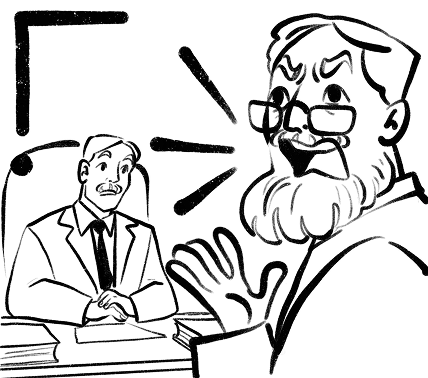
“Mr. Petrovich, let’s calmly, without unnecessary emotion, analyze the message on the blackboard. Let’s boil off the salt, so to speak. They called you the worst teacher. That means, fortunately, there is also a best. Someone whose name won’t be scrawled on the blackboard. You need to fight for your place on the podium of student sympathy.”
“You can’t force someone to like you.”
“Forced, no. The great Soviet educator V. A. Sukhomlinsky was ready to ‘give his heart’ to children to build his famous ‘school of joy.’ What are you ready to give?”
“Look, I know my subject pretty well, and I’ve been… present at the blackboard in this school for twenty years. I’m perfectly capable of explaining the periodic table clearly to someone who’s willing to listen to me.”
The more the principal listened to the chemist, the more sympathy he felt for the young author of that pedagogical epitaph on the blackboard. The teacher’s “tediousness” was precisely the red line — cross it, and any hope of pedagogical success could be forgotten.
This was exactly what the Teacher’s Self-Help Manual insisted upon: “Make knowledge appetizing. Take into account the individual tastes of the gourmands who have come to you specifically for it. Otherwise, the dish will be sent back to the kitchen. Untouched. Don’t lose the Michelin stars earned for your subject by the Platos and Newtons of the world. Important: the dish must be piping hot — relevant. Even ‘dead’ Latin has a life after death.”
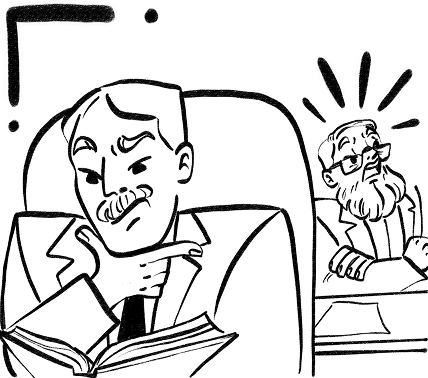
“Dmitri Ivanovich would have had a strong reaction to your ‘presence’ at the blackboard with his table clutched in your arms. Rejection, that is. Professor Mendeleev taught at the Imperial St. Petersburg University. And he did it with genuine talent. In his memoirs My Life. My Contemporaries, one of his students, Prince Obolensky, wrote that Dmitri Ivanovich was a ‘remarkable lecturer.’ The professor nurtured such a ‘passion for abstract science’ in his listeners that ‘every one of his lectures resonated like some kind of prophetic poetry’ and ‘even being examined by him was the greatest pleasure.'”
“So you’re telling me I should put on a shadow puppet show with flasks on my desk?”
“It sounds intriguing. I’m sure on opening night, the applause will be heard even from the cheap seats.”
“You won’t last until retirement on special effects alone. At best, you’ll earn yourself a few ‘likes’ in the local teacher ranking. Beyond a fleeting interest in the subject, you need to build a fundamental — pardon the pun — system of knowledge. The very system without which no one passes a single exam. Without it, you won’t become a doctor or an astronaut. I explain things clearly, using tried-and-tested algorithms, the way they were once explained to me.”
“It seems that at the moment, this ‘system of knowledge’ exists in only one head — the teacher’s. The ‘tried-and-tested’ algorithms clearly haven’t worked on the ‘fresh’ students,” the school principal realized with a flash of insight.
“Learn to teach. Don’t spare yourself. A degree in education does not exempt you from constant self-improvement. Present new material to your students in ways you’ve never done before. Ruthlessly break open your methodological ‘piggy banks.’ Most ready-made lesson plans, notes, and diagrams are disposable — they’re designed for the listeners of today. Tomorrow, your audience will expect freshly made ‘explanations’ of a completely different caliber.”
The Self-Help Manual calls these moments of incomprehension “attacks of pedagogical laziness”:
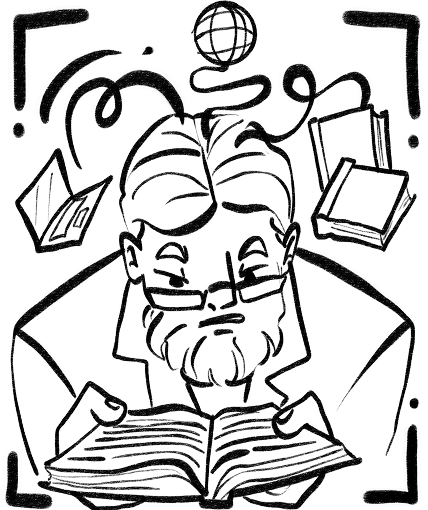
“My dear Mr. Petrovich, countless pedagogical years have flown by since someone explained something to you. And that, as you understand, is a different dimension entirely. Progressive dialectical thinking has mutated into clip thinking. You’re not a courier who needs to deliver a packaged load of frozen knowledge to a new generation strictly on schedule. Thaw it. Cook it. Serve it. In your own way. That’s the art of delivery, not just transmission. Think of Socrates. For the sake of the cause, he abandoned the familiar role of the teacher-orator. His method of seeking truth through dialogue between teacher and student still inspires our colleagues today. Add some interactivity to your ‘undersalted’ solo performances at the blackboard.”
“We’re not in ancient Athens, unfortunately. I doubt Socrates’ ‘interlocutors’ called him an old geezer.”
“Maybe they didn’t. But the philosopher-teacher became so popular — and isn’t that what we’re striving for? — that those in power started asking him questions. Such serious questions that Socrates was actually put on trial and sentenced to death, including for ‘corrupting the youth’ by rejecting traditional values.”
“You see? That’s how dangerous pedagogical innovation can be.”
“Serving people requires sacrifice. To be fair, I should remind you that during a ‘retrial’ in Athens, an international team of lawyers and jurors acquitted Socrates… in 2012. Don’t wait for the court of parents to pass judgment on you for the missed homework assignments and the lack of academic motivation in the wide-open eyes of your young geniuses. Banging a pointer on the desk ‘the old-fashioned way’ just won’t work anymore.”
“And you too! I’m only forty! How am I a ‘geezer’?”
“Completely gray-haired, if you go by the timeless theory of the digital divide. By falling out of the modern technological space, you’re rapidly distancing yourself from both your students and the pedagogical community.”
“Are you recommending I replace my wooden pointer with a laser one?”
“Those kinds of gadgets are already on the desks. The important thing is to stay one step ahead of your charges. Back in the early 2000s, the American publicist Marc Prensky guaranteed failure for any teacher who didn’t master the language of the ‘Digital Natives’ — the generation born after 1984. Only a rich, multimedia educational environment is suitable for children whose cognitive skills have been shaped inside a technological bubble since birth.”
“May that bubble burst!”
“That’s not likely to happen anytime soon. Which means you’ll have to find a point of entry. By the way, I never heard an answer to my question. A Shakespearean question for our profession. Are you ready to give your heart to the children?”
“It’s already leaping out of my chest,” replied the chemistry teacher, Mr. Petrovich, looking through the mirror’s reflection at his alter ego, the school principal, Mr. Petrovich.
A few minutes later, the “inappropriate” resignation letter was moved from the desk drawer to a pile of scrap paper.
An hour later, the revolutionary-minded “Alpha” class was watching, fascinated, as a multimedia flask-and-beaker show unfolded on the desk of the “boring” chemistry teacher.
The micro world makes particles dance to the melody of probability.
Thank you!