Category: Cognitive technologies
The Exam: A Measuring Instrument That Lies
For those who failed — and still made it.
In a world where we weigh single atoms, measure time with nanosecond precision, and determine a satellite’s position down to the millimeter, there is one instrument that still operates on a “hope it works” principle.
This clever little device decides who becomes a doctor, who becomes an engineer, and who remains a “failure” — at best offered a job sweeping the streets after a rigorous casting process. The readings of this instrument determine whether you get a grant, whether you get into university, whether an employer will trust you. And these readings are accepted as the ultimate truth, even though this instrument has never once passed a diagnostic test.
How many lives has this machine ruined? How many children have been convinced they’re stupid simply because they were “measured” incorrectly? How many talents have remained undiscovered because they were forced to take a test at a time when any normal person would still be asleep?
Exactly.
This terrible device is called the exam.
We’ve grown used to thinking that an exam measures knowledge. But knowledge cannot be measured the same way you measure the length of a table or the temperature of the air — because knowledge is not a physical quantity. And the exam itself is a measuring instrument that has long since broken down.
Today, it’s more like a social ritual disguised as science. And it lies constantly. Yet we continue to believe in it — because it’s easier that way. Because otherwise, we’d have to admit that the entire education system tests obedience, the ability to stuff oneself with enormous amounts of useless information, the skill of quick cheating — but not the ability to think.
Measurement 1. Historical Error
Come in, kids. Have a seat. Better yet — just curl up in the corner. We’re about to examine everything that’s been crammed into your still-inexperienced head. Everything here is perfectly clear: 2+2 equals only one number. Even if you don’t know what makes up that number, try to fit your answer around it.
Be sure to solve problems from every category! Why else would we invent a handcar speeding toward a train at 50 km/h?
And don’t forget the language! Place articles before every single word! So that later, when you meet some foreigner, you can immediately say: “I am the fool who, unfortunately and to my great regret, realizes his foolish position in this foolish world, and thereby becomes an even more foolish fool than I was before the start of this sentence.”
Got it?
Got it. What else is there to say.
The first written exams appeared in China in 165 BCE. By the 7th century, during the Sui dynasty, the keju system had taken shape — state exams for selecting officials, which lasted for 1,300 years. The Chinese invented the written exam to assess knowledge regardless of noble birth. It was the first attempt in history to make a career accessible to everyone.
In ancient times, an exam was a conversation with a sage. Socrates didn’t give out grades. He asked questions. In medieval universities, a student would spend days debating with professors in Latin, and their “grade” was simply a decision: whether they were worthy of a degree.
Everything changed in the 19th century. The British Empire needed officials, and thousands of candidates for high-ranking positions demanded a quick sorting mechanism. So in 1806, England decided to borrow the Chinese exam system for selecting civil servants.
The main reformer of the examination system was Horace Mann — secretary of the Massachusetts Board of Education. In 1845, he organized the first written exams in Boston schools. The results were so poor that they landed on the front pages of newspapers. Mann believed that oral exams were too subjective, while written tests would allow students to be assessed “objectively” on a single scale — no allowances for a teacher’s personal sympathies.
Since then, we’ve swapped quills for ballpoint pens, and ballpoint pens for computers. But the essence of the exam remains the same: a desk, short answers to questions, culminating in a number — the number for which all of this was undertaken. Meanwhile, the question of how the exam actually measures what it claims to measure remains wide open.
The Chinese invented the exam to select the smart ones. We use it to weed out the inconvenient. Progress, indeed.
So keep writing. Write, write, and don’t you dare ask why. Otherwise, you might just discover that there’s no reason at all.

Measurement 2. Statistical Error
The classroom was stuffy. The lamps under the ceiling hummed steadily, without interruption — as is proper for institutions where everything has long since been decided.
The teacher slowly sat down at his desk. He wiped his fingers with a handkerchief — one, two, three. Then he picked up a stack of papers from the desk. On the papers were the names of students who would not make the lists — because their bearers had failed to fit into the procedure. They hadn’t passed the exam.
And what of those who did pass? Nothing. They would go on to take the next exam, and then another one. Moving from class to class, from list to list — and so on, ad infinitum.
The teacher smirked.
“So, what do you think?” he asked the students. “Is there life after the exam?”
The class hissed in annoyance, unwilling to look up from their exam forms.
“No grade, no person,” the teacher said, walking between the rows. “No person, no exam. No exam, no report. No report, no institution. Therefore, the exam will always exist. Even when there’s no one left to take it.”
And yet, this infernal machine has been wrong — time and time again.
Albert Einstein failed his entrance exams to the Zurich Polytechnic. Thomas Edison was called mentally retarded and was eventually expelled from school. Isaac Newton had to drop out of school. Steven Spielberg applied to film school twice and failed spectacularly both times.
Charles Darwin was considered a mediocre student. Vincent van Gogh left school at fifteen and never received a formal art education. George Bernard Shaw barely finished school at fourteen. Anton Chekhov became the first student ever expelled from medical school for academic failure.
Bill Gates dropped out of Harvard. Steve Jobs dropped out of Reed College. Leo Tolstoy abandoned his studies at Kazan University. Dmitri Mendeleev barely passed chemistry on his exam at the Main Pedagogical Institute.
Fyodor Dostoevsky received a score of zero in Russian literature at his military academy. Vladimir Mayakovsky was held back for two years in a row in high school. Konstantin Tsiolkovsky was expelled from school at sixteen and continued his education entirely on his own.
The very instrument meant to measure knowledge rejected those whose knowledge and imagination changed the world. Meanwhile, it passed those who know how to sit still and not ask questions.
Measurement 3. Verification Procedure
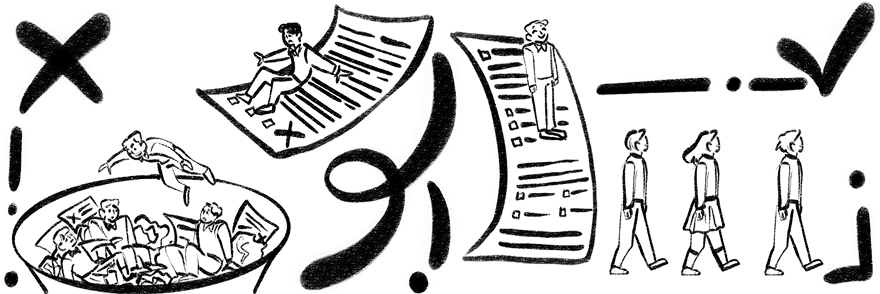
An exam is a form of knowledge assessment.
Knowledge is defined as the ability to provide answers that match the reference standard.
Answers that do not match the reference standard are not considered knowledge.
Answers that match the reference standard but were obtained in violation of procedure are not considered knowledge.
The examinee is required to sit upright, without turning their head. Turning the head is considered an attempt to violate procedure. Violation of procedure results in the annulment of results without the right to retake the exam in the current period.
Each form must be filled out in ink of a specified color.
The use of ink of a different color is treated as the absence of a form. The absence of a form means the absence of an answer. The absence of an answer means the absence of knowledge.
An exam is considered to have taken place if the fact of its administration is documented. The fact of administration is documented by an official report. The report is signed by a committee. The committee is appointed by an order. The order is stored in the archive. The archive is not subject to review.
Any self-respecting measuring instrument must meet three criteria.
Validity. The instrument must measure what it claims to measure. The exam claims to measure knowledge. In reality, it measures the ability to reproduce information in a stressful situation within a limited time. These are not the same thing. Knowledge can be deep, but the examinee may not immediately find the answer to a question. The exam does not forgive this.
Reliability. The instrument must produce consistent results upon repeated measurements. If the same student takes the same exam twice (with different versions), the results can vary significantly. Everything can influence the outcome: mood, level of fatigue, or a conveniently placed “easy” question. A proper instrument does not behave this way.
Sensitivity. The instrument must distinguish between different levels of the property being measured. Does a student who scores 70 points on an exam know exactly 10% less than a student who scores 80? Or did they just choose the wrong topic? The exam’s scale has no physical meaning. It produces numbers that signify nothing.
Measurement 4. Margins of Error
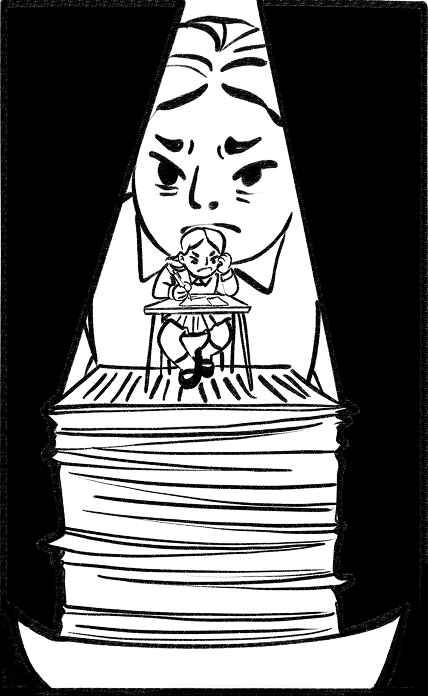
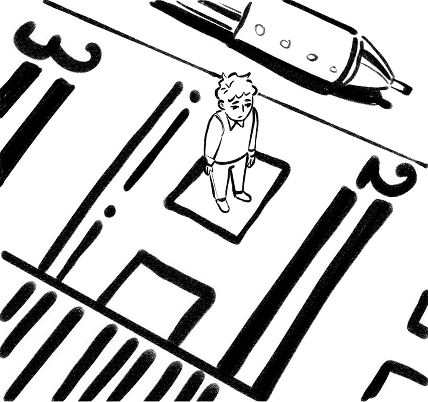
The student looked at the desk. In front of him lay a form with questions. The answers were to be written in boxes — all the same size.
The student thought: if I get 70 points today and 80 tomorrow, what will change?
The grade will change. But he himself — will not.
The ink had to be black, otherwise the form would be declared invalid. The ink was black. The chair stood straight. The breathing of his deskmate was also steady. And the clock on the wall kept a steady rhythm as well — not loud, not quiet, just as it should be in an institution where everything has long since been decided.
In physics, if an instrument is broken, you throw it out or fix it. First, you measure its margin of error. Then you account for it. The result of a measurement never appears as a round number — it appears as “70 ± 0.5.” This means: the true value lies somewhere between 69.5 and 70.5. An engineer designing a bridge wouldn’t say, “The load is 70 points, the bridge will hold.” They would ask: “What’s the confidence interval? What’s the probability of error? How many times did we check it?”
In education, the margin of error is not measured. Because if you measured it, it would be terrifying. And if it were terrifying, something would have to change. And changing something is far too costly — both in effort and in time. It’s easier to pretend the error doesn’t exist.
In economics, the margin of error isn’t ignored — it’s built into every number. Discount factor? That’s an interval, not a number. Interest rate? Also an interval. Net present value of a project? An interval — one that can be both positive and negative simultaneously. An investment project can be both profitable and unprofitable, depending on which margin of error you choose. And economists live with this quite comfortably. They don’t pretend the error doesn’t exist. They’ve learned to calculate it and make decisions with a caveat: “with 95% probability.”
But in education, there are no caveats. Because if you admit the margin of error, you’d have to admit that the exam doesn’t work.
In medicine, a COVID-19 test produces false positives and false negatives. Doctors know this. That’s why they look at symptoms, order repeat tests, check the patient’s medical history. They understand that the test is not the truth — it’s a tool.
But the exam? The exam is always accurate. The exam does not make mistakes. If it says you know nothing — then you know nothing. Even if you do. The procedure allows no room for doubt.
In sociology, there was a famous case. In 1936, The Literary Digest magazine polled 2.4 million people — a gigantic sample, unprecedented for its time. The poll showed that the Republican candidate, Landon, should win the election with 55% of the vote. But the election that same year was won by Roosevelt — with 61%. An error of a full 20 percentage points, with a sample of 2.4 million people.
How did this happen?
It happened because the sample was biased. The magazine polled its own subscribers and people who owned telephones. And in 1936, telephones were owned by the wealthy. And the wealthy, naturally, voted Republican. The enormous sample size didn’t save the result, because size does not equal quality. What matters is representativeness.
In education, they also believe that size is decisive: the more examinees, the more objective the result.
This is not true.
The result depends not on the number of test-takers, but on the quality of measurement. But measuring quality is not customary. It’s easier to pretend it doesn’t exist.
In statistics, there’s a concept known as “insensitivity to sample size” — a cognitive bias where people draw incorrect conclusions about the frequency of phenomena in samples of different scales. Take the famous hospital example: a large hospital has 45 births per day, a small one has 15. In which hospital will 60% more boys be born? Of course, you’ll say: “Both the same.”
The correct answer is: the small one.
Because the smaller the sample, the greater the probability of deviation from the average.
In education, this rule does not apply. A small sample raises no suspicions. The results of a single exam are considered true — even if there are only ten students in the class. Yet the probability of error in such a sample is many times higher. The procedure allows no room for doubt.
An engineer would not build a bridge on such foundations. An economist would not make a forecast. A doctor would not treat a patient.
But an exam? They’ll run it anyway. Because if you admitted that the exam doesn’t work, you’d have to change the entire system. And changing the system isn’t in anyone’s job description. And so, the margin of error remains unacknowledged — and the results remain the only truth.
Measurement 5. Market Trials
28 minutes remaining. Haven’t finished your version yet? 27 minutes remaining. Did you double-check the first question? 26 minutes remaining. Do you think you’ll make it? 25 minutes remaining. Can you feel the air getting denser? 24 minutes remaining. Do you hear that sound? 23 minutes remaining. You should speed up. 22 minutes remaining. Are you still here? 21 minutes remaining. Time is almost up. 20 minutes remaining. Time to turn in your forms.
The exam is an industry. And this industry is thriving — even though its main “product” is numbers that mean nothing.
Tutors. Test prep courses. Textbooks written not to teach, but to drill. Tests that train not the mind, but speed. Psychologists who relieve the stress caused by the fear of not confirming one’s own worthlessness before a soulless machine.

Record-breaking amounts of money circulate around an instrument that doesn’t work. Parents pay for “drilling” — for the skill of passing tests, and for peace of mind: “We did everything we could.” Schools compete by average scores — not by what they taught, but by how their students filled in the bubbles. Universities rank applicants by numbers that have no physical meaning.
And who do you think invented standardized exams like the SAT and the USE? It wasn’t the evil will of the ministry. It was an attempt to make the system transparent — to eliminate corruption, nepotism, “phone calls.” To make it possible for a child from a remote village to get into a good university. The idea was noble. But in practice, it turned into what it turned into: a system designed to equalize chances became a machine for selecting those who know how to take tests.
Money didn’t leave education — it simply flowed into a different form. Now it’s not “connected people” who get paid, but tutors and test prep courses. Corruption changed form, but it didn’t disappear.
Schools pretend to teach. Students pretend to know. Parents pretend to believe. Tutors pretend to be indispensable. And the exam pretends to measure knowledge.
And everyone is happy.
Well — almost everyone. Except for those who didn’t fit the procedure. And as we remember, there are many of them. And among them — are names you know.
Measurement 6. The Cost of Error
“They say this year’s results will be even lower. The committee revised the scale.”
“Again?”
“Again. Now, to get that coveted seventy, you need to know more than you did last year. And last year, you needed to know more than the year before that.”
“That’s so no one complains the tests are too easy. The harder the test, the more honest the result. That’s what they say.”
“And if a child doesn’t pass?”
And do you know why the exam still hasn’t been abolished?
Because it’s profitable.
The test preparation industry is worth billions. Tutors, courses, study guides, online schools — they have a voice, and they will never say, “The exam isn’t needed.” They will say, “The exam is necessary — just prepare better. And we’ll help you. For a fee.”
Universities find it convenient too: the exam absolves them of responsibility for admissions. “It wasn’t us — the scores decided.” No need to explain why one student was accepted and another wasn’t. The exam put everything in its place.
And no one wants to change the system — because to change it, you’d have to admit it wasn’t working. And if you admit it wasn’t working, someone would have to answer for it. And there’s no one to answer.
So the exam continues to operate. The margin of error remains. The money keeps flowing.
And you — keep writing.
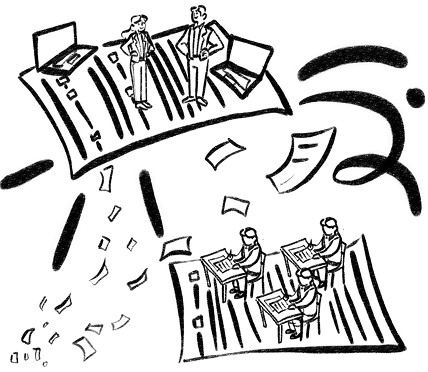
Measurement 7. Alternative Methods of Measurement
The system worked without interruption. It had no weekends, no vacations, no right to make a mistake. Every second, thousands of forms poured into its processors, and every second, it spat out numbers.
It watched as some numbers soared and others plummeted.
It didn’t know what this meant.
Perhaps it meant that one form was better than another. Or perhaps it simply meant that one form had been filled out with ink of the correct color, and another had not.
The system did not know that it had been built by people who hated exams. They had wanted to create a different reality — one where there was no room for tests or scores. But they didn’t know how. So they did what they knew how to do.
We are not suggesting abolishing exams. Abolishing exams would be as impossible as abolishing gravity. The system that has been built around them for centuries will not collapse at the wave of a hand. But that doesn’t mean we can’t work with it.
There are several things that can be done right now — without waiting for the Ministry of Education to rewrite all the instructions.
First. Stop believing in exams as if they were an oracle.
The exam is a tool. And a tool, as we’ve discovered, is leaky. Its results should not be the sole argument in deciding a person’s fate. If an employer rejects you because of a lack of points — that’s the employer’s problem, not yours. If a university screens applicants based on a single test — that’s the university’s problem. Smart people have long understood that talent cannot be measured by a number. As for the rest — one can only feel sorry for them.
Second. Stop measuring knowledge with a single number.
A person cannot be reduced to a digit. This isn’t height or weight. This is the ability to think, to doubt, to make mistakes, to seek unconventional paths. No test can measure that. If you ever come across an employer who looks not at your diploma, but at your projects — hold onto them. They still exist. Rarely — but they do.
Third. Acknowledge that the margin of error in exams is enormous.
A doctor does not make a diagnosis based on a single test. An engineer does not build a bridge relying on just one calculation. Why does education operate under a different standard? Because it’s easier. Because a number can be entered into a spreadsheet — but human uniqueness cannot. But that doesn’t mean we should continue in the same spirit.
Fourth. Use the exam as one tool among many — not as the only one.
Let there also be portfolios, project work, interviews, recommendations. Let people have a chance to show who they are — not just to fill in a form. In some countries, this already works. In Finland, for example, there are no standardized tests in schools. Instead, they assess projects, research, group work. And their education is considered among the best in the world — because it teaches students to think.
Fifth. Teach students not to pass tests — but to think.
Teach them to ask questions, not to look for ready-made answers. Teach them to doubt, not to memorize. Acknowledge that the world beyond the classroom does not consist of tests. In the real world, there are no single correct answers. There are problems that no one will solve for you. If you leave school with nothing but the skill of “quickly filling in forms,” you will be useless. But if you leave with the skill of “thinking,” you will handle any exam — even the one that hasn’t been invented yet.
The system will not collapse in a day. But it can be changed piece by piece.
Stop hiring tutors for “drilling.” Hire them to explain — or do without them altogether. Allow your child to make mistakes. Don’t panic if the result isn’t perfect. A perfect result isn’t always about knowledge — it’s often about the ability to fit an answer to a template.
Stop preparing children for tests. Prepare them for life. Give them assignments that have no single correct answer. Teach them to argue, to debate, to search for information — not just to memorize. Yes, this is harder. Yes, it doesn’t fit neatly into the curriculum. But it’s the only way to raise human beings — not robots.
Stop ranking applicants by their scores. Look at portfolios, projects, personal qualities. Conduct interviews. Yes, this is labor-intensive. Yes, it’s inconvenient. But it’s the only way to select those who are truly capable of learning — not just of passing tests.
Stop demanding diplomas and certificates. Look at real skills. Use practical assignments that test not memory, but the ability to solve problems. Yes, this is harder than filtering by scores. But it’s the only way to find talent — not obedient functionaries.
The exam will remain. But let it be a formality — not a sentence. Like a stamp in your passport at the border: it’s there, and that’s fine. What matters is what’s in your head — not what’s on the form.
And yes — there is life after the exam. It doesn’t end when you walk out of the examination hall. It’s only just beginning. And it will be difficult, messy, and unfair.
But a number is just a number.
Everything else is still in your hands.

Is there life on Mars, or is there no life on Mars? Join the eternal debate on paradoxes!
Thank you!