Category: Life technologies
How to Train a Writer: From First Lines to an Author's Voice
“I received my education in the library. Completely free”
Ray Bradbury
Yesterday, you remembered how skillfully you wrote your school essays, and you thought: “Why don’t I write a book? Or, say, a poem or two?”
At first glance, nothing could be simpler: grab a piece of paper, a pen, and just write. On second glance, your thoughts get tangled, and that great, significant thing you feel in your head turns into small, messy scribbles on the page.
What’s wrong? Nothing at all. You simply lack an education. The good news is: learning to write is possible. The bad news: it will take time, spiritual and creative energy, and discipline.
The path from first lines to a unique authorial voice can be traveled in just a couple of years. Or you can get stuck in the quicksands of apprenticeship for a lifetime.
What’s the secret? And where can a beginning writer go to get some wisdom?
The first thing you need to realize: a writer’s success is 80% painstaking labor and only 20% talent. The cliché about the uncut diamond applies here — theoretically precious and beautiful, but in practice, just a rock.
No matter how grand the ideas and thoughts wandering around your skull, to give them a worthy form, you’ll have to learn.
The Foundation of Writing
A good writer grows out of a reader, just as a cedar grows from a seed. The more you’ve read, the easier it will be to write your own text. But beware: this channel is full of underwater rocks, coral reefs, and sunken ships. If your goal is to learn to write truly well, reading just anything is not only unnecessary but even harmful.
You need a system. And undeniably excellent texts. Leave pulp fiction on the boulevard, and boudoir fiction… well, you get the idea.
Your number one friend is world classics and recognized modern masterpieces. To make it easier to figure out what exactly to read, refer to the list of the 100 Greatest Books compiled by the Norwegian Book Club together with the Norwegian Nobel Institute, or the 100 Best Books according to the BBC.
Your number two friend is genre literature. You’re almost certainly planning to write something specific, so you should study what has already been written before you. This will help you kill three birds with one stone: solidify your understanding of genre conventions, avoid repeating plots, and move away from clichés and tropes.
Your number three friend is contemporary poetry. Regardless of whether you plan to try your hand at prose or poetry, contemporary poetry is a treasure trove of imagery, beneath which pulses the very nerve of the era.
Your number four friend is specialized literature. There are many books about how to write books. Writers and philologists dissect literature with the precision of a pathologist, taking works apart piece by piece. And yes, you need to know how and why it works.
To master everything as comfortably as possible, invent a system. For example, set yourself a plan for a month: read one book about writing, one novel, one short novel, three short stories, and a book of poetry.
Reading Like an Adult
For the first few months, just read. And when a sense of the inner workings has formed in your head, move on to “writerly reading.” The first time, read the work normally. Then, arm yourself with a pencil and a reader’s diary (yes, yes, just like in school).
Your task is to take the text apart and write down: what composition the author used; study the style, the vocabulary, how the rhythmic pattern is constructed; find the author’s techniques; track the allusions and their meanings; feel out the main and secondary conflicts; figure out why the characters feel so alive; try to find logical holes.
After you’ve dismantled about a dozen works, the skill will become automatic, and writing things down will no longer be necessary. The bonus from this exercise is a clear understanding of how to make your text work for your idea. The side effect: in absolutely any text, you will see the structural parts and the seams that the author used to stitch them together.
Practical Exercises
Gradually, we move from theory to practice. Don’t try to storm large forms right away or bring your most ambitious ideas to life — hoard them like a miser hoards banknotes.
Before creating a painting, an artist draws sketches and studies. Be like the artist. Set aside half an hour a day and disciplinedly complete mini-assignments. You’ll have to assign them to yourself.
Options:
- Describe an object in 20 words.
- Write a dialogue without exposition.
- Sketch a full sensory scene: smell, color, sound, tactile sensations.
- Write a 50-word story.
- Write a letter to yourself from the perspective of your mother, the president, or the neighbor’s cat.
- Invent and describe a character: their clothing, appearance, way of thinking, history, and fate.
It’s best to practice every day, gradually increasing the volume and complexity of the tasks. Try to show, not tell. When you feel ready, move on to writing your first novellas and short stories. Ray Bradbury suggested writing one story a week and assured that no one had ever managed to write 52 bad stories in a row.
Copying or Finding Yourself?
To find your own voice, you first have to speak with someone else’s. Take a book by your favorite author and read a particularly powerful passage aloud. Copy it by hand to feel the style. Then write your own text, fully replicating the author’s rhythm, intonation, and vocabulary.
Did it work? Then it’s time to do the next important and engaging exercise. Take any text (a newspaper article, a social media post, a famous fairy tale, or a joke) and rewrite it in the style of Kafka, King, Shakespeare, Dostoevsky, or Hemingway.
By learning to use other people’s techniques, you’ll gradually develop your own unique writing manner. The important thing is not to fixate on a single author, lest you become their pale copy.
And when your own voice finally emerges, you can confidently sit down to your first serious work.
Feedback and Criticism
There’s a high probability that you will be absolutely thrilled with your work. This enthusiasm will be eagerly shared by your relatives and friends, but don’t be too quick to be charmed. Now you need to show the work to a knowledgeable person. A literary circle, an established writer, or an editor would be perfect for this.
Wherever you go, be prepared to hear criticism instead of the praise you’ve become used to. Don’t be afraid that your text will be stolen or appropriated — no one wants or needs that.
The mentor’s task is to show you your weak points and help you become better. And yes, on some points, you might argue, trying to defend your vision. But don’t reject constructive criticism. The ideal method: take a pause, and when the initial anger subsides, calmly evaluate the feedback and make your edits.
A writer must communicate with colleagues in the field. It’s as much a part of the work as the actual writing or reading.
The next step is to become part of the literary process on the scale of your town. Participate in contests, festivals, workshops, book presentations, and public readings. In short, you need to be everywhere the word “literature” is spoken. This way, you’ll stay up to date on current trends, gather inspiration, make useful connections, and get the chance to ask important questions of those who know the right answers.
Enriching Your Text
Reading is great, but it’s not enough. To give yourself maximum freedom and put as many tools as possible on your literary workbench, study related arts.
Try rewriting scenes from movies without losing their tension and emotional intensity. Pay attention to visual metaphors and narrative structure. From painting, you can borrow techniques of light and color to convey mood. Music will give you a sense of rhythm and the skill to use it to change the reader’s perception of a text. Theater will teach you how to reveal conflict and maintain intonation.
But the most important source of enrichment for your writing is life. A good writer is as observant as a scout and as curious as a raccoon.
A walk in the park can provide material for several chapters: curious incidents, anecdotes and legends, customs, the way passersby dress and talk, rare turns of phrase. Even a hard bench with carved names can become an important part of your new work.
Literary muscles grow step by step. The main thing is not to give up and to keep going — especially since modern technology can make the creative process just a little bit easier.
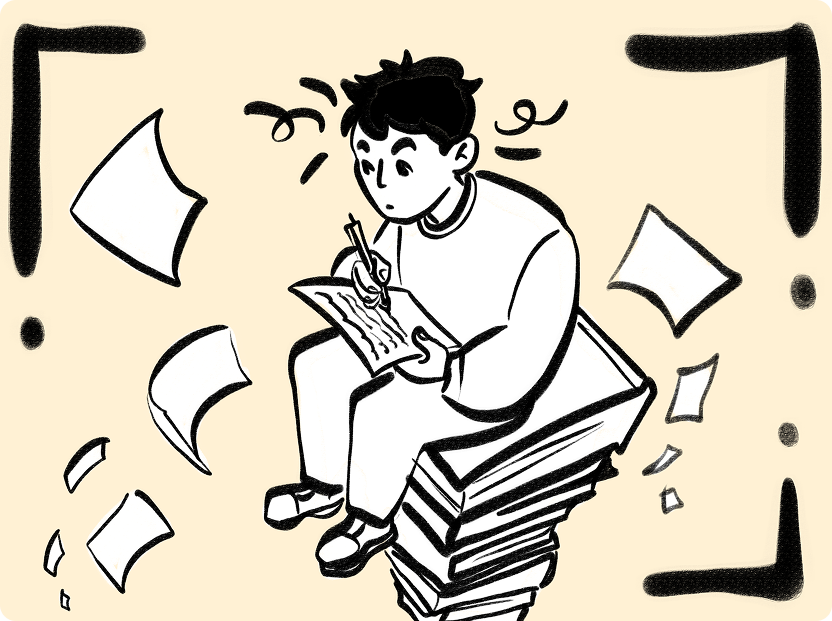
The first and most important thing to understand is that modern technology cannot write for you. It can take on some of the routine work, open the door to the world of big literature — but 80% of the work belongs to you and only you.
How to Learn Online?
Literary circles and books are great, but today you can learn the craft of writing from recognized masters without ever leaving your favorite couch. Yes, yes — just type “writing courses” into the search bar, and a treasure trove of knowledge will open up before you, including international educational platforms that offer courses from leading universities and celebrated masters.
For example, MasterClass offers lessons from literary stars. Stephen King, Margaret Atwood, and other great writers gladly share their personal experiences, talk about their working methods, and give practical advice.
Want more? Set off on a whirlwind tour of specialized writer and publisher communities — free courses often live there, helping you navigate the finer points of book publishing.
And in open libraries and archives, you can find rare editions, audio recordings, and videos that will inspire new ideas or help you work out the details of your book.
Making Life Easier
No matter how competent, attentive, and diligent you are, it’s impossible to catch every mistake — both as you go and after you’ve finished writing. Typos will hide behind internal context, your eyes will glaze over, and the silliest errors will remain. This is very easy to fix with technology. For example, text editors with analytics can check grammar and style, identify repetitions, assess readability, and even make your text more concise and clearer.
Try Grammarly, ProWritingAid, or the Hemingway Editor.
If you just can’t seem to structure your plot, technology comes to the rescue once again — it can organize chapters, notes, research, and visual materials in one place, visualize the story arc and character development, and build diagrams and novel plans.
Scrivener, Plottr, and Milanote have proven themselves well in this area.
And finally, the most interesting cohort of helpers: idea generators. These are crutches for writers whose imagination has run dry, or for those who need a foothold from which the creative process can take flight. These guys can come up with titles, character names, world descriptions, random plots, and characters for you.
Seventh Sanctum and Random Story Generator are great for exercises, too: generate a plot and characters, then simply write your own interesting story using the ready-made patterns. Sometimes an exercise grows into something more, so be sure to give it a try.
What About Artificial Intelligence?
Neural networks, like a spring flood, are penetrating everywhere — and writing is no exception. Can a robot write a novel? Yes, it can. But even the most advanced model writes at the level of a beginner. If you want to grow and develop, you should never trust artificial intelligence to do the work for you — including editing and finishing texts.
That said, AI is a very useful technology. When you need to find logical errors, check style, identify clichés and tropes, or analyze a work for genre conformity and originality — neural networks are just what the doctor ordered.
And yes, you can use them to write dialogues, descriptions, entire chunks of text, and even whole novels. But here’s the question: can such a text be considered original? Platforms like Wattpad and Medium, for example, require you to indicate which parts of the text were generated by a neural network.
Learn Through Play
Are textbooks, courses, and talking with colleagues too boring for you? Well, there are several ways to spice up your learning — and even your writing work — using the popular practice of gamification.
The first group of programs are trainers. They help you stay in shape and develop the useful habit of writing regularly. For example: 750 Words.
The second group is online games. You can solve puzzles while simultaneously mastering the subtleties of plot construction. Embark on engaging text adventures, practice creating characters and dialogues.
Sounds interesting? Then Allstoryteller and Choice of Games are waiting for you.
What’s Next?
This question will inevitably arise once you’ve finished your magnum opus and put it through the nine circles of editing. Next comes the time to set your work free to sail through the minds and hearts of readers.
You can try your luck with publishers. But if you want feedback faster — the best choice is the variety of digital platforms.
Self-publishing platforms allow authors to publish chapters as they write them, participate in contests and support programs, receive royalties, and, of course, get feedback from readers. But be careful: as a rule, each platform gathers an audience with specific literary tastes — don’t publish a noir detective story on a site for romance novels, or a space opera in a fantasy-loving community.
Are there other options? Yes. Crowdfunding projects, like Patreon, help authors monetize their creativity and raise funds for publishing their work in print.
All roads are open to those who are ready to learn and work hard on themselves. The path of a writer is no exception. We’ve drawn you a road map — full of dangers and adventures. Will you dare to walk it?

Dark matter whispers secrets only geniuses can hear.
Thank you!