Category: Materialization technologies
A Guide to Speech Development
“Fear is what always accompanies love. When you have a child, the fear for that child becomes your second skin”
Dennis Lehane
Being a parent is hard. It’s like running an endless marathon, jumping over hurdles made of your own fears and anxieties. From the very first day of a child’s life, we glance at the neighboring running tracks. We compare. We marvel. We worry.
We wait impatiently for the first words, the first sentences — and we compare, compare, compare, losing peace, sleep, and appetite.
— Oh, the neighbor’s baby already says “mama,” but mine just screams and bulges his eyes. Something must be wrong with him.
— Oh, my friend’s two-year-old recites poetry, but ours has only learned one word: “gimme.”
— Look, quick, in this video, a four-year-old doesn’t distort words at all, but you…
Enough.
Speech development is the construction of a huge building, built from an individual blueprint. Every child is unique, and the boundaries of normalcy are very wide. In this article, we’ll trace the path from the first cry to public speaking — so that we can learn to distinguish real problems from normal development.
First Words
The first fears about speech begin to ripen before the first year. Parents desperately want to hear their child say “mama” or “papa” — or, at the very least, “gimme.” And if the child prefers to remain silent, adults start to worry and ask themselves: “Is this a developmental delay?”
No.
In the first fifteen months, your baby does colossal work. Their brain transforms sound snapshots into neural patterns, gradually builds connections with the muscles of the lips and tongue, and generously seasons every repeated sound with a dopamine reward.
In the first six months — while the baby cries and coos — the auditory system is fine-tuned and the vocal cords are trained. The child learns to modulate volume and tone. The next four months are spent training articulation. This is the time of the first repeated syllables, like “ma-ma-ma.” And only around the first year does the mechanism of understanding and speaking begin to take shape.
But even then, the first thing to appear won’t be words — it will be the pointing finger. If your baby points at something they want, they are already talking to you.
Normally, the first word appears somewhere between 9 and 15 months. And it doesn’t have to be “mama.” Any stable sound combination tied to an object — “ma,” “pa,” “ga” — counts as a word.
Don’t demand a first word from your child. If you want to speed up the process, switch on commentator mode and narrate all your daily actions. Roll a ball back and forth — this is the foundation of future dialogue. Hug, stroke, bounce them on your knee — speech is learned faster when words are paired with physical sensations.
But you need to see a specialist if your child:
- Does not coo by 6 months.
- Does not babble or produce repeated syllables by 10 months.
- Does not use any gestures by 12 months.

First Sentences
So, you’ve gotten the first word. Then the second, then the third. But where are the sentences?
Two years old is an important milestone. The internet is full of children singing songs, reciting poetry, and thoughtfully debating “whose doll this is sitting on the table.” Neighbors boast about their little talkers, but your child continues to speak only individual words. Two years and a month. Two years and two months. And now the fear of a developmental delay rears its head again. Is it time to see a neurologist?
What’s actually happening: The fusiform gyrus is learning to connect the sight of an object with its name. A word transforms from a sound into a concept. The basal ganglia begin active work, switching the motor program of speech from one word to another without stumbling.
First, count how many words your child already knows. A vocabulary of 10 to 50 words by 18 months is considered normal. By age two, there should be more than 50. That’s also when the first attempts at two-word combinations appear: “Mama, gimme,” “Daddy, vroom-vroom.”
It’s completely normal if these words are still clumsy. The articulatory apparatus isn’t ready for complex sounds yet, and the brain hasn’t yet learned to hear mistakes on its own. Don’t correct them. Instead, simply repeat the word correctly in response — this activates auditory control and records the correct pronunciation in the child’s memory.
Don’t be discouraged if they have enough words but sentences are slow to appear. You might have a child who prefers to accumulate enough material first — before truly starting to talk.
This is the phenomenon of late blooming: 60–70% of children with few sentences by 2.5 years catch up to their peers by age 3 without any speech therapy intervention (provided their hearing is intact and their understanding of spoken language is excellent).
Ask yourself: “If I ask my child to bring me a toy, will they bring it?” Yes? Then their brain is absorbing language fully. And they will definitely start speaking when they’re ready — most likely in full, complex sentences right away.
At this stage, you can — and should — help your child start speaking. Keep narrating. Use the “plus one word” method. When your child says, “Ball,” you respond: “Red ball. The ball bounces.” Read simple books where the same phrase repeats on every page. Your child will start anticipating and “helping” you read.
The “clueless adult” tactic is also effective. Your child reaches for a cup, and you ask: “What do you want? A cookie? Water? Can you say, ‘Give me water’ or ‘Drink’?” Don’t demand they say it correctly. If they say “drink” — that’s already a victory. At this age, the goal is to create speech situations. For example, when your child asks for a drink, offer a choice: “Do you want milk or water?” This forces them to use a word.
Stop watching videos of “talking prodigies” on social media. Stop listening to other parents boast. It distorts your perception of normal development and fuels anxiety.
But you need to see a neurologist if:
- The child does not understand simple instructions.
- Their active vocabulary has fewer than 10 words.
- There are no attempts to combine two words.
- The child was saying 10 words and suddenly stopped.
Physiological Tongue-Tiedness
Parental fears don’t disappear once a child starts talking. Listening to the endless “whys” and “Mom, look what I can do,” parents realize with alarm that their child is distorting words. And the smug neighbors, relatives, and friends ask for a translation of every sentence.
Don’t rush to book an appointment with a speech therapist. At age 3, a stranger should normally understand 70–80% of a child’s words. At age 4 — 90%, but with a discount for errors in complex sounds, which may be substituted or entirely absent until age 7.
The first reason lies in the thin and still slow connections between the cerebellum and the cerebral cortex. When a child is in a hurry, the amplitude of their tongue movements simply can’t keep up with their thoughts, and words get blurred.
The second reason is that the storage facility for complex sounds hasn’t yet formed in the temporal cortex. Your child literally can’t hear them — and therefore can’t produce them.
The third culprit for the “mush in the mouth” is energy conservation. Until full control over the tongue is established, the brain simplifies the speech program. The child speaks not as they should, but as is easier.
Can this be fixed? Yes.
Rule number one: Demanding that every word be pronounced correctly is counterproductive. The child will become tense and embarrassed about their pronunciation. It’s far better to twist the language together, laugh about the situation, and — once the child has relaxed — try saying it correctly.
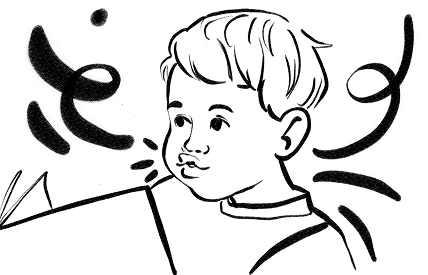
To train articulation and build connections between different parts of the brain, phonemic games work very well — that is, buzzing, hissing, growling, and the like. Without good breath support, clear sounds won’t happen, so games that develop speech breathing — like blowing out candles or blowing soap bubbles — are also very useful.
But you need a speech therapist if:
- At age 3, only the mother can understand the child’s speech.
- At age 4, the child does not speak in any phrases and only says individual words.
- The child speaks through their nose or with obvious strain and grimacing.
- The child does not swallow their saliva.
From Grammar to Narrative
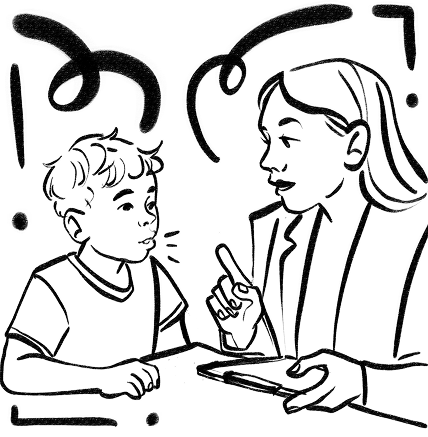
The battle for speech clarity has been won, but the war continues. There’s still the neighbor’s son, who by age 5 speaks in an elegant style, reflects at length about the plot of cartoons, and in general is never at a loss for words.
And so it begins: “Mine is such a chatterbox. And yours?” Well? What do you say? Nothing? Good. Because it’s not about how much a child speaks — it’s about how their brain works.
By ages 5 to 6, all the necessary connections have finally formed in the brain. The prefrontal cortex learns to hold a chain of words in working memory and arrange them in the correct order — meaning children construct a sentence in their minds before opening their mouths. The brain begins to recognize metaphors and other people’s emotions. Adjectives for evaluating situations actively appear in their speech.
At this stage, the task of speech shifts from pronunciation to coherence, narrative logic, and emotional color.
It’s time to learn how to tell stories!
Your allies:
Open-ended questions about books and films: “Why do you think the character acted that way? What are they feeling? What would you have done?”
Reflecting on the day through senses: “What moment today was the loudest? The warmest? The crunchiest?”
The “three words” game before bedtime (instead of a fairy tale): you say three random words, and your child makes up a short story. This builds imagination and connected speech.
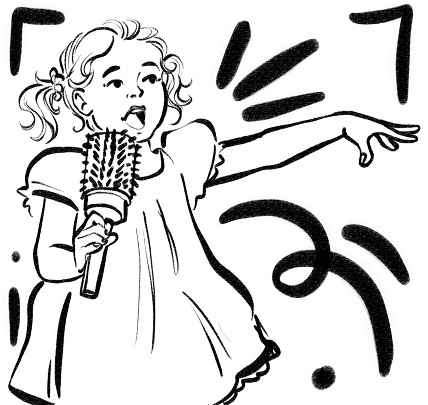
The Desert of Slang
For years, you’ve been shaping your child’s speech into an impeccable ensemble. But then — slang bursts into your life and shakes parents to their core.
Before starting a fight, consider this: from a neuroscience perspective, this is an inevitable and even necessary stage.
The key, once again, lies in the prefrontal cortex. At ages 10 to 12, it actively maps out the social hierarchy. The brain chooses words that raise status among peers. Using slang in a teenage environment triggers a dopamine rush. On top of that, the brain is busy with physical growth and hormonal changes — it’s forced to save energy and turns on the principle of cognitive economy, trying to cram complex emotions or definitions into one short word.
What can you do?
Help your child develop the important skill of distinguishing speech styles and switching between them. Refrain from devaluing the new words, but ask them to offer an alternative — this is a great way to give them a palette of synonyms without restricting their language.
To develop critical thinking and empathy, try the age-old game of “Devil’s Advocate.” Ask your child to come up with three arguments for any debatable topic, and then three arguments against.
And to preserve emotional expressiveness in speech, read dialogues from books aloud — by role.
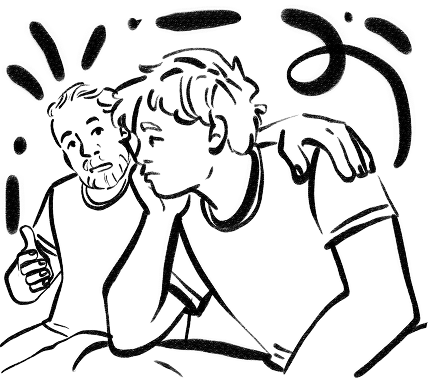
How to Raise an Orator
Slang is a marker of growing up. As soon as it seeps into speech, problems with communication and interaction follow close behind. Voices grow louder. Doors begin to slam and lock. And you don’t understand how this could have happened — or whose fault it is.
The answer is still there — in your teenager’s head.
The amygdala, the center of fear, loosens the reins, allowing them to be less afraid of parental disapproval. The frontal lobes gain full control over the impulses of the limbic system, giving rise to the ability to use irony, sarcasm, and double meanings. The associative pathways finally mature, and the child develops the ability to build long logical chains.
All of this arms their speech for defending personal boundaries and shaping their linguistic identity. And it is primarily through words that a teenager tests the adult world for weakness.
Avoiding this stage is nearly impossible. Separation is inevitable. But it is within your power to navigate it in an environmentally conscious and well-argued way — by teaching your child to listen and truly hear their opponent.
First, agree on one thing: argue about the problem, not about personalities. Allow any point of view to be expressed — as long as it’s backed by reasoning and free of insults.
Second, to help them master the art of understanding and explaining, suggest listening together to short podcasts on topics that interest them — especially controversial ones. Then discuss not “who is right,” but the flaws in the speakers’ arguments.
Third, before disagreeing with your teenager, ask them to clarify whether you’ve understood their point correctly.
Finally, to truly cement the skill of argumentation, suggest keeping a journal, an anonymous blog, or at least notes on their phone. Written speech structures the brain more effectively than spoken language.
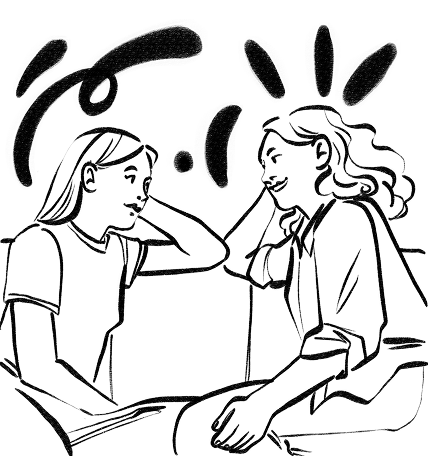
The Parent’s Ultimate Weapon
You’re certainly expecting to be told about love and patience right now.
And you’re absolutely right.
To make it through this exhausting journey of speech development — and, even more so, personality development — you’ll need to stock up on them in unimaginable quantities. The good news is that these are renewable resources.
Remember: no educational app, no cartoon, and no speech therapist, no matter how brilliant, can replace live, warm, engaged communication with you. Your calm presence, your love, and your willingness to listen are the best speech stimulants of all.
Good luck!
Scientists have decoded the human genome. We’ve decoded the genome of interest. Only pure science and facts.
Thank you!