Category: Cognitive technologies
The Physics of Awkwardness: Can We Measure Cringe? An Attempt to Quantify Social Discomfort
Don’t be afraid to surprise,
To be uncool and strange.
Let the wise despise your guise —
Freedom doesn’t need a range.
Ilya Efremov
We live in an era where the word “cringe” has become the universal currency for describing social hell. We wince at other people’s TikToks, recoil at the memory of our own failures, and look away when a coworker decides at the office party that they’re the life of it. Cringe is everywhere, all-penetrating, and agonizing. Our proposal: approach it not as a vague feeling, but as a physical quantity — complete with mass, velocity, and even a quantum nature.
The Etymology of Pain: What Are We Measuring?
The English word “cringe” literally means to recoil or shrink back. It’s an ancient physical reflex: the body trying to disappear from the field of vision of an imagined predator. The Russian language had phrases for “second-hand shame” or “mortification,” but they only described an empathetic projection — shame felt on someone else’s behalf. “Cringe” closed that semantic gap by naming a phenomenon far deeper and more multifaceted.
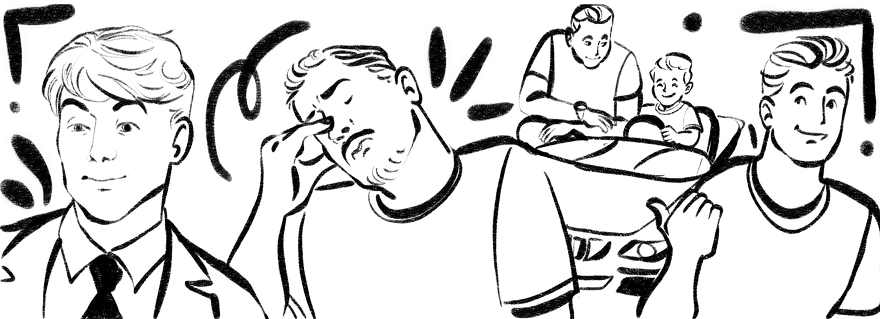
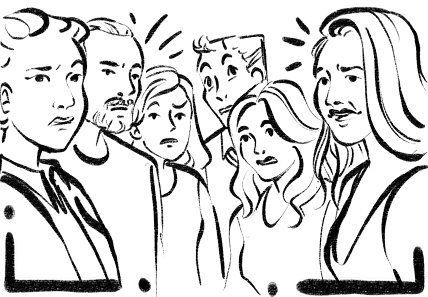
The first face is empathetic cringe. We watch someone violate an unspoken social code: singing off-key in public, bombing a joke, delivering a pompous speech with a stone face. Mirror neurons fire so intensely that it feels like we’re the ones humiliating ourselves. We’re not judging — we’re co-feeling. It’s almost a tactile experience.
The second face is far worse: auto-cringe. The brain resurrects a scene from eighth grade where you confessed your love with your own terrible poetry. Your body twitches; you let out an involuntary groan, trying to physically shake the memory loose. There’s no audience here — just the internal one. The conflict arises between your past self, naive and sincere, and your present self, who’s learned the rules of the game and now looks back at who they were in horror. Cringe is always a rupture in time, a distance between versions of yourself.
Then there’s a third face: cringe on behalf of your present self. Suppose you’re 30 years old, and you go on a carousel with a bunch of kids. You’re not doing anything wrong. You’re having fun. But somewhere on the periphery of your consciousness, an imaginary observer pipes up: “What do I look like from the outside? A grown woman on a children’s ride. What will people think?” You’re simultaneously inside the experience and outside of it, watching yourself through the eyes of others. This is pure, unadulterated awkwardness — a spasm born of fragmentation.
So what, exactly, are we trying to measure? The intensity of a person’s collision with the boundaries of social acceptability — and the strength of the echo that collision leaves behind in its witnesses.
The Unit of Measurement & Cringewell’s Law
Every science begins with an act of audacity: giving a name to the invisible. Let’s introduce a unit for measuring social discomfort and call it the Crin (Cr). One Cr is the baseline dose of awkwardness you feel while watching a video of a stranger trying to tell a joke in complete silence — and it bomb. That’s our Parisian meter.
But the intensity of cringe varies on a colossal scale. Why do some situations cause a mild itch, while others make you want to sink into the earth? We need a formula. Let’s call it Cringewell’s Law.
C = k × (ΔS × A) / (D² × I)
Let’s break down each variable.
ΔS — Delta Status. The gap between who a person imagines themselves to be and what they actually project into reality. When a street musician sings off-key, ΔS is small — you weren’t expecting much from them. But when a respected professor of philology steps out from behind the lectern and starts performing self-written rap to “connect with the youth,” ΔS skyrockets. The higher the pedestal they fall from, the more devastating the cringe.
A — Amplitude of Authenticity. Here lies the central paradox of cringe, its very heart. Maximum cringe doesn’t occur when someone is being fake. It occurs when they are completely, utterly sincere. If a stand-up comedian tells a bad joke but laughs at its own stupidity, cringe approaches zero. But when a person performs something with burning eyes, something they truly believe in, while you can only see its monstrous tastelessness — that’s pure, undiluted cringe. Sincerity without talent is the most explosive substance in the social universe.
D — Social Distance. A figure in the denominator, squared. It works like the law of universal gravitation: the force drops sharply with distance. Cringe for a close friend is hundreds of times stronger than cringe for a celebrity on the news. And the most unbearable case is when we embarrass ourselves. Social distance equals zero, and the formula explodes.
I — Irony Coefficient. A protective field. If someone signals, “I know this is cringe, I’m doing it on purpose,” the variable I rises sharply, collapsing the overall level of C. The entire aesthetic of post-irony is built on this. Modern internet culture is an endless arms race where participants try to raise their Irony Coefficient so high that no sincerity remains possible — and with it, no cringe. The price of this protection is total emotional indistinguishability.
k — Cultural Constant. What makes a Gen Z’er wince might be background noise for a Boomer, and vice versa. Cringe is culturally conditioned. Its maps of minefields shift over time: yesterday’s norm looks like unbearable vulgarity today.

The Neurobiology of the Wave: Can Cringe Be Detected?
If cringe is a physical quantity, it must have a material carrier. And it does — only it’s not a particle, but a wave. Cringe radiates from its source through social space and is registered by our detectors: mirror neurons and the insular cortex, the brain region responsible for disgust and physical discomfort.
Studies show that social rejection and norm violations activate the same brain areas as the reaction to spoiled food. The body expels an indigestible social object. We literally feel sick from awkwardness.
Can we register this with instruments? Theoretically, yes.
Galvanic skin response: palms sweat, skin conductivity changes.
Electromyography captures the instantaneous contraction of the gluteus maximus — the phenomenon of “clenched buttocks,” which the internet talks about as a metaphor, though it’s a literal physiological fact.
EEG during auto-cringe would likely show a characteristic spike in theta rhythm — a pattern associated with suppressing unwanted memories.

Somewhere in there — in the brain’s electrical waves and the muscles’ micro-spasms — hides the elusive Crin: a quantum of social pain.
The Thermodynamics of Awkwardness
Let’s move one level higher in abstraction, and it suddenly becomes surprisingly practical. Let’s think of cringe as the thermal energy of a social system.
Every interaction tends toward equilibrium — toward smooth small talk with polished rituals and neatly distributed roles. It is a state of low entropy and minimal energy. Cringe triggers a catastrophic spike in entropy. Someone breaks the protocol: says the wrong thing, in the wrong way, at the wrong moment. The system instantly overheats, demanding immediate cooling.
This is where the group comes into play as a kind of radiator. When an awkward silence hangs over a conversation, the energy of cringe builds up like an avalanche until a safety valve kicks in: a joke, a change of subject, or deliberately loud laughter. The release of tension is instantaneous, and the system returns to equilibrium. People who know how to “lighten the mood” are essentially social heat exchangers: they absorb excess emotional energy and dissipate it at the cost of their own vulnerability.
Quantum Cringe and the Uncertainty Principle
The deepest paradox reveals itself at the moment of observation. Let’s formulate it as an uncertainty principle for social physics: it’s impossible to simultaneously be in a state of acute cringe and measure its intensity.
The moment you — as a witness or participant — switch from “experiencing” mode to “observing the experience” mode, the cringe changes its properties. You think, “Wow, there’s some serious cringe happening here. I wonder how many Crins that is?” And right then, the distance between you and the situation increases. You’re no longer inside it. You’re outside, holding a ruler. Part of the energy dissipates into reflection.
This leads to an ontological question, almost Zen Buddhist in spirit: does cringe exist without an observer?
If a person, completely alone, sincerely sings off-key from the bottom of their soul in front of a mirror, does cringe occur?
No.
There’s only pure, unfiltered being. Action without evaluation. Cringe isn’t a property of the act itself. It’s exclusively the effect of an act colliding with a perceiving consciousness that holds a mental list of social rules.
Cringe is born in the gap between an action and its interpretation. It always requires an internal split:
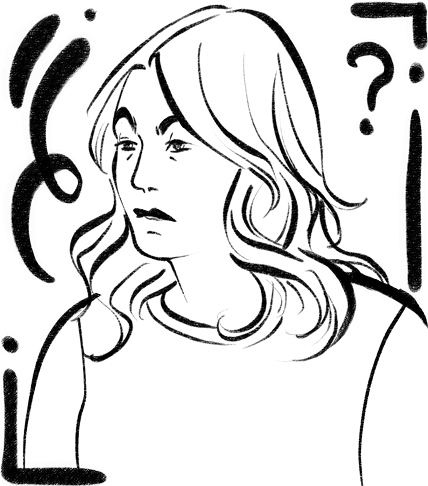
In empathetic cringe, the split is between me and the other. In auto-cringe, it’s between me-today and me-in-the-past. In cringe for your present self, it’s between me-enjoying-life and me-imagining-the-other’s-gaze. No split, no cringe. Just the raw, uncut awkwardness of being alive.
Anti-Cringe Gravity
Where does all of this lead? To one important conclusion.
If cringe is a gravitational field that pulls us toward the earth, making us shrink and hide, then there must also be an opposing force. Let’s call it anti-cringe gravity. And its source is conscious vulnerability.
According to our Cringewell’s Law, the level of cringe is inversely proportional to a person’s ability to acknowledge and own their own awkwardness. When someone steps onto a stage and says, “Yes, I know this might look stupid. I’m scared, but I’m going to do it anyway because it matters to me,” they radically raise the Irony Coefficient (I) while simultaneously lowering the Amplitude of Authenticity (A) — just enough to keep it genuine.
Cringe transforms into charisma.
Sincerity bends the space of social judgment: where shame should have appeared, attraction emerges.
Ultimately, the unit of cringe is a measure of courage.
The courage to be imperfect.
To be ridiculous.
To fall out of step with the world and not look away.
Those who can walk through cringe and not break no longer obey its physics. They become the law themselves.

And perhaps the ideal goal is not to score zero Crins because you’re flawless. It’s to score zero Crins because you’ve finally stopped being a critical observer in your own life.
Scientists have decoded the human genome. We’ve decoded the genome of interest. Only pure science and facts.
Thank you!