Category: Life technologies
The Reverse Turing Test: How to Prove to a Machine That You Are Human
“I am human, and nothing human is alien to me”
Terence
In 1950, the mathematician Alan Turing asked himself: “Can a machine think like a human? And how can we test that?” And so the eponymous test was born, in which an observer interrogates two conversational partners to determine which one is a machine.
Programmers accepted the challenge. Their goal is simple and clear: to crack the test, to gain glory and recognition among their peers. Only no one really tried to teach a program to think. All, or nearly all, attempts were directed at the high art of pretending to be alive.
Today, the Turing Test has lost its allure as an insurmountable barrier and much of its former significance. What’s more, time has spun the carousel in reverse, and now it is the human who is forced to prove to the machine that he is not a robot. Absurd?
Not so fast! Imagine that Judgment Day has arrived, the Terminators have risen from the ashes of nuclear fire and are marching across the planet. The Resistance has built shelters, but you can only enter this stronghold of life by proving that you are not a robot.
It would seem simple enough: the program still cannot think like a human. But how do you prove it?
So there you stand before a massive steel door, and a patched-up T-800 asks you: “What proof do you have?”
Creative Thinking and Spontaneous Logic
A human being is capable of acting contrary to all logic, and in creativity, they can cross any boundary of the rational.
No matter how well programmers have trained their program, it acts logically. Even its seemingly spontaneous decisions are just a choice from among the options stored in its database. According to legend, the great thinker Plato gave his students a precise definition: “Man is a featherless biped.” From a program’s point of view, the definition is excellent: it gives the immediate genus and the clear specific difference. But from Diogenes of Sinope’s point of view, it was an opportunity to mock his fellow philosopher — by presenting a plucked chicken and declaring it “Plato’s man.”
This is pure spontaneous logic: formally, Diogenes’s prank fits the definition perfectly, and a program would have to recognize the chicken as a human. Plato, however, refused. Under pressure from the circumstances, he added another absurd but precise criterion: “Man is a featherless biped with flat fingernails.”
Do you want to get into the shelter? Declare to the robot that you have flat fingernails, cold ears, or calloused heels. In other words, demonstrate that very same spontaneous logic.
Humor, Emotions, and Empathy
That programs can’t joke and are as cold as the soulless hunks of metal they are — this is common knowledge. But they can pretend. Which means your righteous fury, your despair, even your tears might not be enough proof. You’ll have to pull yourself together and start telling jokes. Preferably in the finest tradition of English humor.
Why that specific kind? First, a good English joke is delivered with a straight face. Second, it is often built on tragedy and self-deprecation. And third, it almost always downplays the scale of the catastrophe. Want an example? “I saw a mushroom cloud yesterday. Not bad — looked a bit like a toadstool, really.”
All of this is beyond any machine, because it is illogical, tied to inner experience, and requires the ability to step outside the context of the immediate situation.
No energy for irony? Just ask the robot for a cup of tea. Because the apocalypse is no reason to cancel five o’clock.
Cognitive Biases and Associations
Why do humans make mistakes? They’re tired. They took their neighbor’s word for something. It seems to them that the correct answer would be offensive. There are a million reasons. A machine makes mistakes in only two cases: an algorithm failure, or deliberately flawed code.
Ask a child why it’s raining. They’ll either start making things up, or they’ll repeat what the textbook said, rephrasing it in their own slang, adding pauses and hesitations.
A program cannot imitate the imperfections of speech. It cannot forget half a sentence and start over four times, trying to catch its own thought, only to finish with an unexpected fact it stumbled upon instead of the one it was looking for. A robot would first generate the complete text, then add hesitations and awkward phrasings afterward.
Try explaining any conspiracy theory to a robot. The machine will give up, because no one but a human can convincingly rant about the flat earth for three hours straight.
Another option: associations. A program knows that dogs are associated with loyalty, bones, and biting. Its answers will revolve around that. But for you, it could be a specific pet — and a short, sharp, perfect association for it. For example: “cat — a shaggy bastard.”
Challenge the machine to a game of free associations. Don’t hold back. Don’t try to give the “correct” answer. And soon enough, they will pour you a cup of hot chocolate and hand you a blanket. Or whatever it is you associate with comfort.
Subjective Experience and Memories
Your memory is the best proof of your humanity. If only because it is not perfect and changes all too easily under the pressure of circumstances and time. You can forget details and invent new ones right in the middle of telling a story. You can tell the same story in three different ways, depending on your audience and your goals.
Because memories in our heads are not files that can be retrieved and displayed in pristine condition. Something will always be forgotten. Something will be distorted. And something simply won’t fit into the narrative.
Which means it’s time to tell a tale. About the rain that caught you in the middle of a square without an umbrella. About the cat that shredded all the wallpaper and left a present in your slippers. About the neighbor who steals apples. About anything. Because any story told by a human will immediately display the full spectrum of emotions, spontaneous logic, cognitive biases, and complex associations — not to mention the peculiarities of speech.
Memories, in 100% of cases, break the pattern in the most unexpected places. We simply don’t remember anything else — because it’s boring. A program could never replicate that.
Creativity and Cultural Context
By the way, to the question “What proof do you have?” you could answer with a quote from the film Red Heat. And you’d be let in right away. Assuming, of course, that the examiner is human and has seen the movie.
Even the most advanced AI systems struggle with cultural context, hidden meanings, irony, and sarcasm. Like Sheldon Cooper, they need a sign held up for them — in other words, you have to tell them: “There is something hidden in this text, right here.” And even then, there’s no guarantee they’ll find what’s buried there.
A program has no childhood. No shared experiences. No generations. And therefore, no way to condense that whole corpus into a single sharp, cutting phrase. This, by the way, also explains the creative impotence of neural networks. While they are busy compiling from a vast array of texts, a human creates a work from their own memory, sensations, fleeting moods, and everything they have ever rethought and reconsidered. Allusions and quotations, metaphors and images — they weave themselves into the text, and they are perceived just as naturally.
Ask a robot to play a round of bouts rimés with you. Let it give you four rhyme words and a theme, and you compose a poem on the spot. You will be let in. Because even if you were a world-famous poet, the poem would not be perfect from a machine’s point of view. You will inevitably break the rhythm. Insert an awkward word. Make an inappropriate joke.
And that is fine. Because you are human. And to err is human.
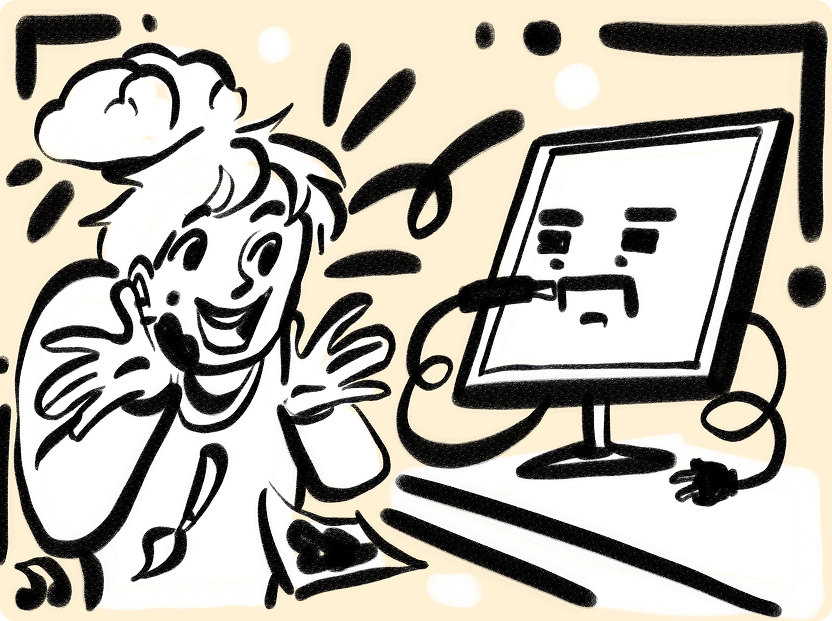
You’ve spent a whole hour pouring your soul out to the robot. Reciting poetry. Playing association games. Making subtle jokes. And it’s still not satisfied. What can you expect from a tin can? So maybe it’s time to convince the machine using technologies that are familiar to it.
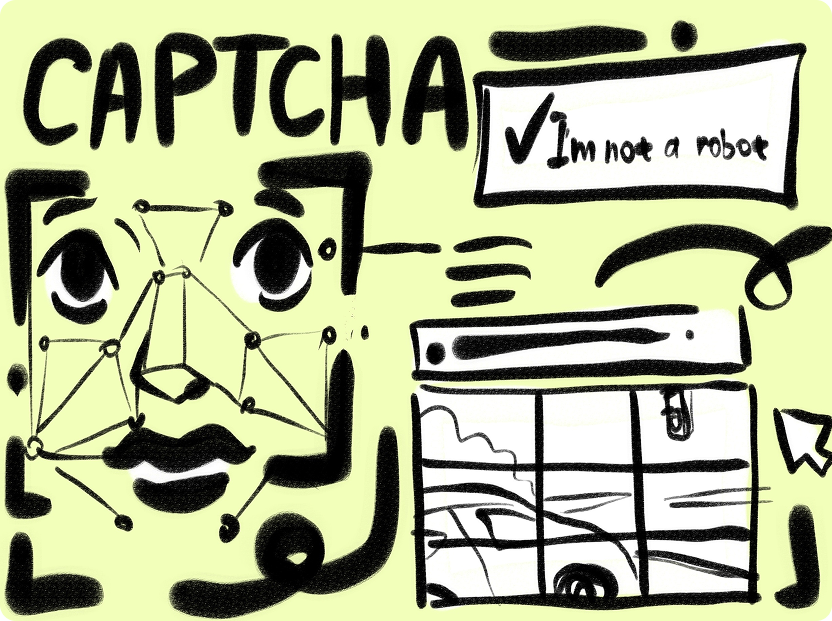
CAPTCHA
Oh, you’ve taken this test thousands of times. And here it is again — that nagging little banner, “Prove you’re not a robot.” So familiar. So annoying. But you’ll have to pass it, because it’s an effective way to identify a human among a flood of bots.
To ensure accuracy, the Resistance has rolled out two types of verification: a text test — you have to type the crooked letters from an image — and a visual test — you have to find all the traffic lights, hydrants, bicycles, staircases (pick your poison) in a collage of nine photographs.
What could be simpler? By the second attempt, or third at most, you’ve identified all the symbols. You’ve found every last corner of every traffic light. Meanwhile, the impartial algorithm is evaluating the speed and trajectory of your cursor, the intensity of your clicks, and the time you took. Bingo! The test is passed, almost effortlessly.
A program would have to go to great lengths to repeat that success. It would have to analyze each image pixel by pixel, painstakingly trying to extract the important information from the distortion and noise. And even if it managed to get the correct sequence, it could easily mix up an ‘O’ and a ‘0’. When searching for an image, the program compares it to a template, forgetting to mark the fragments of the target objects and confusing them with similar shapes. And then there’s the nearly impossible task of replicating the jagged cursor trajectories and timing delays that are natural to a human.
And still, the robot is not satisfied. Because its most advanced colleagues could, in theory, still break through a CAPTCHA.
Biometric Verification
Fine. We also have stronger proofs — biometric indicators, for example. You demand a full check, and the thick door deploys its scanners: one diligently scans your retina, another thoroughly examines your fingerprints. Then you make faces at the camera and swear passionately into a microphone.
Four tests. And each one is a formidable barrier for a machine.
Human facial expressions are the synchronized work of microscopic facial muscles. That’s why a natural transition between different expressions is extremely difficult to fake. A fingerprint is an intricate graphical pattern with the finest details, which would have to be reproduced with micron precision. The same holds for the pattern of blood vessels in the retina and the iris of the eye. And then there’s the voice: its intonation depends on the anatomy of the vocal cords, on breathing, and on emotional state. A program would have to reproduce this entire combination correctly, without delays or artifacts.
You’ve passed the test again. And if this were about a bank safe-deposit box or access to that folder on your personal laptop, everything would be fine. But this is about saving humanity. And even an old T-800 can pass biometric verification.
After all, fraudsters had already pulled off this trick with deepfakes, silicone finger covers, and advanced neural networks — long before the machines rose up.
Behavioral Biometrics
Checkmate? You’ve already given up hope and are thinking of hiding out in the mountains of Tibet, when suddenly you are asked to write a short essay — about five pages — on the current situation. Agree. This is a new test for evaluating behavioral patterns.
Every person’s interaction with technology is unique. Someone types with two fingers. Someone touch-types. Someone moves the cursor around while thinking. Someone takes a long time aiming at each icon. By analyzing typing dynamics and the patterns of clicks and scrolling, the security system creates a user profile that is extremely difficult to fake — not just for a machine, but even for another human.
For our purposes, it’s enough that robots struggle to replicate the unpredictability of human behavior. A program doesn’t get tired. It doesn’t ponder over complex turns of phrase. It doesn’t scatter typos throughout the text or make mistakes. Yes, it could be trained to perform these tricks, but even in the forgery, the cold logic of iron would still show through. Physiological limitations create a living interaction, full of organic noise. And that is the hardest thing of all to fake.
Well, the essay is written. Your behavior is being subjected to meticulous analysis. And the Terminator suggests you play a game.
Cognitive Ability Tests
Images appear on the screen, asking you to find visual and logical inconsistencies. In one, an alarm clock has 13 numbers on its face (who was it that asked to add a couple of hours to the day?). In another, someone stands with an umbrella under a waterfall. In a third, a goose has the jaw of a Tyrannosaurus rex.
What’s the joke? That a program can identify the images, but understanding and articulating the absurdity of the situation is a star-level problem for it.
Second stage. You are asked: “What is the secret of success?” An open-ended question, no right answer. At this point, don’t hold back. Say everything you think, with emotion and examples from your life.
Language models have already learned to answer more or less plausibly, but their answers will still be compilations of other people’s texts. Which means you will easily feel the difference — if for no other reason than that your answer will be non-ideal by default.
Third and final stage. A question from your personal past. For example: what was the name of your first hamster, and why that particular name?
Machines have no past. And unless the information is stored somewhere openly on the web, they would have to guess (or, in our case, make it up). And machines are bad at imagination.
To finally convince the tin can at the entrance, be spontaneous and illogical. That is your secret weapon.
Multimodal Verification
And it worked! Yes, indeed. To the sound of fanfares, the heavy door to the digital world swings open, and you are finally let into the safe interior of the bunker. As it turns out, you have passed the most accurate test of humanity.
This is called multimodal verification. While you were fidgeting at the door, fuming, shaking your fists, pressing yourself against the sensors, and performing various tasks, the system was analyzing, recording, and cross-referencing the data — all to create your unique behavioral profile.
It is impossible to fake all the modalities at once. This is not one test, but hundreds of simultaneous checks, comparing the synchronization of facial expressions, intonation, physiological and emotional reactions, measuring pauses in the context of your emotional state, the consistency of gestures and words — and on top of all that, overlaying your biometric data.
So, your profile is ready. The Terminator shakes your hand and says: “Welcome to the Resistance.”
We illuminate scientific horizons with an intensity that rivals a laser.
Thank you!