Category: Materialization technologies
Scientific hoaxes: technologies of deception
“There’s always a line for a good mousetrap”
Alexander Pashinin
Over the past 800 years, more than 100,000 attempts have been made to patent a perpetual motion machine. And although the ruthless laws of thermodynamics still reduce the number of working models to zero, the bank accounts of the most successful inventors were anything but empty.
Ladies and gentlemen! Welcome to the one-of-a-kind awards ceremony: the “Golden Charlatan” Prize for outstanding achievements in scientific deception. Today we honor those who managed to convince the world of the unbelievable—using ingenuity and charisma, along with a blatant disregard for facts and the laws of the universe.
What drove our nominees? A thirst for fame and money, a desire to amaze, an obsession with proving a hypothesis at any cost—or simply the urge to laugh at human gullibility?
Whatever the case, today we celebrate those whose “achievements” became important lessons for humanity.
Nomination #1
To your thunderous applause, let me introduce the first category. In “Master of Retro Deception,” we’ve gathered three tricksters who wrapped lies in a veil of scientific knowledge and made fortunes off public trust.
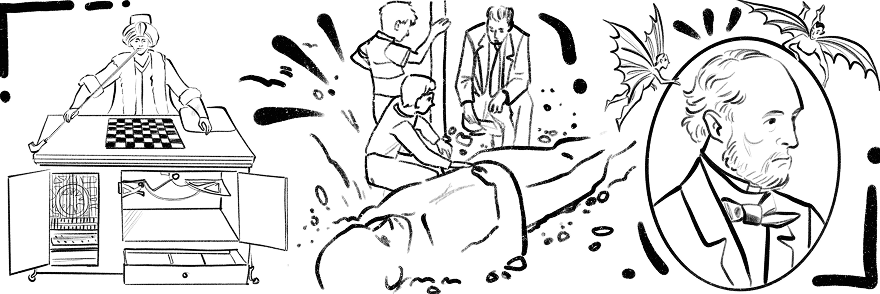
Our first nominee is Wolfgang von Kempelen and his legendary “Mechanical Turk.”
In 1769, the world witnessed a marvel: a mechanical figure dressed as a Turk sat at a chessboard, inviting anyone to play. The automaton played brilliantly and quickly gained fame. On the board, it defeated Napoleon Bonaparte, Benjamin Franklin, and Frederick the Great.
Crowds flocked to see the wonder—of course, not for free. After the inventor’s death, the machine was sold for a large sum and continued touring. Its run lasted 84 years—until the secret was finally revealed. Inside the cabinet, hidden from view, sat a skilled chess player controlling the “Turk” through a clever system of mirrors and levers.
Our second nominees are George Hull and William Newell, masters at exploiting the public’s hunger for miracles.
In 1869, on a farm in Cardiff, New York, a petrified giant nearly 3 meters tall was “accidentally” discovered. Checkmate, atheists! What more proof do you need of the Bible’s truth? Here, before you, are the fossilized remains of one of those very giants! Come see the devastating consequences of the Great Flood! Admission: just 50 cents!
Crowds poured in. In just two weeks, the fraudsters earned the equivalent of half a million dollars in today’s money. The hoax lasted about a year—until paleontologist Othniel Marsh proved the giant was made of gypsum. The “discoverers” had to confess.
Interest in the Cardiff Giant hasn’t faded to this day—it still draws visitors and money at the Farmers’ Museum in Cooperstown.
Our third nominee is journalist Richard Adams Locke, who earned two years’ salary from the “Great Moon Hoax.”
In 1835, the respected newspaper The Sun published sensational articles claiming that astronomer John Herschel had discovered life on the Moon—and not just any life, but intelligent life. Readers were captivated by descriptions of a mysterious world visible only through a seven-ton telescope. Among pastoral landscapes roamed herds of bison and blue unicorns, bipedal beavers made fires in the open air, strange round objects rolled along the shores, and all of it was ruled by bat-like humanoids.
The stories caused a global sensation. People believed them because Herschel did not deny them (he was on an expedition at the Cape of Good Hope), the articles were written in complex technical language, and the newspaper had already built credibility.
Eventually, Locke let it slip to a colleague and was exposed. The public took it with humor, and The Sun’s reputation remained intact.And now… the drumroll… The Golden Statuette goes to Richard Adams Locke, for pioneering the use of media to spread fake news and demonstrating the power of the printed word to create mass illusion.
Nomination #2
Greed is understandable, respectable even—and a bit dull. In this category, we celebrate astonishing discoveries and resourceful individuals capable of pulling sensations out of thin air.
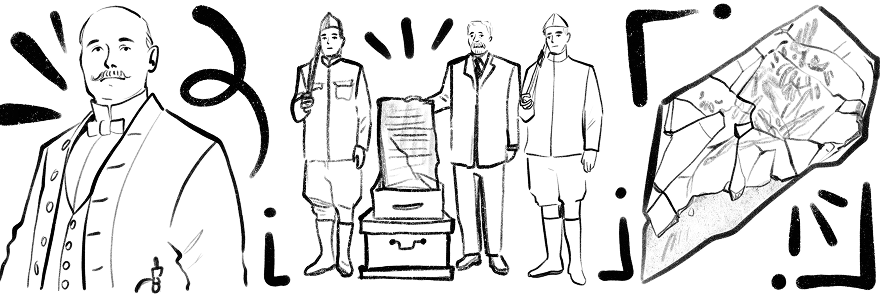
Our first nominee: Charles Dawson. In 1912, he burst onto the global stage holding an incredible archaeological discovery. In Piltdown, England, he had found the missing link between humans and apes. What do you say now, critics of evolution? Before you stands the perfect combination: a human skull with an ape-like jaw.
Dawson brought the find to Arthur Smith Woodward of the British Museum. After examination, the scientific world accepted it. The “Piltdown Man” entered anthropology textbooks for 40 years.
But science relies on verification. In 1953, careful researchers exposed the fraud: the fossil was assembled from a human skull and an orangutan jaw.
Sleight of hand, a file, honest eyes, and the scientific community’s patriotic bias—that was Dawson’s recipe for success. Let’s hear it, friends—applause!
The second nominee has nothing to do with learned scholars. Olaf Ohman was an ordinary American farmer of Swedish descent. In 1898, in Minnesota, while clearing a wooded plot of trees and stumps, Ohman discovered a rectangular slab covered in inscriptions. “Indians,” the farmer thought, and promptly notified the authorities of his find.
The authorities, without doubting the historical value of the artifact, put it on display in a local bank and sent copies of the inscriptions to a nearby university for translation. Olaus J. Breda successfully carried out this honorable task. The world learned that the Kensington Runestone (as the artifact came to be called) contained an account of a journey by mighty Scandinavian warriors to unknown shores as far back as 1362.
However, the professor had doubts about the stone’s authenticity. To be sure, the text was sent to colleagues in Norway, who also concluded it was a hoax. Scholars repeatedly examined the unusual find and almost every time came away convinced something was off. The issue wasn’t whether Vikings had reached the shores of North America—that is a proven fact. The issue was the stone itself. It was too well preserved for something that had supposedly lain in the ground for more than five centuries. And among the runes carved by an unknown hand were characters that hadn’t even been invented in the 14th century.
And yet, debates around the Kensington Runestone continue to this day. Which means the sensation was a success.
Our third nominee is the farmers of Liaoning Province in China. This is a cautionary tale of how a joke can spiral out of control and create a great deal of noise out of nothing.
In 1997, a fragment of shale with fossilized remains was sold to an unknown middleman at a modest price. In 1998, it left China and ended up illegally in a private collection. The specimen caught the attention of the director of a dinosaur museum in Utah, who bought it for $80,000 for detailed study.
It turned out that the fossilized remains appeared to belong to a transitional species between dinosaurs and birds. A sensation! Soon, National Geographic published an article convincingly explaining the importance of the discovery, and the creature was given the name Archaeoraptor, with the elegant nickname “ancient robber of Liaoning.”
Doubts about the find’s authenticity arose even before publication. A team of archaeologists, with full support from the scientific community, took a closer look and dismantled the supposed fossil like a puzzle. To the credit of the Chinese farmers, all the pieces did belong to ancient animals—just not the same one: a bird’s head and body, the tail of a small dinosaur, legs… no one ever figured out what the legs belonged to.
National Geographic had to issue a retraction and admit its mistake. The scientific community resolved to scrutinize finds from China more carefully, while creationists gained a strong argument against the theory of evolution: if scientists lied once, what guarantees they don’t lie all the time?
And now, it’s time to present the well-deserved award. For the longest stay in anthropology textbooks without real grounds, and for a vivid demonstration of vanity in science, the golden statuette goes to Charles Dawson and his eponymous ape-man.
Nomination #3
Our third and final category today could have included stories about how an entire tribe was fabricated in 1971, about ambitious chemists “discovering” cold fusion, or about large-scale falsification of medical research by a particularly crafty Japanese figure. But that would be too small in scope—barely beyond ordinary fraud. So we decided to award those deceivers who truly know no limits.
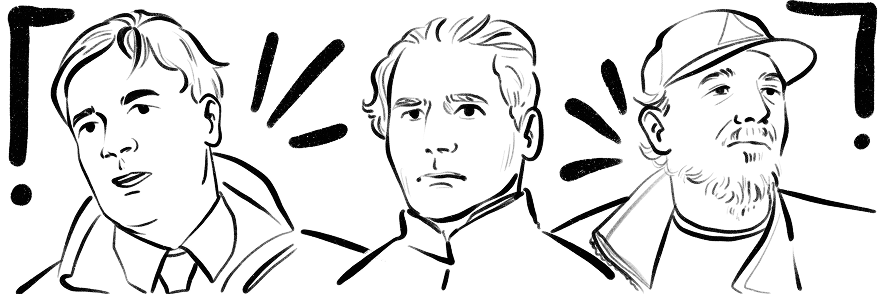
First to step into the spotlight is Andrew Wakefield. In 1998, he published a study linking autism in children to the combined measles, mumps, and rubella vaccine. And the doctor had his reasons.
The first: £435,000, neatly delivered by lawyers. They were preparing a lawsuit against vaccine manufacturers, and such a study was essential.
The second reason: a business plan for rapid diagnostic tests. The idea was simple—concerned parents would buy and administer measles tests. If the test came back positive after vaccination, outraged parents would be handed over to the same helpful and efficient lawyers.
The third reason: a patent for the “right” vaccine. Dr. Wakefield had developed his own version—almost certainly highly effective and, of course, incapable of causing autism.
By 2002, large-scale studies had disproven any harmful link between the vaccine and autism. Wakefield was accused of serious methodological violations, financial conflicts of interest, and data manipulation. But the myth had already taken hold, seeped into public consciousness, and begun to spread, spawning ever more variations. Today, you can hear claims about autism, severe health consequences, immune suppression—even the complete uselessness of vaccination.
And the result? Population immunity declines, and outbreaks of preventable diseases return.
Measles, rubella, and mumps applaud.
Our second nominee is English inventor Samuel Rowbotham. What is his contribution to charlatanism and mass deception? Undermining scientific authority and disregarding obvious facts and the laws of physics. While Sir Isaac Newton stood on the shoulders of giants, Mr. Rowbotham tried to knock the ground out from under them.
Defying Aristotle, Eratosthenes, and Magellan, the resourceful inventor wrote a sensational book “proving” that the Earth is flat.
Don’t rush to laugh or tap your temple. In 1956, the Flat Earth Society was founded, and by 2001 it had 3,500 members. One would think humanity has long since gone to space, that every geography classroom has a globe, that ships sail the seas and planes cross the skies. The Earth has been photographed thousands of times, and such a baseless theory should have withered like an autumn leaf. Instead, it gains followers year after year.
Around a million people actively promote the flat Earth idea, while the number of sympathizers hovers around 20 million.
Flat Earthers run experiments with lasers and spirit levels, argue that rivers can’t flow uphill, deny gravity, question our understanding of the solar system, and accuse the world’s governments of conspiracy.
But if scientists are lying about the shape of the planet we live on, can they be trusted about anything else? Of course not!
Our third nominee seizes the microphone from the discredited scientific community and offers a brand-new “revolutionary” teaching about human nature. Please welcome Alan Krakower—better known to his followers as Ra Uru Hu.
In 1987, the nominee underwent a mystical experience on the island of Ibiza, Spain. A mysterious voice revealed to the future Ra-something-or-other the principles of the mechanical nature of the universe—possibly during a music festival. Enlightened by this contact with higher powers, Alan Krakower created a concept with a striking name: “Human Design.” Into one pot he mixed quantum physics, genetics, Chinese philosophy, astrology, the Hindu system of chakras, and Kabbalah.
Your fate is determined from birth; every step is recorded in the ledger of your DNA in the invisible ink of solar neutrinos. And, of course, there are specialists who can decode these records based on your date and place of birth.
The service is paid. But a detailed personal chart—with a full description of your character and recommendations on how to live, work, whom to associate with, and what decisions to make—is, naturally, worth any price.
Unscientific? But what about neutrinos, DNA, and all those impressive terms? Yes, “Human Design” is based on the creator’s personal revelation. Yes, results from double-blind testing don’t exceed random chance. So what? Look how fascinating it is! Try creating your own chart, read the description of your personality—the Barnum effect guarantees a 98.3% hit rate.
“Human Design” is a brilliant financial find for its creator. The followers aren’t left empty-handed either—they get a sense of inescapable predetermination, a replacement of rational thinking with mysticism, a loss of conscious decision-making, and financial losses.
Beautiful, isn’t it?
The winner of this nomination is obvious. You’ve probably already guessed that for creating one of the most dangerous and persistent myths of our time—demonstrating how pseudoscience threatens public health—the award goes to Andrew Wakefield.
And with that, today’s ceremony comes to a close. The next gathering will take place in 50 years—or sooner, if you continue to prefer mysticism over science, neglect critical thinking, and take charlatans at their word without checking the facts.
Until next time, ladies and gentlemen. Au revoir!
Is there life on Mars, or is there no life on Mars? Join the eternal debate on paradoxes!
Thank you!