Category: Materialization technologies
Literary Believability: Why Even Pure Fantasy Tastes Like Autobiography
“Unless I see, I will not believe”
Fyodor Dostoevsky, The Brothers Karamazov
The 20th century began in an unusual way. In 1905, Albert Einstein revealed to the world the theory of relativity, the nature of light, and the reality of the atom. Discoveries so extraordinary, they seemed plucked from fiction. Scientists dubbed this the “Wonder Year” (annus mirabilis) of physics, unaware of what was yet to come. And come it did. Alexander Fleming, who in 1928 accidentally stumbled upon penicillin, essentially handed humanity a first-aid kit full of antibiotics. People stopped dying from scratches and common colds, living longer and more interesting lives. Diversifying their leisure time was television, pioneered by Vladimir Zworykin. The “little blue screen” showed millions of viewers the Vostok rocket launching Yuri Gagarin into space—and, against the organizers’ own expectations, safely returning him to Earth. News of such marvels spread faster than ever thanks to the arrival of the World Wide Web.
The grounded fantasies of the collective unconscious were desperate to take flight. This technological ferment in the collective mind became the perfect breeding ground for a golden age of science fiction and fantasy. To imagine a world more astonishing than the already unimaginable reality—the writers of the last century definitely deserved hazard pay. But for a fictional world to be taken seriously, to serve as a launchpad for important ideas, authors, volens nolens, lean on the old, reliable crutch of autobiography. The classic storyteller’s boast, “I was there myself, I drank the mead and wine,” transforms from an open declaration into something hidden (implicit, as literary critics would say). It becomes a confession whispered between the lines.
The wildest characters, the most unfathomable settings and situations—these are the literary tools used to grab and hold our attention. Once the reader is dragged down to the depths of the author’s vision, disoriented and stunned, they’ll grasp at any interpretation that might float them back to the surface of reality. And that’s precisely when the Author steps onto the stage, delivering their sermon, a truth distilled from the dregs of their own life. The reader, catching a whiff of confession in the text, is disarmed. Empathy takes hold, and they carry a precious cargo of perceived truth from the fictional world back into their own.
Yes, the literary sea of the 20th century was stormy, and it washed some truly bizarre creatures ashore. Let’s move in for a closer look. Perhaps these monsters aren’t quite as fantastic as they seem.
Discovery №1
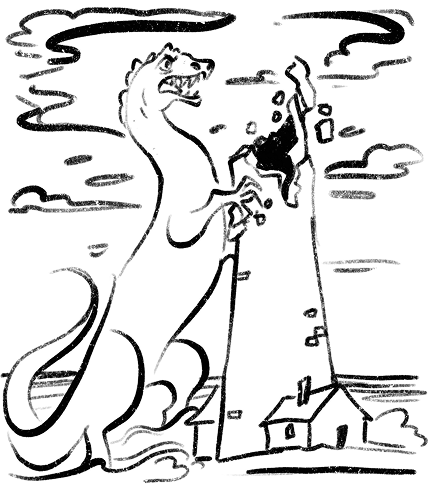
The Creature That Looks Like a Dinosaur, with a Massive, Fang-Filled Maw — from Ray Bradbury’s “The Fog Horn”.
A monster rises from a centuries-deep oceanic abyss, lured by the fog horn’s lonely call. An outcast. Infinitely, achingly alone. It is ready to destroy the lighthouse, to annihilate the very tower that failed to answer its profound, primal affection.
This fantastic hyperbole—a metaphor for the desperate human need for love—reads now like a prophecy. In the new millennium, loneliness would be officially declared a pandemic.
Bradbury himself openly admitted that his life’s success was, at its core, a love story. He would spend 57 years with his wife, Maggie McClure, until the very last breath of his Muse. By projecting his own hidden fear of a life lived otherwise onto this character, he transforms a deep-sea reptile into a truly amoral monster—vengeful, ruthless, and devastatingly real.
Discovery № 2
“An Enormous Black Cat, a Shot Glass of Vodka in One Paw and a Fork Spearing a Pickled Mushroom in the Other.”
One of Bulgakov’s strangest and most charming characters bears a fantastic resemblance to… Bulgakov himself. Peeking out from under the mask of this hero from The Master and Margarita are the unmistakable whiskers of the Author.
As anyone knows, this audacious Soviet satirist appreciated fine cuisine. He referred to his own apartment with Michelin-starred reverence as “the best tavern in Moscow.” A connoisseur of stronger beverages as well, Bulgakov was highly critical of the Soviet government’s attempt to redefine the strength of traditional Russian alcohol. In his diary, he penned a scathing observation about the newly released 30-proof vodka: compared to the Tsarist original, he noted, it was “ten degrees weaker, worse tasting, and four times more expensive.”
Understanding the writer’s firm, principled stance on this matter, we can’t help but believe the “enormous” black cat when he fervently denies his gastronomic “crime”: “Forgive me… would I ever allow myself to pour vodka for a lady? That’s pure spirit!”
The monster Begemot, embodying the sin of gluttony, has been known to humanity since the Biblical Book of Job. It is this very image that the author drags up from the abyss of time, using it as a vessel for his own confession. The reader, culturally shaken by the resurrection of this ancient terror from the collective memory, is now primed to sympathetically absorb every revelation. And gluttony, as it turns out, is far from the only sin Begemot—and his creator—is ready to confess.
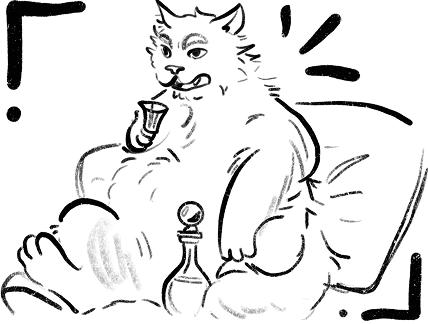
“And he’s writing, writing, writing! Can you imagine? And talking on the phone!” — This is how a minor character, Anna Richardovna, succinctly describes Begemot. In this self-portrait, the conspicuous detail acts as a confession in itself. The telephone. That same device was the trigger for one unpleasant call that split the writer’s life into “before” and “after.”
“Before” was Bulgakov’s desire to emigrate with his wife, remaining free in spirit. But then Stalin called. And “after” arrived—a life lived within the boundaries permitted by the authorities, the result of a bargain with his own conscience, struck in a moment of desperate weakness.
From the lines of the novel, we know exactly what was happening in the soul of this shapeshifting cat—and, likely, his doppelgänger on the other side of the textual mirror: “The night tore off Begemot’s bushy tail, stripped him of his fur, and scattered it in tufts across the swamps. He who had been a cat, amusing the Prince of Darkness, now revealed himself as a gaunt youth, a demon-page, the finest jester the world had ever known.”
Discovery № 3
A Monkey? Predictable.
Across centuries, this animalistic image has accumulated new meanings on each floor of the abyss of time. In terms of cultural associations, the monkey rivals Umberto Eco’s rose in density.
In Ancient Egypt, India, and China, reverence for these animals was elevated to the level of cult worship. In the Middle Ages, a veritable “monkey fever” swept through Western culture. The monkey was seen as an embodiment of the devil, a manifestation of passion and vice. The most striking exposé of this symbolism is Albrecht Dürer’s engraving “Madonna with the Monkey,” where the chained animal represents the taming of base, animalistic nature.
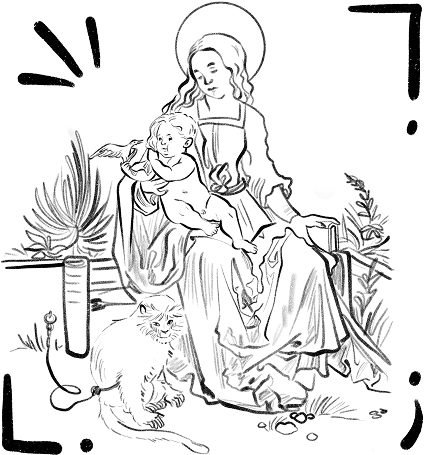
Curious, isn’t it? Who needed a primate in the age of space exploration and the dawn of the internet—a time when the chasm between humans and their Darwinian relatives seemed to widen? Or perhaps, instead of a chasm, a bridge appeared—one that led back to that very same animal nature.
The phenomenon of reversion to a primal state was explored by French writer Pierre Boulle in his novel Planet of the Apes (La Planète Des Singes). The author crafts a fantastic world where gorillas and chimpanzees hunt their own kind—humans—with unimaginable cruelty, conducting experiments on their captives. The narrative is told from the perspective of a victim of this strange planet’s “regime.” A cry of horror in the face of senseless, merciless brutality resonates through the text like an alarm bell, its sound escaping from beneath the cover of a work of science fiction.
The contrast between fiction and reality betrays the writer’s true intentions. During World War II, Pierre Boulle was captured by the Japanese—an ordeal, a hell created by humans who had sunk, in their atrocities, to the level of those very apes. He managed to escape. He went on to become a renowned science fiction writer. And through the voice of his hero, Ulysse Mérou, he warned humanity of the dangers of this reversion: “I entrust this manuscript to the universe, not to call for help. My only hope is that my story might perhaps avert the terrible threat hanging over the human race…”
Discovery № 4
The Enormous Three-Headed Dog Named Fluffy.
The merciless guardian of the Philosopher’s Stone in the Potterverse. Seasoned readers of the 1990s, already battle-hardened by their encounters with the monsters of Bradbury and Bulgakov, nonetheless waited in terror for the outcome of the unequal struggle between Harry Potter and the mutant dog guarding the approaches to the coveted stone.
What won the day? Music. The young wizard’s flute playing affected the hostile beast like a lullaby.
A familiar dynamic, isn’t it? An exact remake of the ancient “concert” scene where Orpheus lulls the three-headed Cerberus to sleep. Yet another monster successfully extracted from the abyss of collective memory—along with the Philosopher’s Stone itself, dredged up from a temporal layer just above: the Middle Ages.
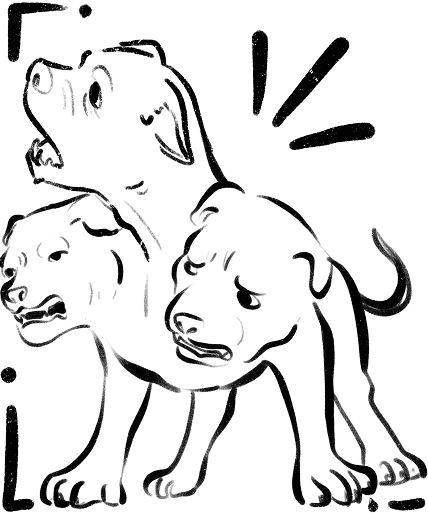
We know, we know—the encoded similarity between these two great dogs is an open secret. And it wasn’t literary critics who unveiled it. J.K. Rowling herself admitted in interviews that ancient mythology is the source of her boundless inspiration. Only the laziest reader would fail to draw the parallel. But where, in all this, is the thread of Ariadne that will lead us to the author’s true “I” and her revelations?
Let’s move to the next comparison: between two musicians. A “professional” and an “amateur.”
In ancient Greek mythology, Orpheus is the son of the muse Calliope. That alone says everything. With his virtuoso playing, he calmed the waves; with his unparalleled singing, he moved the Erinyes—the vengeful goddesses of the underworld—to tears. An impressive résumé, more than enough for ascension to musical Olympus.
Harry Potter couldn’t play the flute. He was incredibly lucky that Fluffy wasn’t a music critic and fell asleep to sounds far removed from any harmonious lullaby. Yet Harry still claimed the victor’s laurels. For him, it was the only chance to survive. Just as it was for the book’s author.
The fates of character and writer are inextricably linked. So much so that they even share a birthday: July 31st.
J.K. Rowling was working on the book from rock bottom: her mother’s death, a brutal divorce, poverty, depression. The Philosopher’s Stone—a miraculous object granting wealth and restoring life—was exactly what a woman on the edge of a breakdown could only dream of. Dreams came true, thanks to Harry Potter’s staggering success. Rowling became the first billionaire author in history. A self-fulfilling prophecy?
Every so often, the writer’s pen fishes costumes for fantastic beasts out of the abyss of time, draping them over the skeletons hidden in the author’s own closet. A dinosaur, Begemot, a monkey, Cerberus—that flicker of déjà vu is absolutely essential. It makes the reader believe: “We’re the same blood, you and I.” It allows the writer to take them by the hand and lead them into the quiet room of their confessional.
Every text is a dialogue with the reader, merely postponed in time. A heart-to-heart in an atmosphere of trust. The conversation will happen, and the book will be called genius, if it contains a measure of truth—that is, the author’s authentic “I.” Bradbury revealed this unbreakable law for writers long ago in his famous work, Zen in the Art of Writing: “The time will come when your characters will write your stories for you, when your emotions, freed from literary pretension and commercial taint, will burn the page and tell the truth.”
While living organisms undergo translocation, deletion, and duplication, we offer scientific knowledge without mutations – only useful discoveries and theories.
Thank you!