Category: Materialization technologies
How to surprise Apollo: a modern guide to anti-art practices
“Art has always been a metaphor for reality”
Yuri Bondarev
“Apollo is full of apathy”—the grim news spread swiftly across Parnassus. The golden lyre of the Olympian beauty had fallen silent. The cause of the patron of the arts’ melancholy was clear to all of creative Greece. A crisis of inspiration was looming over the ancient world.
In vain, at the foot of the mythical mountain, poets tore at the strings of their souls, competing for the title of the greatest. The son of Zeus merely yawned. The laurel wreath meant for the victor remained in the hands of the arbiter of public taste. Apollo returned to his abode in a foul mood.
The hushed Muses gathered around their leader in a tight, anxious circle, awaiting a storm.
Instead, through the opening of a nonexistent door appeared a flushed Heracles in the company of Pegasus.
The sight of the winged horse summoned a faint, sorrowful smile on Apollo’s eternally youthful face.
“I borrowed him from Bellerophon for a couple of days,” the hero nodded toward the rusty steed. “To lift the creative spirit in your stagnant antique swamp. You’ve sunk up to your kithara in harmony and its canons, dragging several generations of followers down with you. Is there truly nothing more aesthetic than the past?”
“How dare you speak to me so insolently?” Apollo thundered, his eyes flashing as he became the very image of his famous father.
“I can’t bear to watch art wither. It makes me itch for a feat. If it weren’t for the Hydra and other mythological vermin, I would have devoted all my strength to fighting the ‘Apollonization’ of the Renaissance. Your Delphic temple would have been in ruins long ago. It was time for the Renaissance to stop loudly mourning the ruins and move on. Alas! Aesthetic tears do not dry so quickly. Artists continued to dream of the ideal proportions of your Olympian body. We find clones of Apollo in Raphael Sanzio and Andrea Mantegna—recognizable images in familiar ‘Muse-filled’ surroundings, with colorful hints that only the Beautiful is destined to become an eternal Masterpiece.”
“I only wanted what was best,” the son of Zeus muttered, embarrassed.
“‘Wanted’—you alone, or whoever hides behind you. And ‘what is best’—no one knows that. Not even you. Of your nine Muses, six are occupied with poetry. Under such ‘artistic leadership,’ there is no room for the prose of life in art. The Delphic temple, let me remind you, has long been destroyed. No one is in a hurry to rebuild it. Man does not live by Ideals alone.”
“What am I to do now?” A very human wrinkle of bitter contemplation suddenly appeared on the beautiful brow of the golden-haired youth.
“Come down from Parnassus to earth. I’ll introduce you to Anti-Art. Let us consider this my thirteenth labor—how symbolic!”
Mounting Pegasus, who was clearly displeased with this turn of events, the two interlocutors set off on their journey.
Stop One. Meeting the Anti-Artist
“On the crest of the ridge along which a great artist moves forward,every step is an adventure,the greatest risk”
Albert Camus
“We’ve arrived. In the age of the ‘cancellation’ of art,” Heracles said, helping his shivering companion—now wrapped in a tracksuit jacket bought along the way—down from the winged horse. “Come, I’ll introduce you to Marcel Duchamp—the Anti-Apollo of the new millennium. And please, try not to let your kithara jingle. Not everyone considers your hymns music anymore, and the Master is busy.”
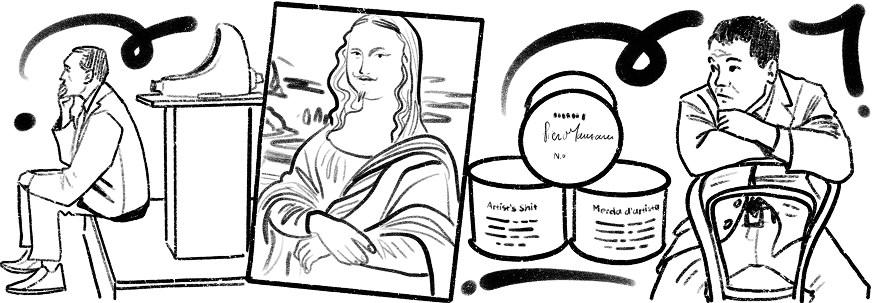
“Busy with what?” Apollo scoffed. “Mocking the masterpieces of old masters like da Vinci? Was the ‘Bearded’ Mona Lisa his doing? He won’t receive another laurel leaf!”
“Temper your zeal. Only Homer still fears your threats. Even modern Greeks no longer believe in you—let alone the global art community. As for Duchamp’s ‘madness,’ I must disagree with you. He was one of the first to bravely venture on a hunt for meaning into the beautiful yet impenetrable forest of classical aesthetics. Instead of a laurel wreath, the reward for his courage was hundreds of thousands of dollars paid at auction for one of the many copies of the Mona Lisa with a beard and mustache.”
“He’s bluffing! By that logic, the Augean stables could be called a museum—just frame some manure!” Apollo laughed melodiously, and the perceptive Pegasus answered with a cheerful neigh.
“You can be witty when you want to. I was beginning to doubt whether you still had a drop of proactive creativity in you. But you’re too late—the ‘manure’ genre is already familiar to the public.”
“???”
“The Italian artist Piero Manzoni beat you to it. With the noble intention of opening the viewer’s eyes to what often hides behind the resounding word ‘art,’ he sold cans labeled Artist’s Shit—priced, incidentally, like gold. And you know what? Over time, those ‘cans’ have risen significantly in value.”
“So a rebellious fit of rejecting the Ideal has now been elevated to the rank of Art?”
“This is not a matter of episodic rebellion—it’s more of a pandemic-level, sustainable trend. There’s a bit more bread now, thanks to the industrial revolutions. What people want next is spectacle—topical, provocative. Aesthetic hunger has driven yesterday’s passive spectators out onto paths leading toward an understanding of what unfolds on canvas, stage, and page. It’s naïve to think humanity will forever reheat frozen black-and-white mythologems about gods and heroes—though, to be fair, that kind of fast art does still pop up. Anti-art is created here and now, by those capable of revealing something new to an audience frozen in anticipation of an answer to the uncomfortable question of life’s meaning. Mastery of the paintbrush is not required. Duchamp’s anti-artistic feat lies in discovering—exposing—the artistic essence of everyday consumer objects. His famous readymades—ordinary objects signed by the Artist—are works with low conventional aesthetic value and immense conceptual weight. His urinal alone, titled Fountain, says it all.”
“So everyone is their own Apollo?” the resident of Parnassus raised his brows in astonishment. “Is that even possible?”
“More than possible. Let’s move on. I can see the viewer is ready—and you too—to perceive anti-art practices.”
Stop Two. Meeting the Anti-Masterpiece
“Modern life is a sacrilege against art;modern art is a sacrilege against life”
Alexander Blok
“Confess, my friend—does dance still live? And where may I taste the bitterness of tragedy here?” Apollo scanned the chaos of urban development, unable to find the familiar architectural dominance of a theater.
“I’ll say this: little remains of Aeschylus. But please, don’t lapse into Olympian hysteria just yet. Anti-art cracks the shell of form for the sake of meaning’s embryos. I can’t present oppositional art practices to you systematically, like an alphabetical entry in the Great Soviet Encyclopedia. Here, no one ‘canonizes’ modes of creation, genres, or techniques. The Idea is what matters. Take Vasily Kandinsky, author of the manifesto On the Spiritual in Art: he saw no boundary between painting and music. Look—and listen. His Composition VI, a ‘painting’ in the traditional sense, in fact sounds like an entire orchestra, where each instrument performs a specific color spectrum.”
“So from now on, music is given to us only in color?”
“You’re like a child—still unable to play in the sand without molds. Anti-music can also be perceived differently—as an unwritten book. That’s how the avant-garde composer Pierre Boulez saw it. This outstanding musical innovator drew inspiration from the poet Stéphane Mallarmé and his aesthetics of indeterminacy and fluid form. Boulez’s experimental work, ‘perpetually in the process of becoming,’ is his Third Piano Sonata: its individual fragments may be performed in any order. Care to listen?”
“I’ll refrain, I think.”
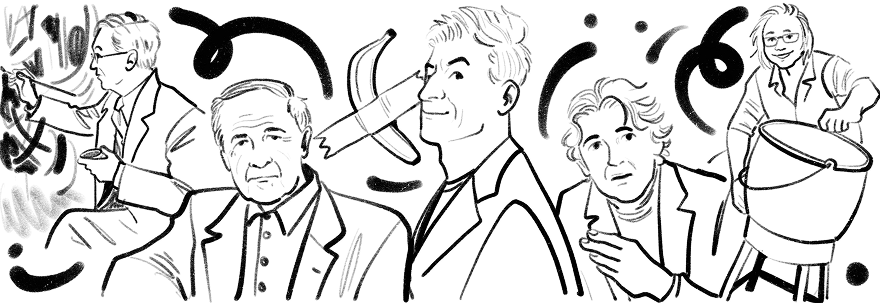
“And that’s perfectly acceptable! The ‘factory settings’ of the Anti-Masterpiece allow for outright vandalism, not to mention rejection. Maurizio Cattelan’s provocative work Comedian—the infamous ‘banana taped to a wall’—has been eaten and restored several times over the six years of its existence. An Anti-Masterpiece can be consumed not only with the eyes.”
“Blasphemy!”
“Not at all. In the space-time of Anti-Art, the Artist and the Viewer engage in dialogue as equals. This is the new ‘aesthetics of interaction,’ articulated by critic Nicolas Bourriaud at the end of the twentieth century. There is no longer a Master hiding behind the mask of a masterpiece before which the public bows. You could sample the exotic dishes of Thai artist Rirkrit Tiravanija: a representative of third-millennium ‘relational aesthetics,’ he prepares them directly in the museum. Guess what the art object is here? Not the contents of the frying pan (even if it holds a banana), but the shared meal itself. The social relations created become the artistic image within art-time.”
“I see it clearly now. Art no longer exists. Everything has merged into one great mass,” Apollo said, tightening his lips as he mounted Pegasus, bewildered by what he had seen.
“In times of upheaval, life knots itself into a tangled ball. Anti-art pulls Ariadne’s threads from it ‘on demand’—at the request of a viewer reflecting on their own existence,” Heracles tried to justify all oppositional artists at once. Finding no further arguments, he followed silently behind the tail of the mythical horse.
Stop Three. The Final Stop
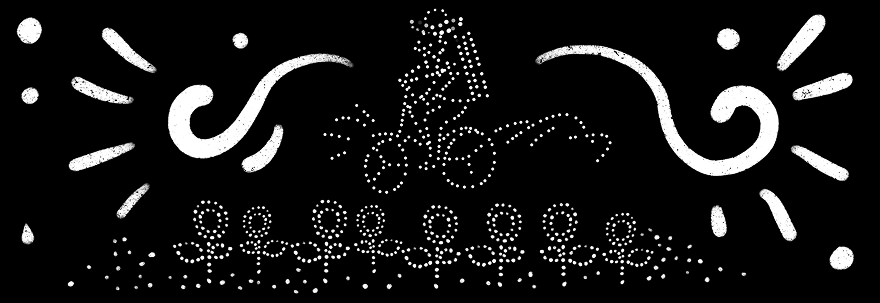
“One thing remains unclear: what legacy will you leave to posterity? Nothing but performance. You live for the day!” Apollo exclaimed, stopping to admire Van Gogh’s animated Sunflowers reproduced in the sky by Chinese drones.
“Exactly! No one knows how long Anti-Art will last. Perhaps we’ll return to you someday. It has happened before: in the 19th century, the French suddenly turned to Parnassianism. An entire generation of poets, led by Théophile Gautier, ‘caught’ aestheticism again, obsessed with form at the expense of social content. But for now, we’re immune to art for art’s sake… Is it time to say goodbye?”
“I’m with you!” Pegasus shouted, tossing his rider off.
The cell divides into the nucleus and cytoplasm. Our journal divides into interesting facts and discoveries.
Thank you!