Category: Cognitive technologies
How to Learn Mental Math Without Screwing It Up
“Hello there! Hello there! Glad to see you, curious friend so true!
I bet you’re proud of yourself, a tech expert through and through!
You’ve grasped the power of science, you can read and write,
Twenty issues of the journal keep you from the night!
You know your physics, signs, inventions, secrets to be found,
You take things apart and build them up, never feeling down!
But when it comes to counting, you’re like a fish out in the pond,
Put that calculator down, or trouble will soon respond!
In school they told you: ‘Count by columns, silly brain!’
Now your mind’s stuck in the maze of numbers, feeling strained.
If 10 plus 10—oh, the column will do just fine!
But what if 115 and 116 combine?
Here, columns won’t help, you’ll need to use the rule,
Imagination’s your key to collecting numbers cool.
Don’t fret, we’ve got advice to help you reach your prime,
Physicists—they’re clever, but advice is worth the time.
Here’s the answer, friend, it’s clear and bright:
‘Round it up to the nearest ten, it’s right!’
And after that, don’t delay,
Subtract the extras right away!”
What on earth is going on, ladies and gentlemen? Just look at this. Take an ordinary citizen. He lives his life. He reads, say, serious magazines. Studies physics and the like, can fix an internal combustion engine, believes in omens, puts all kinds of charms on his business—you couldn’t pry them off with a crowbar! Maybe he’s even held a telescope once, peered through it at the Milky Way stars. In short, a well-developed individual, so to speak.
And everything in his life seems to be in order. Career—check. Personal dramas—check. His phone is the latest model—slim, shiny, mind-blowingly advanced. But, pardon me, adding two numbers together? That’s a problem. A real catastrophe, if you please.
It’s fine if the cashier peers straight into his tightly packed wallet and purrs, “That’ll be exactly fifteen hundred.” But what if they don’t? What if they don’t take a look?
Then our citizen stands there, wiping sweat from his brow with his sleeve, trying to add numbers in columns, knees going soft inside his trousers. “How do you even add 48 and 67? I mean, how? And what if they realize I’m this big important business type, and here I am—excuse me—tripping over basic arithmetic. I’ll never live down the shame and ridicule!”
And the worst part is, honestly, that his brain is perfectly fine. Not some cheap knockoff—an authentic, biological brain. Not silicon, but the real thing. And it worked flawlessly for years, right up until the moment it was asked to add 48 and 67 in his head.
Naturally, we can’t just stand by and watch this outrage. Respectable citizens are meant to be educated through popular science magazines like ours, so they can finally be freed from calculator dependence. There are, as it happens, several methods of quick mental arithmetic, and all of them are—no exaggeration—as simple as two times two equals four (we couldn’t resist, we confess).
So fine, we’ll teach you how to storm large numbers in your head. Have a seat on the bench—we’ll be forging new neural connections and fondly recalling teachers with their column addition and a choice word or two.
The first thing they never explained in math class is this: to add large numbers in your head, you need imagination.
The brain clings to round numbers like a life buoy, because they’re clearer, nicer, friendlier, and much easier to add. That’s just how people are wired: no one expects trouble from a round cat (all it can do is roll from side to side—what kind of mischief is that?), and no one anticipates disaster from a round, easygoing neighbor. So we’ll put this habit to work at full throttle. Like round numbers? Great—round everything!

48 is almost 50
67 is almost 70
See? The dizziness is already gone, and that awkward fear of big numbers has magically disappeared.
5+7 = 12
So, logically:
50+70=120
At this point, you’re even allowed to straighten your tie. After all, you’ve just added two hefty numbers in your head without once thinking about a calculator! Sure, you cheated a little—but hey, no calculator, right?
Where did you cheat? When you rounded a second ago.
48 is almost 50 (we added 2)
67 is almost 70 (we added 3)
That’s a total of 5 extra
And do we really want to hand out fives left and right? Of course not. Let’s take our precious five back.
Almost 50 + almost 70 = 120
Now subtract the hard-earned five:
120 – 5 = 115
48 + 67 = 115
That’s it. Done. No sweating required. Honestly, you can check it on that cursed little button machine if you want. Notice something else? We never actually worked with 48 or 67 directly.
Want to lock in the win? Be my guest. What’s 298 + 567?
Why are you stomping your feet again like steam’s coming out of your ears? On the one hand, we launch satellites to Mars; on the other, we trip over two-digit math. The principle is exactly the same!
Fatten up 298 to a nice round number (it becomes 300).
Leave 567 alone (feeding that one would take too long, and then you’d have to starve it back down).
Now just add. Zeros don’t need any help—just repeat the other digits like a broken record and you’re done.
300 + 567 = 867
Now subtract the little 2 we invested to fatten 298 up to 300.
300 + 567 = 867
867 – 2 = 865
So: 298 + 567 = 865
That’s how easy it is. Math with zeros is ridiculously simple. Now you can brag to your neighbor’s spaniel that you can crunch big numbers in your head without even needing its intelligent stare. Give a condescending little snort and announce the result.
Although, to be fair, the spaniel obviously does mental math perfectly well—otherwise how would it know exactly when it’s time to be fed?
The second thing they never explained in Math class: division and multiplication are about weighing thoughts, not all this nonsense.
Our brains freeze in front of long numbers like a rabbit in headlights. But they love clear, manageable chunks. Instinctively, the mind looks for something solid to grab onto—a convenient unit of measure—anything to keep from drowning in a flood of digits.
And yet, once upon a time, simple operations didn’t scare you at all: breaking off a third of a chocolate bar, giving away half a cookie, dividing apples evenly. So why does calculating the price per 100 grams suddenly feel terrifying?
The situation is frankly humiliating. A citizen stands at the counter, staring at a price tag: 4.8 dollars per kilo, and instantly feels like a complete fool. Maybe he only needs 300 grams. Or worse—exactly 350, because guests showed up unannounced and the fridge is painfully empty.
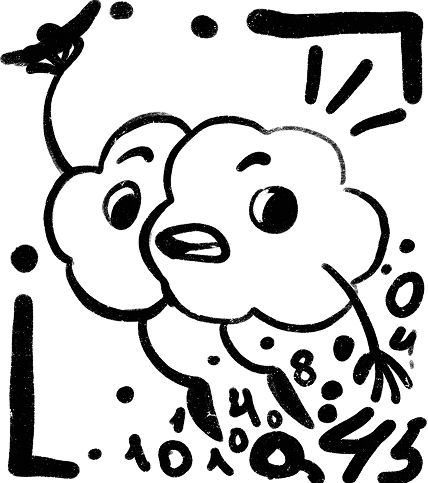
And now he’s already reaching for his phone to calculate how much his family will judge him for spending, while nearby shoppers watch these maneuvers with the same indulgent pity reserved for someone tangled in their own shoelaces. How many grams are we weighing out, exactly?
The first thing to do is cover the hateful zero with your palm:
480 cents per kilogram is the same as 48 per 100 grams.(To get the price per 100 grams, divide by 10.480 ÷ 10 = 48. Or just drop the zero)
Now we start weighing thoughts:
350 grams is three lots of 100 plus a half.
That means:
3 × 48 and 1 × 24
If you’re on good terms with multiplication, you can multiply 48 by 3 right away. But if you mix up left and right, forget to turn off the living room lights, leave your keys in the car, and keep the balcony door open—don’t risk it. Just round 48 up to 50. Measuring out three fifties is much easier.
50 + 50 + 50 = 150
True, now we’ll have to take back the three twos we invested in rounding.
2 + 2 + 2 = 6
150 – 6 = 144
That’s the price for 300 grams. Now add half of 48—that is, 24.
144 + 24 = 168
So if a kilogram costs 480 cents, then 350 grams will cost 168 cents or 1.68 dollars. Sure, we’d all like it to be cheaper, but we don’t set pricing policy. We’re just learning how to count in three mental steps—faster than the brain has time to panic.
Which means that math, essentially, is the ability to find a convenient chunk of reality—whether that’s 100 grams of sausage or 100 grams of true happiness. Because really, it’s not about numbers at all. It’s about the simple confidence that your own head is more than enough.
The third thing they never explained in Math class: multiplication is like filleting a herring so you don’t choke on the bones.
A normal person, seeing 16 × 25, immediately thinks about debts, inflation, and how dinner will once again be unaffordable. Sixteen portions at 25 dollars each—no joke.
The numbers themselves aren’t pleasant. Sixteen is tolerable, but twenty-five is already one of those figures that can trigger mild existential sadness. The problem is that the brain takes it as a whole and has no idea what to do with it. Is sixteen good? Or nauseating?
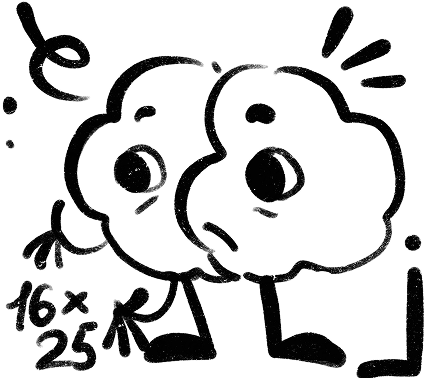
To avoid falling into a financial pit right outside the restaurant, you need to break 16 apart—like a matchbox. Inside, you’ll find four fours.
16 = 4 + 4 + 4 + 4
Why ruin such a nice number? So you don’t have to multiply 16 by 25. Instead, you just multiply 25 by 4.
25 + 25 = 50
50 × 2 = 100
25 × 4 = 100
Now take that result—100—and multiply it by the remaining four you pulled out of 16. More tricks? Not this time.
The point is that in the “doubling and breaking down” method, we work with factors, not raw numbers. And 4 is a factor of 16.
100 × 4 = 400
Which gives us:
16 × 25 = 400
Clean and elegant.
Sure, skeptics will say: “Why all these tricks? Technology is easier.”
But, dear citizens, this isn’t about arithmetic. It’s about moral satisfaction. When you dismantle a heavy number in your head, your self-esteem shoots through the roof. You almost feel like going to city hall and writing “mental arithmetic acrobat” under occupation.
And if the lady you’re dining with turns out to be trickier, and the waiter is already approaching with the bill—do the same thing. Say you need to multiply 36 × 15.
Strip 36 down to its essence and discover six sixes. Take one six and pair it with fifteen.
6 × 15 = 90
(or: 15 + 15 = 30, then 30 × 3 = 90)
Now multiply 90 by six. Ninety times six is 540.
9 × 6 = 54
90 × 6 = 540
So:
36 × 15 = 540
Too easy? Exactly. Why complicate life when you don’t have to? In the end, all these tricks exist for one simple reason: to keep your inner balance intact. To avoid drowning in numbers, all you need is one solid four to grab onto.
You leave the restaurant full and spiritually enriched. And your companion looks at you with fresh interest—as if you’re a mathematical virtuoso extracting hidden poetry from numbers.
Because happiness isn’t about counting money. It’s about counting it faster and more elegantly than everyone else, with the faint smile of a refined intellectual who was simply solving a little problem for fun.
The fourth thing they never explained in Math class: numbers are as flexible as words.
Sometimes life forces a person to multiply two perfectly ordinary two-digit numbers. Not out of joy, of course.
Picture a homeowners’ meeting. The chairman announces: “We need 23 cans of paint to renovate the stairwell. Each can costs 41 cents. Can anyone quickly calculate the total?”
Silence. Museum-level silence. One person pretends to tie a shoelace. Another fakes a sneeze. A third claims their ears are ringing from a draft.

Why? Because multiplying 23 × 41 feels like science fiction for the average mind. Long multiplication takes time—and looks shameful. People might think you’re ignoring vital civic matters and threaten you with a mop.
To avoid such situations, there’s a simple rule: vertical cross-multiplication. Sounds like macramé instructions, but numbers are flexible—you can weave anything from them.
Take the rightmost digits:
3 × 1 = 3
Half the job is done.
Now multiply crosswise:
2 × 1 = 2
3 × 4 = 12
Now let’s add up what we’ve got:
2 + 12 = 14
Remember the 4. Keep the 1 in your pocket, like spare change.
Now multiply the leftmost digits:
2 × 4 = 8
Add the saved 1:
8 + 1 = 9
Read the result bottom-up: 9-4-3. “Comrade Chairman, the total is 943 cents!”
The chairman nervously checks the calculator. And you’re no longer a confused bystander—you’re someone who understands how numbers bend.
That’s the price of knowledge: not columns on paper, but public respect.
The fifth thing they never explained in Math class: tens should stick with tens. Units should stick with units—no freelancing.
Suppose a citizen shows up to collect his hard-earned 73 dollars, and accounting hands him 49. He just stands there, as if scalded with boiling water. How is that possible? He’d already mentally divided those 73 dollars between bread, milk, and the tram fare—and now suddenly it’s a sign here, here’s 49. So how much did they short him? His heart senses trouble, the numbers scatter, and his vision even starts to blur. Should he make a scene, or forgive accounting their miserable little mistake and say, c’est la vie?

That’s exactly the moment when the average person feels like a complete bungler who doesn’t even know his own rights. And yet the whole problem is this: instead of subtracting 73 and 49 directly, these numbers need to be sent to opposite corners—like misbehaving schoolboys.
We separate the aristocrats—the tens—from the commoners—the units:
70 – 40 = 30
Everything is perfectly civil—no one even raises their voice.
Now we deal with the small change:
3 – 9 = -6
There’s a slight awkward moment here, of course—but we’ll take it into account.
Now balance it out:
30 – 6 = 24
So it turns out the citizen was shorted a full 24 dollars. Now he can demand what’s rightfully his with a clear conscience, scolding accounting for their carelessness.
Too small a catch? What if instead of your honestly earned 542 you’re handed 278? What then? Exactly—pair hundreds with hundreds, tens with tens, and units with the small change.
542 is 500, 40 and 2
278 is 200, 70 and 8
Now let’s count it:
500 – 200 = 300
40 − 70 = −30 (an awkward moment again)
2 − 8 = −6 (and again)
Now we add up all the negative bits:
30 + 6 = 36
And balance it out again:
300 – 36 = 264
A full 264 hard-earned dollars! That’s enough to march straight to court against all those number-crunchers who balance million-dollar reports while munching on cheeseburgers.
And now you’re standing there no longer embarrassed, but confident in your rightness. Accounting looks at you with newfound respect, and even the line by the water cooler falls silent. Because in this country, people don’t respect those who shout the loudest—they respect those who count faster and quieter. That’s real culture: knowing how to stand up for your interests without unnecessary noise or fuss.
The sixth thing they never explained in Math class: numbers want to talk.
Our brains, it must be said, have a deep dislike for fractions. The moment they see something like ¾ + ⅖, it’s as if they run straight into a glass wall. With whole numbers, at least something makes sense—you can turn them over in your head, round them, break them into pieces. But here, pardon us, it’s two numbers in one, with a cursed line between them.
So it turns out that a grown adult, stumbling upon a recipe with fractions in a cookbook, suddenly feels like a failed schoolboy—as if he’s not about to bake a cake from the internet, but to sit a hated exam. And that, between us, is a long and humiliating procedure.

And so, instead of delighting the household, he spends the evening in painful attempts to add three quarters to two fifths, casting melancholy glances at the oven.
The secret, it turns out, is that there’s no need to force ¾ and ⅖ to a common denominator. You just have to let them talk to each other directly—crosswise.
We multiply the numbers crosswise, letting each fraction speak through the other’s denominator:
(3 × 5) + (2 × 4) = 15 + 8 = 23
That’s how the first agreement is reached—the numerator.
Next, the witnesses need to come to terms with each other—the denominators.
They simply get multiplied:
4 × 5 = 20
And so we arrive at the final harmony—without whipping the numbers into shape or forcing them into the result:
23/20
The denominator 20 is one whole pie cut into 20 slices. The numerator 23 means 23 such slices. We take one whole pie (20 slices), and we’re left with 3 extra pieces.
23/20 = 20/20 + 3/20 = 1 and 3/20 or one full cup of flour plus three generous pinches on top.
That’s how it is, dear citizens. It turns out we’re forever searching for a common denominator—with the neighbor in the parking lot, with our boss at work, with our own spouse. We rack our brains trying to squeeze ourselves into someone else’s rules, to fit our essence into the Procrustean bed of shared norms.
But all that’s really needed is to speak directly—to multiply your soul with another soul, your thoughts with someone else’s thoughts. Let the result be 23/20—not a perfect fraction, but an honest one. And your own.
And then that humiliating dependence disappears—on other people’s recipes for happiness, on imposed rules of behavior, on your former helplessness in the face of two simple numbers separated by a line.
The seventh thing they never explained in Math class: real arithmetic begins where fear ends.
All these clever calculations—addition, subtraction, and other mental gymnastics—are just warm-up exercises. Real mathematics begins where the ordinary person is left alone with a quarter tank of gas, one can of paint for an entire building, the eternal question of “how many grams should I get?”, ten dollars to last until payday, and the need to stretch them across four days.
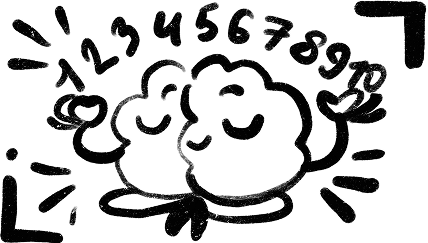
You probably think the main thing is to reread the article a few times and master every technique of fast mental arithmetic. But we’ll say it differently: the main thing is to finally stop being afraid of numbers. To stop seeing them as something hostile, forever throwing down a challenge.
Our practical advice is simple: try living one full day without a calculator. At all. When you buy herring, estimate the price in your head. When you pay for transit, count the change without your phone. When you go to a restaurant, surprise the waiter.
At first it will be hard, because a brain unaccustomed to real work will be lazy and will sabotage every attempt. But after a day or two, something remarkable will happen: numbers will stop being abstract. They’ll fill up with meaning, with weight, almost with flavor. Three cents will be a cup of sunflower seeds. Thirty-three cents will be two tram rides. Three hundred thirty-three cents will be more than half a liter of sunflower oil.
And then you’ll understand the most important arithmetical truth of all: mental math is for clarity—for knowing exactly where you stand, how much you have, and what you can count on.
In that sense, arithmetic turns out to be far more important than many lofty sciences, because no philosophy can give you the feeling of solid ground under your feet that the simple ability to count in your head can.
Your thought is a big bang of ideas. Our journal is its source.
Thank you!