Category: Cognitive technologies
Why Do We Only Trust Ourselves?
“Gather ten paranoids together, and you’ll get ten different but equally convincing theories”
Nassim Nicholas Taleb
We’ve learned to edit the genome like a high school essay, sent rovers to Mars, and carry in our pockets computers that, back when Gagarin went to space, would’ve filled a hangar and needed a crew of twenty engineers to run. Progress is undeniable: it rustles in packaging, hums with cooling fans, and hands us an extra thirty years compared to what our great-grandmothers got. But scroll through the comments under a post about the health benefits of apples, or if you have nerves of steel, dive into a neighborhood parents’ chat—you’ll step through a portal into an alternate reality that would make Dante’s Inferno look like a boring office party. It’s a full-blown holy war against “chemicals,” a witch hunt armed with nitrate testers, and the tireless decoding of secret government messages supposedly hidden in toothpaste. How did it happen that a species which mastered the atom is now terrified of eating yogurt? And more importantly—who keeps fueling this fear, and why?
The Anatomy of Distrust: How Science Undermined Its Own Credibility
You’d think we’d have every reason to trust science. Yet, public faith in it is melting faster than last year’s snow on a hot skillet. And the roots of this distrust go deeper than they appear.
It’s not that people have gotten “dumber.” The real issue is our brain—an ancient cave dweller trapped inside a modern skull, evolutionarily wired to spot danger first. It couldn’t care less about ten thousand flawless flights; they’re just the baseline, leaving no mark. But one single crash, and the synapses light up: “Flying is deadly!” Bad news sticks to our memory like glue, while good news evaporates. When 99.9% of food is safe, we eat in silence. But let one watermelon turn out to be a nitrate “surprise,” and the news spreads faster than a rumor about an impending salt shortage. This is how a virtual apocalypse takes root in our minds, where food becomes Russian roulette and the air is nothing but exhaust fumes.
Added to this natural bias is the distortion amplified by the media. Science, by its very nature, isn’t a collection of truths carved in stone. It’s a messy, ongoing process of inquiry: “Yesterday we thought one thing, but today new evidence suggests the picture is more complex.” Try explaining that in the format of a news feed, where clicks and views are king. On Monday, a killer headline drops: “COFFEE CAUSES CANCER, SCIENTISTS PROVE!” By Friday, an equally confident retraction follows: “SHOCK STUDY: COFFEE COMPLETELY CURES CANCER!” The reader, who has spent the intervening four days panicking, downing valerian root, and giving away their last bag of beans to their enemies, reaches the only logical conclusion: scientists are just frauds who don’t know what they’re talking about.
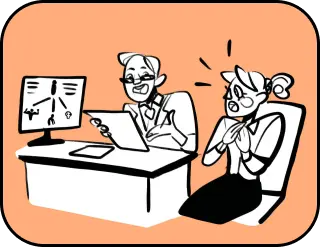
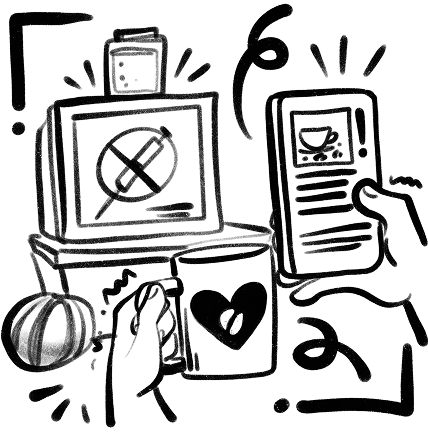
But there’s a third factor, perhaps the most bitter one. It’s tied to how science presents itself to people on a personal level. When your family doctor, instead of prescribing an affordable and effective generic, pushes a pricey brand-name alternative (because of a “deal” with a pharmaceutical rep), you feel less like a patient and more like a wallet. This feeling of betrayal cultivates the very soil in which paranoia flourishes. “If they ripped me off on aspirin,” the thinking goes, “then they’re probably lying about vaccines, too, and GMOs are a conspiracy, and hey, maybe I’ll put a jug of water on my TV to let it charge with positive energy.” The corruption and incompetence of a few individuals within the system end up discrediting the very pursuit of truth. And that is the most irreparable loss of all.
A One-Way Journey
This train, running on the “I Don’t Trust Anyone” line, has clearly marked stations. Where’s your ticket take you?
First Station: Blissful Apathy. This is the land of lost innocence. People here still eat mayonnaise, drink tap water without a second thought, and vaguely trust that the health authorities wouldn’t warn them for no reason. It’s a paradise we’re about to be exiled from the moment we decide to take that next step.
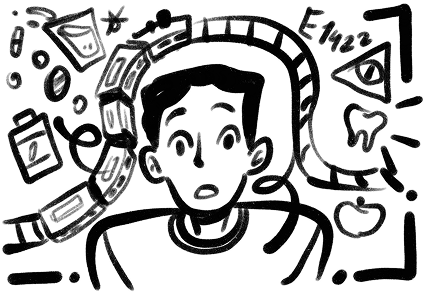
Second Station: Anxious Awakening. Things get exciting here, albeit a bit stressful. This passenger has started reading yogurt labels and recoils in horror at the mysterious “E1422.” They Google the side effects of Vitamin C and buy dietary supplements because the pharmacy only sells “chemicals anyway.” The truth feels tantalizingly close, but its outline is still blurry, so the passenger frantically tries to bring it into focus.
Third Station: The Final Stop. Welcome to a world of its own, complete with new laws and rituals. Food is screened with nitrate testers, water gets its “energy” from pyramid schemes, and dentists are part of a global conspiracy to ruin perfectly good teeth for the sake of selling fillings. Humanity is split into two camps: the “sleeping sheep” and the few who have “woken up.” The relentless pursuit of truth has become a full-time job, the very meaning of life. There’s just one problem: happiness is strangely absent. The world, in fact, has become a cramped and hostile place.
The Fear Industry
At this point, it’s worth pausing and asking a simple question: who actually profits from our fear? Fear is a commodity, just like oil or gas, and it has its own massive infrastructure.
Look at the barons of alternative truth. They sell you celery juice at a premium price, plastered with a “NO CHEMICALS” label. The irony, of course, is that the celery, the water, the vitamin C—it’s all pure chemistry. It’s just that, at some point, a clever marketer realized that if you make everything complex and unfamiliar sound scary, you can print money. And so we terrify each other with “E-numbers,” forgetting that a single ordinary apple contains a whole freight train’s worth of these substances. But the word “organic” works like a magical incantation. You’re not just paying for food; you’re paying for an indulgence. It buys you the right to five minutes of not being afraid. The fear, of course, always returns, demanding another dose of “pure” products.
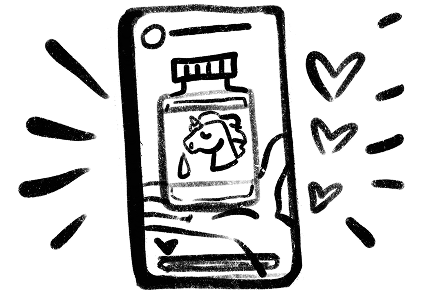
Another cog in this machine is the wellness guru. A regular doctor will honestly shrug and say, “The cause is unclear, we need more tests, it’s complicated.” This uncertainty is terrifying; it leaves a person feeling alone and vulnerable in a chaotic world. But a guru, silhouetted against a sunset, declares with absolute certainty: “I know the ancient secret of the Tibetan lamas! Drink unicorn urine!” He offers an illusion of control, a simple, graspable narrative. And people are willing to pay for that certainty, even if it’s false. They pay handsomely.
The Real Cost
The saddest part of this whole story is that paranoia comes with a very real, tangible price tag. And it’s not just paid in frazzled nerve endings.
Forgotten diseases are making a comeback. Measles, which we had nearly eradicated, is once again knocking on the doors of children whose parents are staunch anti-vaxxers. People are going bankrupt on useless detox programs, squandering precious time and delaying a visit to an oncologist until the point where medicine is powerless.
But there’s another cost, too: the toll on human connection. Being friends with someone who sees a conspiracy in every atom and considers tap water a weapon of mass destruction becomes a true test of endurance. Paranoia corrodes not only the person, but their relationships as well.
A Lifeline for Those Drowning in Conspiracy Theories
We’re not suggesting you throw your hands up in despair and live on freshly mowed grass, washed down with cola and a prayer. Skepticism is normal, even healthy—it’s the engine of inquiry. But there’s a fine line between healthy doubt and a clinical distrust of reality. Three simple rules can help you stay on the right side of it.
The first could be called Occam’s Razor for Boring People. If you’re promised a secret that “governments are hiding,” “they won’t show on TV,” and “doctors are silent about”—you’re most likely dealing with nonsense. The truth is boring. It lives in open access on the WHO website, gathering dust because no one reads reports that don’t blow their minds. But it’s precisely in that boredom that credibility lies.
The second rule is: Trust, but verify the diploma. Your level of trust should match the speaker’s level of competence. The opinion of a fitness blogger about vaccines carries zero weight, while the consensus of a community of oncologists or virologists carries a great deal. Don’t confuse a blogger with a scientist, even if the former has a magnificent beard and films their content from the Maldives.
The last, and perhaps the most difficult, is to make peace with reality. We are all mortal. It’s an unpleasant but functional fact. The question isn’t how to live to be a hundred and fifty by dining on dew and prana. The question is how not to destroy your nervous system in a frantic pursuit of phantom safety. The odds are, you and I won’t die from the GMOs in our yogurt or the fluoride in our water. It’ll be something far more prosaic: lack of exercise, chronic stress, or just a particularly unlucky twist of what we call fate.
Instead of an Afterword
The real crisis of our time is that we’ve fallen out of love with complexity. We want the truth to be as simple as a nail, and as loud as a coin clinking in a charlatan’s pocket.
Science, in contrast, asks us to lift heavy stones, to doubt, and to admit that we don’t know anything for certain. It’s hard work, with no guarantee of results. Fear offers an easier path: just be afraid, and feel righteous. Righteous always, everywhere, and under any circumstances.
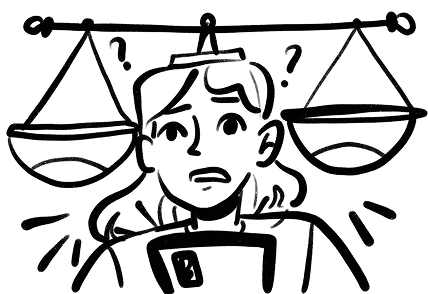
So here we stand at a crossroads. On one side: peaceful ignorance and the cozy myth of a global conspiracy. On the other: the anxious, painstaking, but honest effort to understand how the world actually works.
We don’t know which path you’ll choose. But if you ever find yourself chasing the truth in videos posted by dubious gurus, at least check if they have a medical degree. And if they don’t, ask yourself: why would you trust your health to someone who never passed an anatomy exam? Just a thought. Nothing to see here. No conspiracy.
A navigator determines the current location of a person on Earth. We’re mapping new routes in your consciousness.
Thank you!