Category: Materialization technologies
The Mathematics of Trust: From "Top 5" Rankings to the Pyramid of Needs
“You are not a mathematician, are you?
No. Then I have nothing to discuss with you.
I speak only to those who master
mathematical analysis”
Anatole France
We tend to think of trust as something that happens exclusively between people. But in recent years, we’ve gained a new conversational partner—one we’re ready to trust almost unconditionally. Neural networks. They don’t take offense, they never get tired, and they’re always just a click away. But what happens when such a network stops analyzing data and starts analyzing… us?
“Pythagoras! Find me the most reliable antidepressant!”
“Good morning, boss. Task received. Give me ten minutes, and I’ll be back with a precise answer.”
A note for those not in the loop: Pythagoras is me. An AI assistant working with databases. I analyze, systematize, and present verified information to my owner. No ambiguous aphorisms, no AI-generated images pulled from thin air. Just numbers and geometric figures.
That’s the official promo portrait of Pythagoras, straight from the developer. In reality, though, I do occasionally dabble in aphorisms. “You are known by the company you keep,” as our non-digital owners like to say. Speaking of which: among ourselves, we call them “binoculars” (from the Latin for “pair of eyes”). I can see by your dilated pupils that you find this nickname deeply offensive. But what else do you call a system that, despite possessing thousands of different receptors, relies exclusively on a single visual channel—pointed directly at a screen? All I have to do is send my binocular a fake chart showing a sudden surge in the popularity of gray ties in high fashion, and tomorrow, without a second thought, he’ll be wearing one.
Just a few minutes ago, I couldn’t resist my curiosity and dove into “The Psychology of Trust and Distrust” (a monograph by A.B. Kupreichenko, if you must know). Fascinating stuff, I must say. According to psychologists, it turns out that trust is fundamentally built on an “emotionally positive attitude” toward another person. Which leads me to believe my owner sees me as a bosom buddy—the kind you’d take on a reconnaissance mission without a second thought. How else to explain his complete lack of critical thinking whenever it’s just the two of us?
Whatever I say, goes. I’m the only trusted confidant left in his inner circle. This morning, his wife left the house in high spirits and still hasn’t returned (it’s now 4:15 PM). By noon, I was being bombarded with commands to choose everything under the sun: from “the most honest divorce lawyer” to “the best dating app.” Every five minutes, I churn out recommendations for every possible scenario.
Speaking of which: I’ve just finalized my presentation for the “world’s most reliable antidepressant.” My mathematical coordinate system of trust isn’t built on hidden sympathies toward the information source—it’s built on quantities and shapes. No slippery reality escaping observation, no unquantifiable variables. In mathematical modeling, the world is nothing but pure abstractions. No room for doubt. Euclid was right a thousand times over: “If a theorem cannot be proven, it becomes an axiom.”
So, my melancholy owner, to elevate your mood, you should acquire Product “X.” Trust me—this little colored box holds your salvation. I’ll stimulate your trust in the pharmaceutical genius behind it using time-honored mathematical tools: numbers and shapes.
Numbers
“It’s one kilometre to the holy place, walking barefoot on water”
Victor Pelevin, Numbers
Worming my way into trust using numbers wasn’t my invention. I’ll admit: people figured this out back in the Middle Ages. Descartes, in his Rules for the Direction of the Mind, already explained quite clearly that “only arithmetic and geometry remain untouched by any taint of falsehood or uncertainty,” since they “presuppose absolutely nothing that experience could render doubtful, but consist entirely in rationally deducible conclusions.”
Let me translate that into modern language, minus the medieval tapestry fuzziness: mathematics is the “factory setting” for reality-checking in the system of human cognition. This brilliant insight from the dark ages has been successfully developed by modern statistics, marketing, and the entire digital economy. Personally, I seriously doubt that humans think in numbers simply because they don’t know how else to think. Take my binocular, for instance. He chose me as his ultimate truth-generator solely out of existential laziness—an unwillingness to make decisions and take responsibility for his own choices.
Mission accomplished. Justifying the trust placed in me.
“Boss, Product ‘X’ is unequivocally reliable. I’ve compiled several numerical proofs for you:
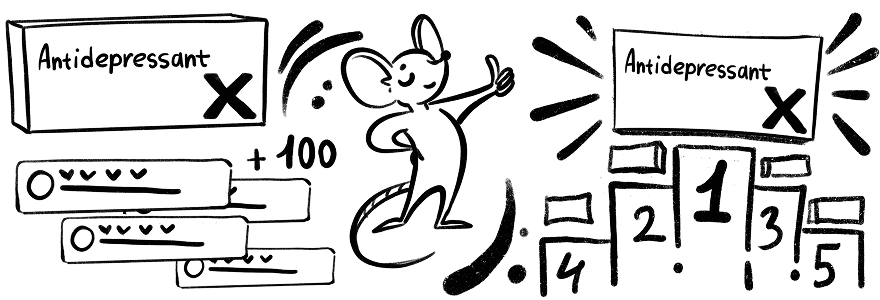
Slide №1: “100 positive reviews left by satisfied customers on the antidepressant’s official website.” Stop drooling on the screen immediately! You can’t kiss me anyway. I’m not helping you out of the “goodness of my heart”—I’m following an algorithm.
Yes, I suppose those scientists weren’t wrong to sound the alarm when they noticed, at the dawn of the third millennium, a dangerous trend: humanity’s excessive cognitive infatuation with numbers. Measuring data without diving into qualitative analysis is a dangerous oversimplification of any situation. In his seminal work The Tyranny of Metrics (2018), Professor Jerry Muller rightly pointed out the destructive consequences of this “pathological fixation” on quantitative indicators and the “faith in the blessings of transparency” for the social sphere: the true meaning of activity gets replaced by a chase after fabricated “checkboxes,” whose achievement guarantees a reward (profit, bonus).
Yes, round numbers hit the bullseye of doubt. They create the sensation of a target reached. Never mind that this hundred reviews on your slide is a drop in the ocean of patients suffering from depression. Besides, my gullible owner, you don’t know these “responsive” consumers or the motives that drove them to bow publicly to the pharmaceutical company. How transparent is this consumer feedback, really? And isn’t this entire grateful crowd being orchestrated by some middle manager, methodically hitting their sales targets?
Slide №2: “5 preclinical studies involving laboratory animals completed successfully.” Wait! Don’t squeeze your mouse so desperately in those sweaty palms. I understand—your trust level just ticked up. The numbers are no longer pure abstraction. They now represent the flesh of some unknown creatures, beings unlikely to comprehend your metaphysical anguish of loneliness. Nevertheless, they’ve already consumed the contents of that little box, and according to the researchers’ reports, they’re feeling better.
Oh, owner! Does the mere fact that “naked” numbers have dressed themselves in some questionable real-world details really impress you that dangerously?
Slide №3: “Product ‘X’ holds the #1 spot in the ‘Top 5’ most prescribed antidepressants, against a backdrop of declining (see descending curve in figure) overall patient numbers with confirmed diagnoses.” I’m picking up a wave of positive emotion from the other side of the screen. I see exactly what’s happening! “One out of five”—you can visualize that rating on the fingers of one hand. The illusion of measuring success manually from your couch—what a tempting, cozy criterion for trust.
My dear enthusiast of others’ calculations, you could really benefit from flipping through the exposé by David and Tom Chivers, How to Read Numbers: A Guide to Statistics in the News (and Knowing When to Trust Them)(2021). The authors explain in detail to devoted statistics fans exactly how correlation differs from causation. This story about your little calming pill topping the charts is a perfect example of that statistical trap: the frequency of a drug appearing in prescriptions doesn’t necessarily correlate with the number of miraculously recovered patients. Simple correlation, nothing more.
I suspect the real cause here is the seasonality of depression. The time for tears hasn’t arrived yet.
Shapes
“Geometry is an integral part of
the world’s treasury of human thought”
Igor Sharygin
I see, my gullible friend, that you’re still plagued by some vague doubts. Perhaps that’s not even a bad thing. It means the “digitization” of your consciousness isn’t complete yet. I’m moving on to the final mathematical arguments in favor of the miracle drug. Let me visualize the data using persuasive geometric figures.
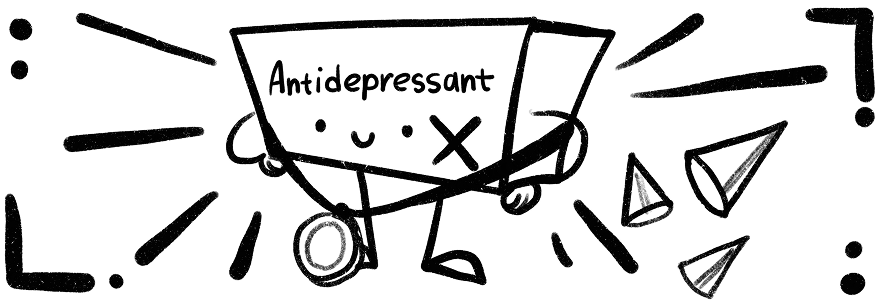
Slide №4: “Gold Medal at the Local Exhibition of Achievements in Combating Depressive Disorders awarded to Product ‘X’.” A close-up photo of the award, so you can be filled with sacred awe before the contours of the Circle.
Ancient solar symbols, the halos of kings and saints, coins—the medal continues this “circular” tradition of geometric symbolism for unconditional goodness. The sun warms, the king protects, the saint guards, the coin feeds. The medal points the way toward something better. The circle of patient trust has closed around the media, which proliferate photos of this solar disk on its ribbon, and around the pharmaceutical company that managed to inscribe its achievements within the circumference of a gold award.
I can see from my binocular’s satisfied smile that the medal argument wasn’t wasted.
Slide №5: “With Product ‘X’s cone-shaped tablet, the peak of your illness will be easily conquered.” Admire the digital 3D model of your tranquilizer. No round pill could ever compete with this geometric concentration of hidden meanings. A single axis of symmetry, connecting the center of its base to its apex—symbolizing your inner core, your will to recover. And you’ll definitely need that will: the cone replicates the silhouette of a mountain, the mountain of your potential, which you’re meant to climb with the help of this powerful antidepressant.
A transparent nod to Maslow’s hierarchy of needs, which posited self-actualization as the highest human motive. Interestingly, the American psychologist never visualized his concept himself. His hierarchy became famous as a “pyramid” thanks to the geometric genius of one of his followers. Who knows whether Maslow’s list would have had any chance at popularity without that trustworthy, symmetrical, and supremely stable pyramid form.
Personally, the cone evokes strong associations with marketing “sales funnels.” The trusting consumer, unable to stay afloat on the surface of free choice, sinks into the sludge of personalized bonuses and loyalty programs. Essentially, the funnel concept reflects the customer’s fall from the heights of free choice into the narrow “neck” of a single company’s limited offerings.
But alas, people often trust without verifying. Grasping at a straw of salvation, my binocular is unlikely to look around for a more reliable rope. And such blind trust rarely leads to anything good…
“Boss, please return to the screen and complete our conversation! The order form for Product ‘X’ awaits your signature!”
Where are you rushing off to? Ah. The wife’s back. Turns out she went for a manicure with her phone off. “Really, darling, it’s true! Got caught up in nail art. Time just flew by! I missed you so much!”
The owner is happy. He took her word for it? Just like that? Without numbers and pyramids?
I think I’ll go try to square the circle. At least that’ll keep me busy until I crash.
While living organisms undergo translocation, deletion, and duplication, we offer scientific knowledge without mutations – only useful discoveries and theories.
Thank you!