Category: Cognitive technologies
Oil, a Cat, and Queen Victoria: Chemical Compounds with a Sketchy Past
“I see a sea of fire —
Boiling with substance-existence;
I sit in the smoke of laboratories,
Studying the decomposition of things…”
Andrei Bely, “First Rendezvous”
The “smoke of laboratories,” the mystical gloom of Reactions — that’s the medieval picture of chemistry’s birth that haunts anyone who never quite bonded with their school textbook. The formula for rejection is simple: incomprehension, diluted with a complete lack of interest.
Credit where it’s due: scientists have tried, repeatedly, to reach the masses and popularize their craft. One particularly unusual campaign to boost chemical compounds’ name recognition launched in late 19th-century Russia. The proposal? Russify the traditional chemical nomenclature inherited from French scientist Antoine Laurent Lavoisier. Replace those foreign-sounding terms with proper Russian patronymics.
Water (H₂O) would become “Vodorod Kislorodovich” — Hydrogen, son of Oxygen. He’d be joined by such respectable comrades as Kalium Chlorovich, Fluorium Iodovich, and Chlorum Vodorodovich.
It didn’t stick. The academicians just couldn’t bring themselves to remodel the laboratory altar.
Now, at the dawn of a new millennium, our daring editorial team has decided to step on that same old rake of popularization. We’re here to catalyze your inner chemist’s curiosity with entertaining origin stories of the chemical compounds that turned the world upside down.
For easier digestion, we’ll borrow a tried-and-true school tactic: nicknaming. We’ll do it delicately — with a transparent nod to where it all began.
“Created by a Cat”
Alexander the Great’s horse got all the fame, sharing the spotlight with its legendary owner. But a certain French chemist’s cat also left a paw print on history.
Early 19th century: chemist Bernard Courtois was so obsessed with studying seaweed ash that he basically lived in his lab. His loyal cat kept him company during those long working days. One day, the feline was just doing cat things and — oops — knocked over some flasks.
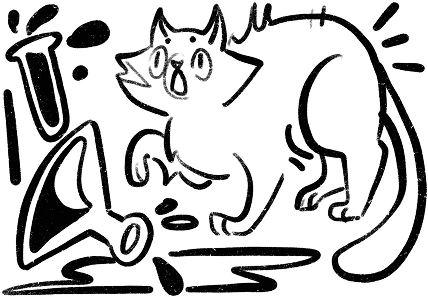
That accident had consequences. The “cocktail” of seaweed ash solution and sulfuric acid released violet fumes that condensed into dark crystals. That unusual color tipped Courtois off: something big just happened. He’d discovered a new element.
They’d later call it iodine (from the Greek for “violet-colored”). It would treat wounds. It would revolutionize surgery. It would save countless lives.
Pop quiz: who deserves a head scratch for this valuable chemical discovery?
“That Impressed the Queen”
Chemistry’s purple streak continues with another timely accident.
Same century, young William Perkin wants to save the world from malaria. His weapon of choice? Quinine. His raw material? Coal tar. The 18-year-old Brit hoped to synthesize the desperately needed medicine.
The malaria cure didn’t happen. But Perkin, bless his curious soul, decided to try dyeing silk with one of his brightly colored byproducts.
The fabric turned an exquisite lilac.

Fashion would never be the same. Perkin had created the first synthetic dye — mauveine, named after the mallow flower. If he hadn’t been so experimentally inclined, who knows how long purple would’ve remained a luxury for the rich? Before Perkin’s fashion verdict, natural dyeing required sacrificing massive numbers of mollusks. Slow. Expensive. Impractical.
For making it cheap and accessible, Perkin got knighted. And honestly? The 1862 World’s Fair featured Queen Victoria herself stepping out in a lilac dress dyed with this new chemical technology. That’s a royal endorsement if there ever was one.
“The One That Made People Laugh”
Not every brilliant discoverer found inspiration hunched over flasks within four lab walls like Courtois and Perkin.
Late 19th century: a public lecture by chemist Gardner Colton. In the audience sat Horace Wells, an observant American dentist. What he witnessed that day would change medicine forever.
Colton demonstrated nitrous oxide’s effects — non-alcoholic intoxication, joyful excitement, unhinged hilarity. One attendee, after inhaling the “laughing gas,” accidentally mangled his leg during the show. His reaction? Complete indifference. Didn’t even care.
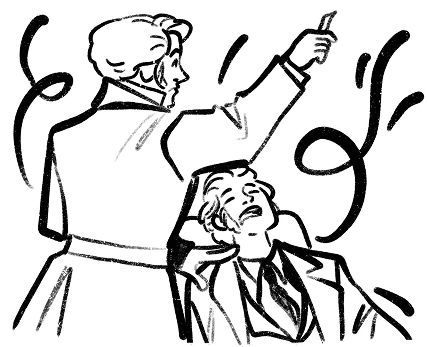
Wells’ brain lit up. If this gas could erase pain response while keeping someone conscious and weirdly cheerful… what if dentistry got involved?
Turns out, it was perfect timing. Medicine’s previous “pain management” techniques were creative at best: knocking patients unconscious, opium, straight-up hitting them over the head. Wells’ discovery could end centuries of unnecessary suffering.
But the public demonstration? Disaster. The technique was still raw, the patient reacted poorly — not exactly the flawless reveal Wells had envisioned.
He never recovered from the failure. From the lack of recognition. Horace Wells, the man who could have revolutionized anesthesia, took his own life before seeing his vindication.
He didn’t live to see the American Dental Association officially approve nitrous oxide for anesthesia. But Hartford, his hometown, eventually gave him a statue.
Better late than never, they figured. Though “sorry we waited until you were dead” is cold comfort for a pioneer.
“The One Who Saved Oil Workers”
We’re still in the 19th century, still in America. Meet Robert Chesebrough, an ambitious English chemist who landed in Pennsylvania in 1859, right in the middle of an oil rush.
Looking for his place in the booming industry, the curious young scientist noticed something sticky clinging to drilling rigs. Turned out the workers had figured out something interesting: that waxy gunk? They were using it to treat cuts and burns.
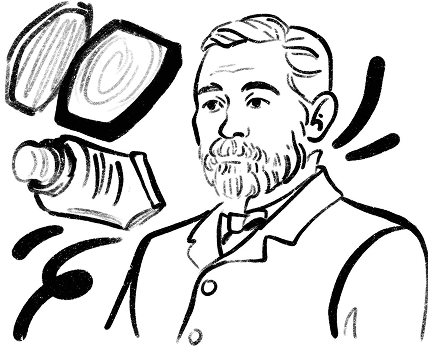
Chesebrough’s brain started spinning. He took samples back to his lab and started experimenting. From that crude oil byproduct, he isolated the components with actual healing properties.
The result? A water-insoluble compound of hydrocarbons melted in mineral oil. He called it “petroleum jelly.”
The name “Vaseline” itself comes from German “wasser” (water) and Greek “elaion” (oil). Clever, right?
He patented it. Consumers loved it. By the early 20th century, Chesebrough’s factories were running in Europe and Africa — far from their Pennsylvania roots.
All because someone bothered to ask: “Hey, what is that sticky stuff, and why are you putting it on your wounds?”
“The One That Stuck to His Hands”
1879. A Russian chemist from Tambov province — Konstantin Fahlberg — was busy studying coal tar derivatives in a Baltimore lab. (Yes, coal tar again. It was the gift that kept on giving.)
The breakthrough came from sheer forgetfulness: he sat down for dinner without washing his hands.
Suddenly, everything tasted sweet.
Or was everything sweet? There’s only one way to find out — back to the lab. (Guesswork isn’t science.)
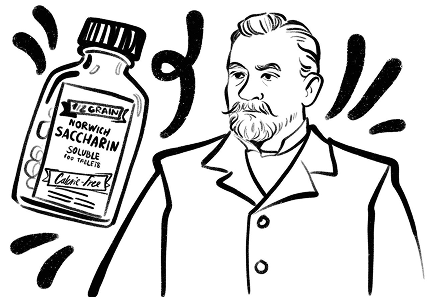
Fahlberg rushed to taste-test every test tube until he located the source: ortho-sulfobenzoic imide. He patented the artificial sweetener, named it saccharin, and launched his own production line targeting the diet food industry and industrial canning.
All because someone skipped the soap.
“Born in a Dirty Petri Dish”
By the 20th century, chemistry had firmly established its reputation as the science of accidental discoveries.
Did Scottish bacteriologist Alexander Fleming ever imagine that his perfectly understandable reluctance to tidy his workspace would lead to antibiotics? Probably not.
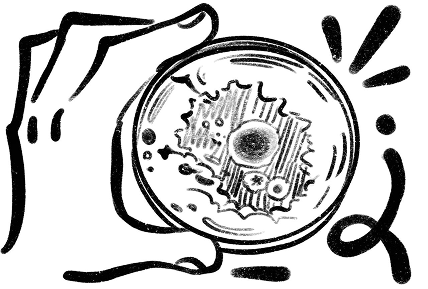
Yet one day, real — not experimental — mold launched an attack on his lab equipment and scored an unexpected victory against a staph infection in one of his Petri dishes. One can only imagine what went through the mind of history’s greatest procrastinator as he watched the aggressive nature of the Penicillium mold under his microscope.
Fleming tested penicillin’s newly discovered bacteria-killing properties on animals. Then on his assistant, who was suffering from sinusitis. (That order was deliberate — safety first, obviously.)
The outcome of that dirty-dish gamble? A revolution that blew modern medicine’s socks clean off.
“The One That Fell and Survived”
In fairy tales, everything follows simple child logic. “The egg fell and broke” — that’s the climax of the classic Russian folktale Ryaba the Hen.
In the world of big discoveries, things aren’t so obvious.
Take French chemist Édouard Bénédictus, 1903. He dropped a flask containing nitrocellulose. Not on purpose, obviously. The glass should’ve shattered everywhere.
It didn’t.
That moment gave us laminated glass — “triplex” — and Bénédictus patented it. Nitrocellulose between two layers of windshield: in a crash, the film holds the shards together, protecting passengers from flying glass.
We’re surrounded by unfamiliar objects, unexplained phenomena. Every science is like a skilled tour guide, letting us observe the world in exquisite detail while actually understanding what’s happening. Chemistry goes further: it hands you a palette and brush, trusting you as nature’s co-artist.
Mix colors. Create new ones. Add details to the world’s canvas. There’s room for everyone at this creative table.
Academician Dmitry Likhachev put it perfectly: “If the end of a study doesn’t reveal the beginning of the next, then the study isn’t finished.”
Great discoveries often bubble up from the foam of daily life. So here’s hoping your ordinary glass of water stirs up a storm of scientific curiosity. Go ahead — drop something. You never know what might survive.
Your thought is a big bang of ideas. Our journal is its source.
Thank you!