Category: Cognitive technologies
Chemistry for Kids Who Grew Up
So, kids, gather round. Today we’re going to talk about the science everyone’s heard of but only a chosen few truly understand. Chemistry.
Chemistry in school is like sex ed taught by a nun: everything is technically correct — here’s the vagina, here’s the penis — but none of it makes sense and nothing feels dangerous. Not a hint that all this polite shuffling of elements is sticky, unpredictable, and fully capable of ruining your life.
Once upon a time we all sat at our desks believing that chemicals were well-mannered dinner guests: they swap places neatly, observe etiquette, and only start to stink in extreme cases clearly labeled in the textbook.
In reality, a real substance is more like an unhinged psychopath who shows up at your house to rearrange your fridge, defile your sink, ruin the atmosphere, and set the curtains on fire simply because it can. It doesn’t care about your rules. It has never heard of your expectations.
And one perfectly ordinary day, I met one of these psychopaths in person. My pink, sugary, school-trained universe — curated by uninspiring chemistry teachers — shattered on impact. Dun-dun-dun!
P.S. Your favorite perfume is made from petroleum and beavers. Sweet dreams.
Here’s what happened.
I stepped out of my apartment into a suffocatingly gray stairwell. Cracked whitewash grinned at me from the walls and escorted me to the elevator. I pressed the button and heard the cabin groan its way down. A young, powdered woman stepped out and winked at me cheerfully. I winked back, stepped inside — and immediately walked into a chemical cloud that smelled of flowers, lingerie, hope, and some volatile organic conspiracy that shot through my sinuses and settled straight into my brain. Who decided it was acceptable to bathe head-to-toe in Chanel No. 5?

Do you know, my friend, that some of those fragrant molecules floating in that pretty liquid you spray on yourself are chemical cousins of benzene — yes, that benzene, the carcinogenic solvent? That the difference between “violet aroma” and “potent toxin” can be just a couple of atoms in the wrong place? That a perfumer isn’t really an artist but a high-functioning maniac who, instead of synthesizing nerve gas, chooses to make eau de toilette?
Exactly.
Before you inhale, consider this: someone took a foul-smelling substance, tortured it with acids, bases, and heat, and extracted what they now call a “heart note.” Did you imagine pleasant essences were made some other way?
At the base of most perfumes is alcohol — ethanol, C₂H₅OH. Not the drinkable kind, so you won’t chug the bottle in despair, but denatured. Sloshing alongside it is water. Obviously, spraying alcohol and water on yourself doesn’t make you a perfumer, so clever inventors add aromatic compositions — in plain terms, chemical hooks.
Natural oils are obtained by taking tons of petals and either soaking them in alcohol or steam-distilling them to pull out the smelly molecules. Synthetic fragrances are built in reactors from petroleum, coal tar, or other inexpensive feedstock. Don’t believe it? Vanillin — the smell of vanilla — can be synthesized from guaiacol (a byproduct of wood processing) or lignin (waste from paper production). It was once extracted from dried beaver glands. That’s not a joke.
Indole? It’s a key molecule in the scent of jasmine — and of feces. The same molecule. At low concentrations: floral softness. In pure form: unmistakable stench.
Musk used to come from the glands of musk deer. Now it’s often replaced with macrocyclic ketones — large, intricate molecules assembled in chemical plants like molecular Lego.
Not nervous yet? Fine.
Imagine the master perfumer shifts a ratio or rearranges a few atoms. Benzene — cousin to your “aromatic aldehydes” — is also the foundation for nitrobenzene, which smells like bitter almonds and is, in reality, a powerful poison capable of causing fatal methemoglobinemia.
The same principle can turn an innocent solvent into phosgene—a choking gas from the First World War that filled soldiers’ lungs with fluid until they drowned in their own mucus. And if you dig into neurochemistry, you’ll find that some of the esters and lactones that give perfumes their fruity and creamy notes are close relatives of molecules that, in another context, act as neurotoxins, shutting down the respiratory center.
That’s how it works: “Let’s take petroleum waste and make it smell like you’re not a hopeless loser but a sex god!”
Chemistry wasn’t born for beauty or for knowledge. It was born for survival—when humans realized the world was trying to kill them. A caveman roasted a slab of mammoth and noticed that fat dripping into the fire made the flames burn brighter. That was the first chemical experiment: take one substance, subject it to change, get a useful effect. Then he thought, “That berry killed my friend. What if I boil it, soak it, mix it with clay—maybe then it won’t?” That’s how medicine and toxicology were born. “Hey, this mud gets harder if I throw it straight into the soot!” That’s metallurgy. “Mammoth hide smells awful. What if I rub it with a brew of equally awful-smelling roots—maybe I’ll end up with a ‘heart note’ like that lady in the elevator?” That’s how the first soap appeared—fat boiled with ash. And with it, perfumery and the chemistry of surfactants.
Chemistry was needed to survive. We learned to smelt ore, poison enemies, wash hides, preserve food. We became gods of transformation. We even learned to make things smell like roses when there were no roses anywhere nearby—only petroleum, acids, and a couple of chemists with a sense of humor.
Humans domesticated chemistry. But some decided to take it further and use it not for survival, but to shorten other people’s lives. And that’s where it gets interesting.
P.P.S. Chemistry has already told the whole story about you.
— Hey, Doris.
— What?
— Is it true they put polonium in tea?
— True, Ethel. But that makes for very expensive tea. Not for the likes of us.
— What about arsenic?
— Arsenic’s for amateurs. Every dog can sniff that out.
— So what do you do if someone needs to be… removed?
— Sit on the bench and behave. You and I are good for nothing but gossip anyway.
There’s an old spy saying: if you want someone gone, do it quietly. Bullets, shell casings, witnesses, a wet stain on the pavement, and questions from grim men in trench coats—that’s for amateurs. A real conspirator does it elegantly, say, with chemistry: pour a comrade some tea, he drinks it, goes out for a smoke, collapses face-first on the asphalt—no reason for a forensic investigation. The doctors write “acute heart failure” in the chart, the relatives collect the insurance. Beautiful.
But there’s a catch. Chemistry leaves traces.
Every substance that enters the body does something: reacts, binds to receptors, wrecks the liver, pleases the kidneys—lives its own small toxic life. And in the process, it turns into other substances—metabolites.
That’s the main problem for killers who rely on chemistry: those metabolites can later be found in blood, urine, hair, nails—even bone marrow if someone digs deep enough. Those little chemical freaks sit there quietly recounting every detail: who their host was with, what he drank, how much he spent last Friday. Not very elegant.
But chemists are stubborn people. If you can’t avoid leaving traces, you learn to hide them. Or you make sure there’s nothing left to find.
Take 1978. On Waterloo Bridge in London, Bulgarian dissident Georgi Markov was jabbed in the leg with an umbrella. Three days later he was dead. The autopsy revealed a microscopic dose of ricin—but the poison itself was already gone from his body. Experts realized it was ricin only because they found a tiny capsule nearby. Had the capsule dissolved, that would have been it—case closed, no answers. Bulgarian intelligence would be sipping tea and smiling. But it didn’t quite work out that way.
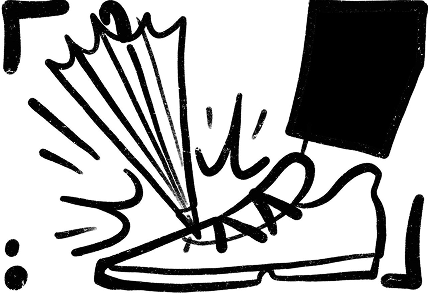
The trick with ricin is that it’s a protein. And proteins in the body break down into amino acids. Inject someone with ricin and, after a couple of days, nothing of the original toxin remains. Gone. Try and find it.
Or take VX, a compound from military chemistry. An organophosphate that blocks an enzyme, preventing muscles from relaxing. The victim simply locks up and stops breathing. Beautiful? Not really. Effective? Absolutely.
Sometimes it’s even stranger. In 2006, former intelligence officer Alexander Litvinenko was given tea laced with polonium in London. He lingered for three weeks and died. At first doctors suspected infection, then severe poisoning. Only when his hair began to fall out and his bone marrow collapsed did they suspect radiation. Polonium-210 is its own kind of story—a radioactive isotope that emits alpha particles until it decays into lead. By the time physicians caught on, most of it had already decayed, but the traces that remained lit up Geiger counters off the scale.
Chemistry has no morals. It doesn’t care what you do with it. It sits on a shelf as powders and reagents, waiting to be combined. Whether you end up with a medicine or a poison, perfume or explosive, fertilizer or gas depends not on chemistry but on you. The history of chemistry is the history of people learning to connect atoms—first to survive, then to live better, and sometimes to kill one another. So what does chemistry have to do with it?
P.P.P.S. Don’t trust your eyes. Trust molecules.
In ancient India there was a tradition described in the Arthashastra, a treatise on statecraft from the 4th century BCE. Women would see their husbands off to work, to the hunt, to negotiations with a neighboring raja—and slip poison into their food, providing the antidote only in the evening when the husband returned home. If he returned.
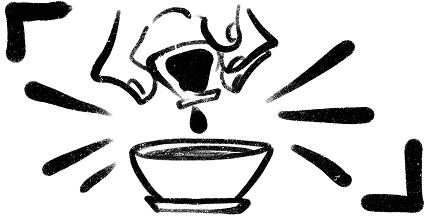
The system worked flawlessly. The wife didn’t kill her husband. He killed himself—if he chose not to come back, or decided to defect, or lingered too long with a mistress and missed his antidote.
Chemistry functioned as a system of trust. Or distrust. Depends which side you’re on.
You know what’s funniest about digital security? That it only exists conditionally. Your password is just a string of characters that can be seen, intercepted, stolen, guessed—or extracted at gunpoint.
A molecule is different. You can’t peek at it over someone’s shoulder. You can’t intercept it over a network. You can’t steal it without stealing the substance itself. It has already reacted by the time someone points a gun at you.
And that’s where the real game begins.
Imagine a safe. Big, heavy, with a code lock. Inside is a reagent; outside, a tiny opening where you’re supposed to drip a special liquid. The solution flows through microchannels, reaches the reagent inside. If the composition is correct, the reagent glows green, contacts close, the door opens. If it’s wrong—and the designer had a dark sense of humor—there’s a small explosion. Small, but enough to discourage curiosity forever.
That’s a molecular key. The funny thing is, you hold molecular keys in your hands every day—you just don’t know it.
Take a banknote and a UV lamp. Under ultraviolet light, colored fibers glow, hidden numbers emerge, patterns come alive. These are luminophores—chemical compounds that fluoresce at specific wavelengths. You can try to counterfeit that, but you’ll need a synchrotron and a couple of academicians.
Real money carries holograms. A simple hologram can be copied. But if it’s made from cholesteric liquid crystals that change color with heat or viewing angle, you’d better have a PhD before you try. Warm them—they turn red. Cool them—they shift blue. Good luck reproducing that.
During the Cold War, agents wrote messages in milk. Invisible on paper—until heated over a candle. Romantic.
Today there are inks containing nanoparticles with unique luminescent spectra. In your hands it’s just an ordinary document. But under the right device, the molecules glow in different colors and spell out: “This document is a forgery. Call the police and detain the idiot presenting it.”
Or maybe not a message—just a tiny green dot that tells an expert, “All clear.”
It’s even more entertaining to watch how the molecular key works on criminals. The criminal thinks he’s clever. Wears gloves, wipes surfaces, airs out the room, burns evidence. Walks away satisfied—never noticing the invisible speck clinging to his jacket.
And that speck contains a unique isotopic signature found only in one African mine. Or a rare-earth element extracted in a single Chinese plant supplying the defense industry. Or a polymer produced by the only factory in the world—and that one shut down ten years ago.
Suddenly the experts know where he was yesterday, what he breathed, what he ate for breakfast, which country he bought his jacket in, and whether he stepped inside that warehouse full of explosives.
The digital world says: don’t trust your eyes. Chemistry says: trust reagents. It’s harder to fool a molecule than a human being. It doesn’t care whether you intend to deceive it. It simply reacts—or doesn’t. Glows—or doesn’t. Opens the safe—or keeps it closed.
In a world where information has become plasticine, chemistry remains the last witness you can trust, because atoms don’t lie. They don’t need to.
P.P.P.P.S. You’re just a set of reagents that learned to read.
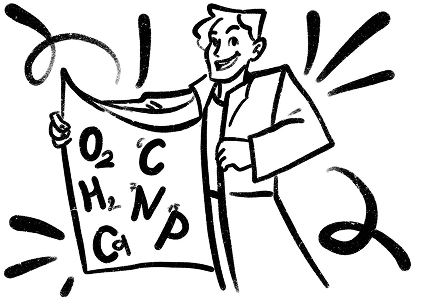
I dragged into the stairwell a gram of zinc, a few milligrams of copper, iodine, manganese, molybdenum, selenium. Also oxygen—65%, carbon—18%, hydrogen—10%, nitrogen—3%, calcium—1.5%, phosphorus—1%. And in smaller amounts: potassium, sulfur, sodium, chlorine, magnesium, iron. That was me. Total market value—about $150, if you believe biochemists. Yet from that pile of reagents emerges a person who walks, breathes, loves, hates, makes decisions.
So when I decide to go home—is that my decision? Or did dopamine remind me there’s a fridge and nudge me in the right direction? When I smile at the old ladies on the bench—is that happiness, or just serotonin levels holding steady? When I trust the banknotes in my wallet—did I learn that, or did oxytocin spike because I just got paid? That faint anxiety about my safe—is that caution, or cortisol hedging its bets? My irritation at the shabby stairwell—is that character, or adrenaline in my bloodstream?
Where am I in all this? Where does free will fit?
A human being is just a way for atoms to reproduce and move through space. We think we travel, eat, love—but really it’s carbon looking for somewhere new to settle, oxygen wanting to breathe, iron enjoying its time in hemoglobin.
You are simply a fortunate arrangement of atoms that learned to ask questions. A few dozen elements assembled in the right proportions, in the right order. And that collection of reagents suddenly wanted to understand how it works—and wrote an article about itself.
That’s what chemistry really is. Now go eat something. Dopamine will tell you to.
A navigator determines the current location of a person on Earth. We’re mapping new routes in your consciousness.
Thank you!