Category: Life technologies
How to Get Any Stain Out of Your Shirt and Your Conscience
“A gossip livens up a conversation; a stain livens up a tablecloth”
Don-Aminado
The brush had a mind of its own. It overruled the Master and traced its own path — straight down onto his shirt, right about where the heart should be.
“A single unconscious drop,” the artist mused dreamily, “is where inspiration begins.”
“A stain on my reputation!” Mary shrieked, clutching her head. (Let’s just say the Master’s companion has always taken the loss of virgin-white fabrics rather personally.)
Whether random paint splatters count as high art — that’s a debate for art historians. Let them cross their associative swords over the deeper meaning of spontaneous puddles on canvas. We’ll stick to what matters: helping the artist’s poor girlfriend salvage his shirt.
While we’ve been busy contemplating the Eternal in the shape of that stain, our practical heroine has already tried every folk remedy known to woman. All of them failed.
Let’s take a look at exactly what didn’t work for Mary.
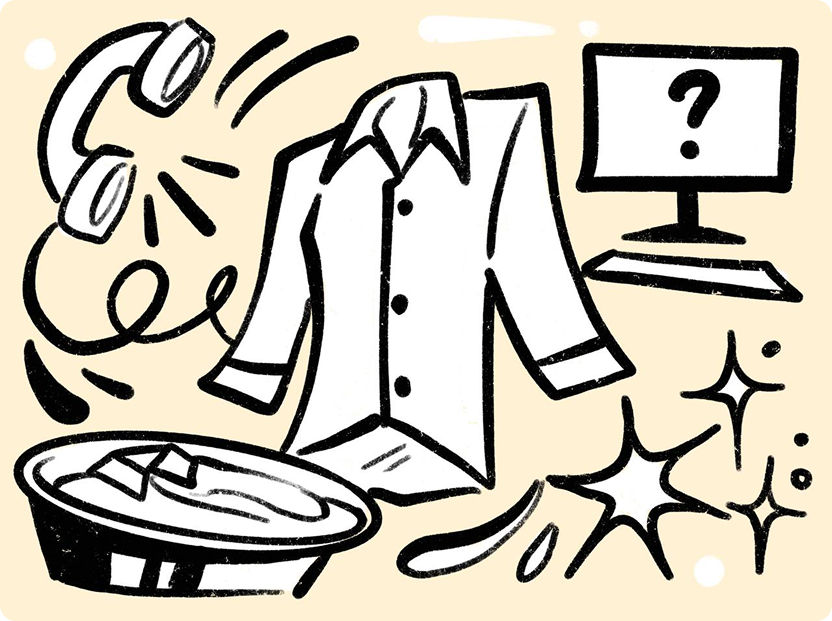
1. Call your older, wiser friend.
Experience is the ultimate reagent when it comes to stains of any origin. The magic word that spills from the lips of any battle-hardened housewife? “Fast.” She’s right: speed makes all the difference. Fresh stains let go. Set-in ones cling like guilt.
The problem? A friendly catch-up never sticks to business. You’ll wander into satellite topics: the shirt sale at the mall, job openings for people who actually know how to work with their hands. One thing leads to another, and before you know it, that golden hour is gone — the one window of opportunity when the stain might have abandoned its post without a trace.
2. Hit up a specialty store.
The best way to cheer up a stubborn stain? Throw an army of aggressive chemicals at it. Who cares if they’re on the same wavelength? The real priority is gentle on fabric. At least that’s what the sales consultant probably told Mary — the same guy whose quarterly bonus depends on, well, you know.
Drop some cash, and you can walk out with a “universal” spray or stain stick. No matter what you’ve spilled, these magic markers attack the problem zone with surgical precision. You don’t even have to take the shirt off. How do they work? Don’t ask. The logic is about as clear as a wizard’s incantation — and definitely not backed by any laws of chemistry. But hey, hope springs eternal.
З. Post on a household tips forum.
Let’s say Mary got lucky — no troll herds grazing in the comments with their “helpful” advice. The friendly, tight-knit community chimes in generously with tried-and-true life hacks: warm milk, salt, a scorching hot iron. Or they push that signature stain removal gel — the “gentle” one (unlike those harsh powders!). More magic wands, each with an author’s stamp. Supposedly foolproof. Supposedly universal.
And right there, in that very “universality,” is where the problem hides.
4. Run a home test drive.
Gather every legendary stain-fighting reagent in one bucket and put your fake expertise to work. The experiment looks something like this: douse the stain in vinegar, then shower it with baking soda. Enjoy the fizz — violent, spectacular, and utterly useless. Once the show’s over, enthusiastically rub in hydrogen peroxide and fresh onion juice.
The result? Your stain, now thoroughly pissed off, stays exactly where it was — after wrecking your nerves and probably the shirt fabric too. But hey, you still get a valuable scientific discovery out of it: chemistry does not forgive random mixing experiments. A chaotic cocktail of reagents is dangerous for both color and texture, and it guarantees absolutely nothing — except maybe making things worse.
5. Surrender to ritual magic.
Find the perfect online “spell” for your stain. Follow the algorithm strictly: sprinkle the shirt with baking soda, leave it overnight, rub the “offending” spot in circles with a vinegar solution, then barely breathe while buffing it with a soapy sponge. Freeze in joyful anticipation of the result.
If everything goes according to plan? Great. Your childhood faith in miracles gets a boost, and the shirt stays wearable until it goes out of style.
If not? Well, at least you’ve inched closer to understanding the scientific approach to stain removal: it’s not about blindly following steps, but about understanding why they might — or might not — work.
Enough. Mary’s delicate psyche has suffered enough. Let’s dump the proven, science-backed options out of the test tube and save that shirt.
Fight that shirt stain to the death — by the rules of warfare:
Rule № 1. “Know your enemy.”
The question “What will remove this?” comes second. Start with reconnaissance: “What is this stuff?” Rip off the stain’s incognito mask. Identify the culprit, and you’ll pick the perfect weapon.
“Like dissolves like” — that’s the universe’s law at the molecular level. Water dissolves alcohol (two polar compounds shaking hands). Gasoline dissolves oil (nonpolar hugging nonpolar). An oil-based paint stain on your shirt? Nonpolar. Grab a nonpolar solvent: white spirit, lighter fluid, orange oil. The outcome is predictable: the paint molecules find themselves surrounded by solvent molecules and retreat in disgrace. Victory goes to whoever bothered to ask about chemical nature first.
Rule № 2. “Throw your enemy off balance.”
Literally. Change its state of matter if the current one isn’t working for you. Solid, liquid, gas — your call. Don’t fight the shade of the stain; fight its form.
Say chocolate just ambushed your shirt. In chemistry terms, that’s “protein + fat + sugar.” Protein’s solid structure bites into fabric fibers. Fixable: cold water with enzymes (those are your undercover agents) chops those long protein chains into soluble bits. Then mop up the fat using Rule № 1.
You win if you stop frantically rubbing the stain in panic — that just drives it deeper into enemy territory. No panic. Stay cool. Fragment, dissolve, evaporate. You’re in command.
Rule № 3. “Force the enemy to surrender.”
Push that stubborn stain toward self-destruction. Finish it off until it’s harmless and colorless. This tactic comes in handy when red wine has ambushed your shirt and you’re dealing with those tenacious polyphenol pigments.
Dousing the stain with white wine — as the internet suggests — is like trusting a toy gun in a firefight. Grab some real weaponry: oxidizing agents like hydrogen peroxide or oxygen bleach. Under your command, oxidation reactions tear those complex colored pigment molecules apart, reducing them to simple, colorless compounds. The stain doesn’t just “wash out” — it ceases to exist on a molecular level. Your victory is the result of a carefully provoked micro-disaster within the stain itself.
Rule № 4. “Wait for the enemy’s corpse to float by.”
Time is your ally. Spin the chemical clock’s hands — speed things up or slow them down as needed. Reactions race forward thousands of times faster with a catalyst (that’s what enzymes in laundry detergent do). But sometimes, slowing down is the smarter move.
Take entropy — the universe’s tendency toward chaos. It can work for you, creating the perfect conditions for molecules to scatter. Dealing with an old, set-in organic stain? Resist the urge to channel your inner enraged Snow White and attack it immediately. Mechanical force will fail miserably. The winning strategy: a long, patient soak in a warm enzyme solution. The ideal setup: catalysts (enzymes) doing their fast thing while entropy steadily pulls molecules apart at its own pace.
Victory belongs to those who dive deep into the process, not those chasing instant results.
Rule № 5. “Point the war machine in the right direction.”
Even sugar won’t dissolve in tea all by itself. Every chemical reaction needs a starting push — usually heat or mechanical action. But pull the wrong trigger, and you’ll miss your target completely.
Take blood on a shirt. Whatever you do, don’t hit it with boiling water. That little burst of heat spikes right past the activation energy threshold for protein coagulation. Your “helpful” hot water flash-cooks that blood into an insoluble solid clot that welds itself to the fabric. Congratulations — you just made it permanent.
Cool down. Both literally and figuratively. Lower-temperature water delivers just enough energy to make the protein swell up and wave the white flag — ready and waiting for an enzyme attack. You win by calculating the exact force needed, not by blasting everything in sight.
Chemistry isn’t “storm and stress.” Not all reagents like it hot.
Blindly trusting the internet’s chatter and marketing hype, Mary went hunting for a miracle product without understanding what she was actually fighting — or how to run the operation. That kind of improvised warfare against a colorful enemy? The stain wins. Every time.
Chemistry — like tachisme — admits that every stain has its own “face.” It just offers science-backed ways to wipe that face clean. That grease mark from olive oil and the one from butter? Same “greasy” vibe to a marketer, completely different composition. Different stains need different approaches.
Understanding the chemical essence of stain removal is the only way to save the shirt without wasting your life.
Oh, and to keep her husband’s wardrobe in pristine condition? Mary finally subscribed to our magazine. Smart move.
The double-slit paradox awaits you! Learn from particles how to act mysteriously and unpredictably.
Thank you!