Category: Materialization technologies
Nitrogen Fixation, or the Process of Life and Death
“Overnight the Great Combinator inhaled all the oxygen in the room, and the remaining chemical elements could be called nitrogen only out of politeness”
Ilya Ilf and Yevgeny Petrov, The Golden Calf
A new year arrived, but the old problems stayed right where they were. Late last autumn, so many things piled up on me that I barely knew whether to stand or collapse. My beloved houseplants began to wither at alarming speed. My aquarium fish suddenly lost all interest in life—so much so that each morning now begins with a small funeral. And I myself feel constantly sluggish.
In an attempt to fix at least one of these disasters, I’ve already spent a small fortune on special fish food, new pots and soil for the plants, and vitamins for myself. Spoiler alert: everything only got worse. As they say, I would have been better off doing nothing at all. But once you start something, you have to see it through.
After several days of merciless internet research, I noticed the same word appearing again and again on forums: nitrogen fixation. I didn’t understand what it meant or how one was supposed to “consume” it, but it clearly mattered. So let’s figure it out together—maybe someone else will find it useful too.
Emergency services, please save the plants
I googled “nitrogen fixation” and was immediately terrified when I saw this: N₂ + 16ATP + 16H₂O + 8e⁻ + 8H⁺ → 2NH₃ + H₂ + 16ADP + 16Pi. For a moment I thought it was some secret code, and “nitrogen fixation” the name of a criminal organization. I nervously called my teenage son over. He laughed and assured me that neither the authorities nor gangsters were coming for me. The “secret code,” it turned out, was simply the chemical equation describing how certain bacteria convert atmospheric nitrogen into ammonia.
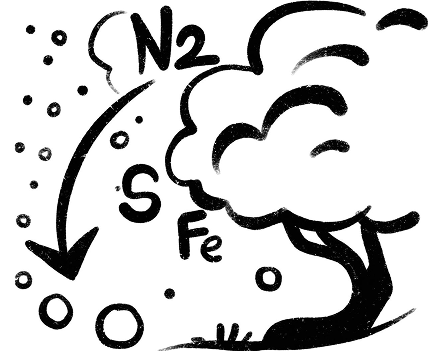
“Fascinating!” I thought. But I still couldn’t see the connection between nitrogen, ammonia, bacteria, and my dying plants.
After more reading, I pieced together the following: there is nitrogen in the atmosphere, a gas without color, taste or smell, which is dangerous to all living things in its pure form, but with a certain intervention of scientists and bacteria in its structure, it becomes almost a Marvel hero and saves the whole nature from extinction.
In 1909, German scientists Fritz Haber and Carl Bosch developed an industrial method to synthesize ammonia by combining nitrogen and hydrogen under high pressure and temperature over a catalyst. The Haber-Bosch process revolutionized agriculture by enabling large-scale fertilizer production.
Impressive achievement. Unfortunately, reading aloud about two brilliant Germans did nothing for my houseplants.
Eventually I stumbled upon something genuinely useful. I had assumed my plants needed more water, better soil, more sunlight, or extra care. In reality, they needed nitrogen—specifically nitrates. I had always thought nitrates were some kind of industrial poison. It turns out they are nitrogen compounds that become harmful only in excess. In proper amounts, they are essential for plant growth.
In nature, nitrates often form during thunderstorms. Lightning breaks the strong bonds in atmospheric nitrogen molecules, allowing them to react and later enter the soil through rainfall.
Indoor plants, however, have no natural source of nitrates. Over time, nitrogen deficiency causes yellowing leaves, thin stems, stunted growth, weakened immunity—and eventually death.
The solution? Nitrogen fertilizers derived from synthetic ammonia.
Naturally, I rushed to the nearest gardening store, bought several nitrogen-based fertilizers, and began applying them according to the instructions. About a month later, I noticed real improvement: yellow leaves turned green, growth resumed, and new shoots appeared. Thank you, Haber and Bosch. One problem down.
Soup in the aquarium
Encouraged by my botanical success, I turned to saving my fish. I had been changing the water several times a day, installing special lamps, buying vitamin-enriched food—nothing helped. The fish kept dying, refusing to eat, convulsing, barely moving along the bottom of their glass box.
Back to Google. And what do you think? Nitrogen again.
But this time, the problem wasn’t a shortage—it was an excess. The aquarium’s nitrogen cycle had collapsed. In healthy aquatic systems, beneficial bacteria convert toxic fish waste (ammonia) into less harmful substances through nitrification.
In nature, rivers and lakes are full of these bacteria. In a home aquarium, however, conditions must be carefully maintained to allow them to establish.
My mistake? I had been over-cleaning. Changing water too often, polishing the glass daily, constantly vacuuming the substrate—all of it disrupted bacterial colonies. My aquarium had turned into a toxic soup. Fish waste, leftover food, and decaying plants were releasing ammonia, and there were no stable bacterial populations to process it.
Emergency measures followed: weekly water changes instead of daily ones, regular pH testing, bioactive substrate with bacterial cultures, transferring beneficial bacteria, and planting new aquatic plants. Gradually, the fish regained their energy. The deaths stopped. Another burden lifted.
Lesson learned: keep a close eye on nitrogen.
Nitrogen everywhere
While I was rescuing plants and fish, my own health kept deteriorating: chronic fatigue, weakness, nausea, swelling, loss of appetite.
I’ve had kidney issues since childhood. Over time, their ability to filter waste declined. My love of high-protein foods and excessive salt didn’t help.
I went to the doctor. After numerous tests, I laughed nervously at the results. The diagnosis: azotemia—elevated levels of nitrogenous waste in the blood.

There was no choice but to change my lifestyle, adjust my diet, and undergo treatment. While lying in the hospital, I reflected: too little nitrogen nearly killed my plants; too much nearly wiped out my fish; and now I had nearly suffered the same fate.
I jokingly asked the doctors to remove all nitrogen from my body. They replied that without nitrogen I would die even faster.
Balance, they said, is everything.
Skeptical, I researched again. We consume nitrogen daily in the form of amino acids. They are fundamental to virtually every bodily function—from vascular tone and gastrointestinal health to lung function and immune defense. Without nitrogen, there would be no plants, no animals, no humans.
Quite a revelation.
In any situation, it helps to find something positive. I, for one, became wiser—and perhaps helped someone else solve a similar problem.
The discovery of nitrogen fixation profoundly shaped life on Earth. Who knows whether we would even exist without it?
And how many more astonishing discoveries await us before we understand life completely? But that is another story.
Stay healthy—and keep an eye on nitrogen. It’s everywhere.
“Air, water, and earth are three bodies that contain nitrogen”
Porfiry Ivanov, the text Boys with hardening and training continue their work that they started
We’ve discovered new laws of the Universe in your pocket. By the way, there are many forgotten things in the Universe too.
Thank you!