Category: Global minds
Interview with a senior pulmonologist
There are professions where you cannot hide behind an instruction manual. Where a starched white coat does not protect you from pain—neither your own, nor someone else’s. Where every morning you sit down across from another person and must find those very words that will literally make it easier for them to breathe.
What does a doctor think about when they see a patient? What does a patient think about when they see a doctor? No one in a white coat has ever received a medal with the words “good doctor” inscribed on it in large letters—people bestow this title upon a physician.
Doctors are taught many things: to recognize diseases, prescribe treatment, read scans. But they are not taught the most important thing: how to never stop seeing themselves in the patient. Sometimes this skill comes with experience; sometimes it never comes at all. We are taught to choose a doctor by ratings, read online reviews, google symptoms, and shift the responsibility for recovery onto anyone but ourselves. And it seems we haven’t been taught the main thing either.
In this interview, our guest and we discussed medical practice and patients; bacteria that evolve faster than we can develop new drugs; useless medications and life-saving treatments; viruses, immunity, and telomeres; the body’s hidden reserves; the drugs that will eventually replace antibiotics; and what truly heals—the pill, or the person who prescribes it.
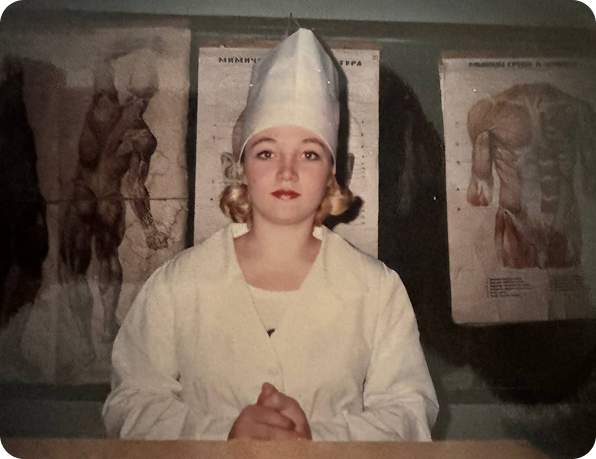
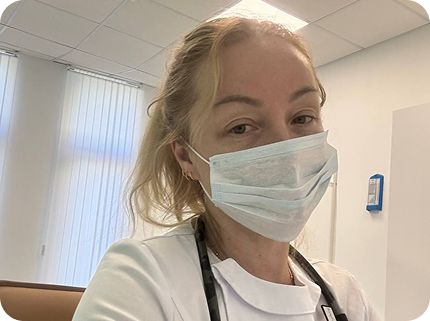
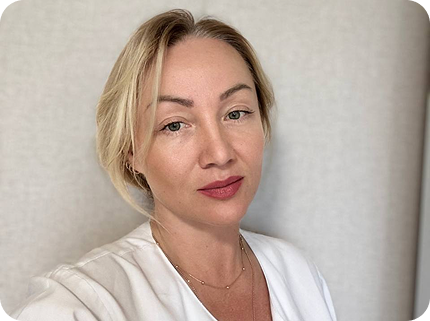
Our questions were answered by Geyshterova Olga Vadimovna, a first-category physician, therapist, and pulmonologist.
— Olga, do you remember the moment when you first realized you would become a doctor? Not when you wanted to, not when you thought about it, but when you truly knew.
— It was a choice my grandmother passed on to me. She experienced war as a child—hunger, cold, poverty; she went through it all. Later, she traveled all over the Soviet Union with her husband, who was in service. She worked wherever her hands and heart were needed: delivering babies in a maternity hospital, saving people on ambulances, nursing the wounded in hospitals. She worked as a midwife, a nurse, a paramedic. When my grandmother’s strength began to fade, she took a job as an ambulance dispatcher in the town of Kirs, where I was born.
My parents worked a lot, so my grandmother would put little me in a sled and take me to the ambulance station. I still remember that smell: sterility, cleanliness, starched gowns, white caps. A small room, a desk with a telephone where grandmother took calls, and next to it a room where they could give injections, bandage wounds, and provide emergency care. I would sit quietly, absorbing it all, and even then I knew this was my world.
My grandmother often said: “Olya, if you go into medicine, remember this: you have to love people. Not the profession, not the money, not the status. The people. And if you’re going to be a doctor, be a good one. Not ‘one more or one less doesn’t matter,’ but a real one.” She never became a doctor herself—circumstances prevented it—but all her life she worked alongside them. She saw the good ones, and she saw the kind it’s better not to speak of.
Once she said something I will never forget: “I will know my life wasn’t lived in vain if you become a doctor.” I first followed in her footsteps—I graduated from medical college and became a paramedic. Then I decided to go further: I took preparatory courses, entered the medical academy in the city of Kirov, six years of study, a year of internship. In total, it took me ten years to become a doctor.
My grandmother didn’t live to see that day, but she saw me studying, she saw me on my way. And I think that meant more to her than any diploma.
— You spent ten years becoming a doctor. Did you immediately decide to become a pulmonologist?
— When I was graduating from the institute, I passed all my state exams with honors. Yes, I can praise myself for that, because I studied honestly. And at the state exam, the commission asked me: “What would you like to be?” I said: “A cardiologist.” But fate had other plans: I was assigned to neurology in the city of Kirov. And then love happened—I followed my husband to Ukhta and became an ordinary therapist.
In 2011, we moved to Kaliningrad. My oldest son was four at the time. I got a job at a local district hospital and worked there for two years. In 2013, I moved to the inpatient pulmonology department. And there they taught me how to work with pulmonary patients, they taught me how to do punctures. It’s almost like surgery! I loved it madly. Nowadays only thoracic surgeons can perform such procedures, but back then it was allowed. And I loved doing it.
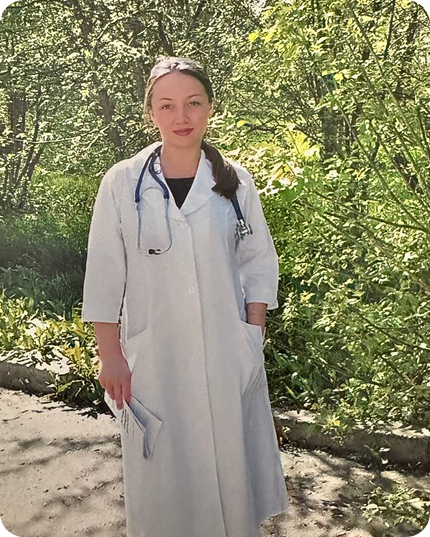
In 2013, they sent me to Smolensk for specialized training in pulmonology. After my second maternity leave, I started working at the Central Clinical Hospital, then at the Third City Polyclinic, and then at a military hospital. Those were happy times with a wonderful, close-knit team. We still meet up—that’s how strong our friendship is.
The hospital had its own specifics—young conscripts and a ward of pensioners that I managed. But I wanted more: more practice, more knowledge. So I moved to the regional hospital.
The regional hospital was interesting. The head of the department there was Elena Petrovna. There are no doctors like her anymore. You have to absorb them like a sponge—sit with them, talk to them, ask questions. They know so much! Just like Natalya Appolinariyevna Khovanova, who taught me how to do punctures and manage an inpatient department back at the Third City Hospital. I had good teachers, generally. There are none like them now. They’ve either left or work in private clinics. There’s no one to learn from anymore.
So I worked at the regional hospital, and then we were laid off. And here I am now, telling you my story. I never became a cardiologist, but pulmonology found me on its own. And I’m grateful for that.
— Olga, do you remember that very first day when you were left alone with patients for the first time?
— Of course. Although even before that day, my path had been very long. I graduated from the medical academy, and in the last months of my studies, on May 4th, I met my future husband. And a year later, on May 9th, I gave birth to my first child. So I received my diploma and entered my residency already pregnant. During my residency, honestly, I worked through sheer willpower: I was tormented by toxicosis, then by blood pressure issues, there was so much running around, and sometimes I had no strength left at all. Then maternity leave began.
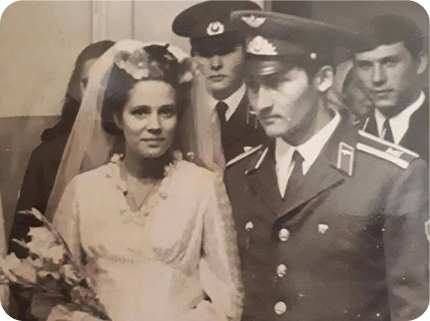
But if we’re talking about that first real day of work, when I returned after maternity leave—I was terrified. In total, I had spent two years at home with my child, which means all that time I thought more about diapers and formula than about medicine. Naturally, I had forgotten a lot; some things had become outdated, some things had simply slipped my mind.
And then that first work day arrived: my district, patients waiting for help. Nothing supernatural, really—treating acute respiratory viral infections, prescribing medications… But for me, every single pill was an event. I would prescribe them, then open my reference book to check—had I prescribed correctly? And if I prescribed something more serious, like an ECG, I would run to the functional diagnostics specialists afterwards and ask: Well, how does it look? Is everything all right?
My colleagues, understanding I was back from maternity leave, were lenient with me. But I didn’t spare myself; I approached every case with immense responsibility. And one day, one of the senior colleagues said: “Well, the way she runs around over every case, the way she’s afraid for every patient—that means she’ll be a good doctor.” That phrase really supported me back then.
Fear in your first year of work isn’t weakness. It’s a way to avoid making mistakes when you haven’t yet gained experience but are already responsible for other people’s lives.
— Did your sons resent you for not being around so often?
— Probably, yes. I left home when I was seventeen because I always felt this certain independence—I always felt as if I was born already grown up. And when I had my own children, I think I expected the same from them, even though I understood that they, like any normal children, just wanted their mother to be there.
When you’re a district doctor, you can somehow balance things. But when we moved here and I switched to hospital work, the night shifts began. And I am endlessly grateful to my husband, who took on so many responsibilities. He could have left, started another family, but he stayed and simply accepted that a wife who’s a doctor—yes, she’ll be away, which means he just has to be there. I was always thinking about my patients: hoping everyone would stay alive, everyone would stay healthy.
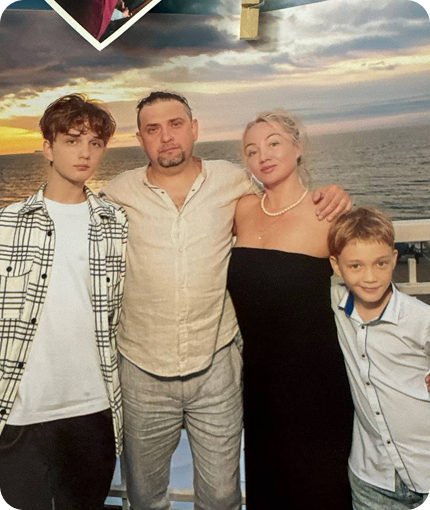
I remember once, my oldest son was eight. I came home in the morning after a shift and saw he was with his tutor. I didn’t even have the strength to wait until the lesson ended—I just collapsed on the sofa and fell asleep. I woke up because my son was covering me with a blanket and saying: “Mom, go back to sleep, the tutor left, everything’s fine.”
My youngest son was often sick, so I would take him with me to the hospital during my shifts. Everyone knew that the young pulmonologist was on duty with her child today. It probably looked strange, but I had no choice—I had to work. I could have taken sick leave and stayed home with him, but how could I leave? How could I abandon my patients, the administration, my colleagues? Maybe you’ll say I should have done things differently. Perhaps. But doctors of my generation still have that old training: we must fulfill our duty.
Now, looking back, I realize: they saw everything. They understood everything. And they don’t resent me. But sometimes I think they just don’t talk about it.
— You’re talking about the price a doctor pays, about those inner feelings that patients never even think about. Since we’ve started talking about the people close to you, the question arises: who is easier to treat—strangers or your own family?
— You know, everyone needs their own approach. With experience, you understand: pills are pills, but without human connection, they work completely differently. A person walks into your office, and you have to tune into their wavelength. Even if they’re angry, aggressive—there’s always something behind it. Maybe their child is sick at home, maybe they’re just so exhausted that politeness is the last thing on their mind.
My grandmother used to say: “Olya, no matter what golden pill you prescribe, without a kind word it won’t help.” And by “kind word,” she didn’t mean patting someone on the head. She meant simply being there. Listening. Not brushing them off.
I always say: “Let’s make an agreement. If you and I don’t find common ground, the treatment might drag on. Recovery isn’t just about pills—it’s also in your head.”
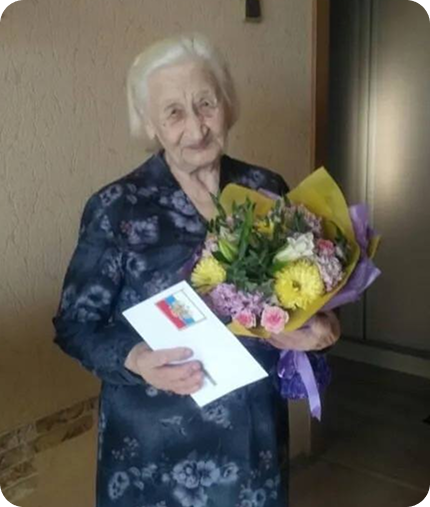
Of course, sometimes it’s difficult—I’m only human too. Sometimes I think, “why is this patient behaving like this?” And then I stop myself: “Maybe their life is such that anyone else in their place would have broken long ago. They have their own truth, and my job isn’t to take offense but to understand.”
My husband sometimes says: “Another woman would have run away from such a burden long ago, but you keep going. Thank you.” We’ve been together for 20 years. And that, I suppose, is also about approach.
— If you could go back in time and give yourself, as a young doctor, one piece of advice, what would you say?
— Probably, I would say: “Olya, stop worrying so much over every single pill.” I was too anxious. I would come home and immediately bury myself in books. The children were nearby, and I was in my books. My husband can confirm this—I had so many of those books at home because I constantly felt that I didn’t know something, didn’t understand something, that I was about to make a mistake and someone would suffer. Perhaps I needed to give myself more freedom, more inner calm. But on the other hand… how do you become a doctor without that? I still don’t know the answer.
It was always difficult for me to finish a twelve-hour shift and simply switch off, to stand up at exactly 5:00 PM and go home. I couldn’t do that. Maybe I needed to be braver. I needed to give myself more freedom, more peace, to allow myself sometimes not to think about work. But back then, I didn’t know how.
That’s what I would tell myself: “Olya, don’t be afraid. You already know enough. Just live.”
— We often tend to attribute almost divine qualities to doctors: they should know everything, be able to do everything, never make mistakes, never tire, never doubt. Do you think it’s fair to demand the impossible from a doctor? Should we be attributing the characteristics of God to physicians, or are they just people too?
— Just people too. I have a cousin. She worked as the director of an orphanage in Donbas, and she once said something I’ve never forgotten: “Olya, I’ve seen so many of these children, and they’re all so different. But I’m afraid that while I’m saving strangers’ children, my own will end up orphans.”
She gave herself to those children completely, without reserve, just like we doctors do. And perhaps someone would say: she was a God to them, because she gave those children what they didn’t have. But on the other hand, to those same children, she was just an ordinary person who had to be: had to be kind, had to be patient, had to be perfect. And reaching that bar that the children had set for her was practically impossible, because that bar was divine, and she was only human.
It’s the same with doctors. You give everything you have, you do everything you can, and the patient looks at you and says: “Not enough. You’re not God.” And they’re right, because you really aren’t God. You’re just a person who can’t jump over their own shadow. Some have more strength and knowledge, some have less, but attributing divine qualities to us is dangerous—both for patients and for ourselves.
God is somewhere up there. And we’re down here, with our hands, our books, our exhaustion, and our desire to help. And sometimes that desire isn’t enough, and sometimes it is—but it doesn’t make us gods. It makes us human.
— You just mentioned that doctors are people too, and they also need to learn, grow, keep up. Does a doctor always have the opportunity for self-improvement?
— You have to learn. There’s no alternative. You need to go to Moscow, to St. Petersburg—that’s where the main training centers are, and that’s where you find the specialists who can truly teach. Many institutes are opening now, but not all have good facilities, and you can’t get quality education everywhere.
But how do you learn when you’re a practicing doctor? According to the rules, you’re supposed to leave your position and go study. And who will take your place? The workload falls on other doctors, and there’s already a shortage of them in the budget system.
As a result, specialists increasingly turn to online education. Formally, the doctor completes their training there, but in reality? I’m not saying online education is always bad—no. But when it becomes merely a way to check a box rather than to impart knowledge, then problems begin. The doctor is left alone with the patient and whatever knowledge they already have. And that knowledge is often formed not in courses, but during night shifts, through mistakes, through the experience of senior colleagues who were fortunate enough to be nearby. And all of this happens against a backdrop of chronic fatigue and lack of time.
— You just described how difficult it is for a doctor to stay in the profession while also learning new things. Meanwhile, patients are also learning from the internet—diagnosing themselves, prescribing treatments. How do you feel about that?
— It’s not just dangerous. It’s deadly dangerous. Because you can miss that very moment when a person can still be helped, when you can intervene and pull them through. I know all about those “grandmother’s remedies”—vodka, sun therapy, baking soda, all of it. And I’m telling you: it’s a trap.
People turn to alternative medicine, to healers, to shamans, and an irreversible process begins. Time slips away. That very diagnostic window that could have saved them closes. And when the person finally comes to a doctor, evidence-based medicine is already powerless, because doctors can only work within the boundaries where there’s still something left to treat. Beyond those boundaries, there is only silence.
I’m not against traditional methods as a supplement, as support—but when they become a replacement for real medicine, it’s a catastrophe. All the scientific research, all the clinical trials, all the evidence base—they weren’t created for nothing. Behind them stand thousands of lives that could have been saved, if only they hadn’t fallen into that trap earlier.
— How do you feel about patients who don’t follow your recommendations?
— I feel bad about it. I feel badly, and I say so directly. If a patient has started treatment with a doctor, if they’ve chosen that doctor, it’s important to maintain contact and trust. Of course, if the doctor is competent, if they’ve prescribed something, then it needs to be followed. Not to please me, but to speed up the recovery process, to move on to prevention in time.
Someone forgot to take a pill, someone got scared of side effects, someone decided it would just go away on its own. But then such patients come back and say: “Well, maybe you can prescribe something now?” And I look at them and understand: the window of opportunity is gone. We can try, we can make an effort, but the result will never be as effective as it could have been if everything had been done on time.
And that’s frustrating. Because I know things could have been different.
— You see every day how humans are built, what they get sick from, what they suffer from. And lately, people are increasingly saying: our biology can’t keep up with how we live. We’ve become taller, heavier, we’re developing new bones—like the fabella in the knee, which almost no one had a hundred years ago, and now 39% of people have it. And at the same time, we carry genes that once helped us survive but now manifest as allergies, autoimmune diseases, unusual reactions. Do you sense this in your practice? Are we evolving—or just breaking down?
— Of course. And evolution is still happening now. In the past, people would dive for pearls and train their lungs; now we train our brains. Even if not intentionally—life has just changed that way. We receive all our information through screens, we react faster, we process more.
I think some of our functions will diminish, and others—on the contrary—will develop incredibly. For example, the brain’s capabilities haven’t been fully studied yet. Can you imagine what reserves are there? Evolution will stimulate certain areas—those responsible for decision-making speed, for information processing.
And other things will go away. Things that are no longer needed. Just like we once lost our gills and tails.
— There’s a concept called the placebo effect. From a scientific standpoint, it’s a mystery: give someone a sugar pill, and they feel better. Their brain chemistry actually changes, endorphins are released, pain decreases. As a doctor, have you encountered this? Have there been times when you realized it wasn’t the medication helping, but something else?
— Medicine truly doesn’t stand still. We’re all a little bit Botkin, a little bit Avicenna now. What did we have before? You listened, you looked, you tapped—and that was it. I won’t argue, taking a patient’s history is 90% of diagnosis, that’s sacred. But now we have CT scans, MRIs, ultrasound. We see what before we could only guess at.
And this “before” and “now” are constantly at odds. So much in the past was cut out on the principle of “we’ll remove what’s extra, and we’ll see what happens.” And now you look back and see that the scalpel itself was the extra thing.
But the placebo effect isn’t about “not needing treatment.” It’s about something else. It’s about the fact that sometimes a person doesn’t need a pill—they need attention, or hope. But if a patient has a blood clot in their heart, saline solution won’t cure them.
And antibiotics—that’s a whole separate pain. They’re prescribed so often now, and not just by doctors. People prescribe them to themselves, take them however they want, don’t complete the course, don’t follow the dosage. And we’re already seeing where this is leading. In the United States, for example, they found a strain of Klebsiella that doesn’t respond to anything at all. Absolutely nothing. That’s the future. That’s where we’re heading.
They say there are already new antibiotics in laboratories that we don’t know about yet. And it would be good if they reach us quickly, but for now, we work with what we have.
And besides, if one antibiotic doesn’t work, we can see that, which means it needs to be changed. We’ll do a culture, of course, but it takes six days for results, and the patient is here right now. That’s why it’s so important to only take medication under a doctor’s supervision.
Anti-inflammatories—Nurofen, ibuprofen—they blur the picture. They reduce fever, and fever is an immune defense. We remove it, we take it away, but the viruses and bacteria haven’t gone anywhere.
Mothers give their small children fever reducers, they bring the temperature down and down, and then the child ends up in intensive care. Because the disease process continues, but the body’s defense is gone.
In the first few days, we treat ARVI, we treat the virus—and a virus, to put it simply, opens the door for bacteria. If the body doesn’t cope, if antivirals don’t help, bacteria move in—and that’s already complications.
So balance is needed in everything. In pills, in faith, and in knowing when to stop and think: what am I actually doing?
— You mentioned antibiotics and how bacteria become resistant to them. It’s already happened: we’re in an arms race with the microworld. On the organism’s side, on the human side, what can we do to simply prevent infections from taking hold? Or do we already live in a world where this is inevitable?
— A strong organism can handle it on its own. That’s why I always say: for the first five days of an acute viral infection, we simply observe. We might give anti-inflammatories, general supportive care, antivirals—depending on the situation—but we let the body work. If the cold drags on beyond five days, if a cough with purulent sputum appears, or if nasal discharge turns yellow-green, that means bacteria have joined in. Then it’s time to see a doctor, run tests, and bring the course of the illness under control.
Antibacterial therapy isn’t evil—it’s necessary when truly required. But everything must be rational, timely, and as prescribed. Don’t grab antibiotics at the first sign of a 38-degree fever. Let the body fight; the immune system doesn’t exist for no reason. If after two or three days the temperature goes down, it means the body coped—continue treatment, provide support. But if a second wave begins, that’s when you go to the doctor, no alternatives. Self-treatment ends there.
— We were discussing that bacteria mutate faster than scientists can develop new antibiotics. Is there a chance that genuinely effective new substances will emerge?
— Work on fundamentally new antibiotics is already underway. They haven’t officially announced this at conferences yet, but information has been surfacing in some sources. Not widely, but it’s happening.
But here’s something important to understand: any medication, any substance, is always developed for the average person. Any new drug is designed for a population: it will help 90%, and it won’t help 10%. That’s statistics. It’s always been this way and always will be.
Yes, each organism is individual, but we all share the same set of chromosomes, the same receptors. Everyone’s eyes, nose, ears work according to the same principles. So as a whole, we will react to a new substance similarly.
Individual reactions haven’t been canceled, but the foundation, the basis, will always be common. That’s what scientists and doctors rely on. Otherwise, you couldn’t build any science at all.
So yes, new antibiotics will appear. Fundamentally new ones, not from the same base as before. But they will still be aimed at the majority, and the body will take its own course.
— Olga, what do we lack overall? You—as a doctor, people—as patients, all of us—as human beings who get sick, treat, wait, and hope.
— We lack personnel. First and foremost—people, and secondly—equipment. For example, there’s a method called lung scintigraphy: a radioactive substance is injected, it distributes through the bloodstream, and a special machine detects where it’s illuminating and where it’s not. It’s an excellent method for assessing blood supply.
We don’t have PET-CT at all. And that’s positron emission tomography—a simultaneous examination of the entire body. A radiopharmaceutical is injected, and all affected cells begin to glow. Metastases become visible as if on the palm of your hand. If a regular CT scan doesn’t show them, but this does—it means chemotherapy can be prescribed, there’s still time. Not always radically curative, but a person will live longer. That’s an enormous difference.
We don’t even have contrast-enhanced CT everywhere. And contrast CT reveals the small vessels, the details—it shows everything. That’s what we lack: the ability to see what the eye cannot. And to see it in time.
— We talk so much about immunity: boost it, strengthen it, suppress it, weaken it. Does it actually exist? As something tangible, or is it just a word we use for things we don’t understand?
— Of course it exists. Both humoral and T-cell immunity. T-cell immunity is the first to encounter infection on the mucous membranes. Tissue immunity triggers a cascade of reactions, and then humoral immunity kicks in—the one dissolved in the blood, the antibodies.
All of this is real. There are congenital disorders, primary immunodeficiencies, secondary ones. But overall, immunity certainly exists.
Have you heard about telomeres?
— Of course.
— They’re the ends of chromosomes. People with longer telomeres live longer. They shorten with age, but there are medications that can help maintain their length. Genetically, some people age more slowly, and others can be helped.
Immunology is a distinct discipline altogether. It’s not a textbook chapter you can learn and forget. It’s a science you have to live, not just know—because everything is interconnected: one cell triggers another, one mechanism activates ten others. If you don’t have a feel for this system, you’ll prescribe the wrong things in the wrong ways. But when research exists, when medications have undergone trials, that means they work.
Personally, for example, I really like Polyoxidonium. It’s a stimulator of phagocytosis and antibody formation. It’s not like Viferon, where the interferon is ready-made; it’s a medication that makes the body produce its own defense. I felt its effect on myself, on my family, and two years ago I started prescribing it to patients. And this year, it was included in the treatment standards for viral infections. Do you understand? I’ve been prescribing it for two years, and only now has the research caught up.
So immunity does exist. And you can work with it. The main thing is not to interfere and to help when needed.
— At the same time, there’s this opinion: “The immune system should work on its own without external help.”
— Well, I suppose that opinion has a right to exist. People lived without antibiotics before, after all. The only question is: for how long, and with what quality of life?
Maybe on some level, psychosomatics plays a role: a person starts taking handfuls of pills, believes it will help them, and they actually do feel better. But here, everything also depends on the virus itself—its aggressiveness, the dose a person received.
Imagine this: someone takes vitamin C for five days at 90 micrograms, and everything turns out fine. Why? Because the infectious dose was small; the body handled it on its own, and the vitamin C just sweetened the deal. But another person sits in an office where five colleagues, already on day three with 39-degree fevers, keep coming to work. This person is constantly in that hot zone. I think vitamin C alone won’t be enough for them.
So it’s not that immunostimulants are harmful. It’s that they, like everything else, require a thoughtful approach. And if the infection is strong, faith in pills alone won’t save you.
— There’s another popular belief: if you take vitamin C, you won’t get sick. Is that true?
— I had a patient who took massive doses of vitamin C for six months. Maximum doses, borderline amounts. And eventually, he came to us with sarcoidosis. I ask him: “What have you been taking? Where have you been? What have you been doing?” We go through everything. No one in his family had ever had anything like this—clean genetics. And the only thing that came up in his history was those six months of vitamin C overload.
The etiology of sarcoidosis is completely unknown—we can’t say exactly what triggers it. But when a patient themselves says: “I was drinking vitamin C by the liter for six months,” it makes you think.
Yes, vitamin C is water-soluble—it’s supposed to be excreted, not accumulate. But it can form salts in the kidneys, leading to kidney stones. And, as you can see, it can affect immunity in a way that causes it to malfunction.
So everything is poison and everything is medicine. The main thing is the dose. And the timing. And taking things without a doctor’s prescription.
— People are often afraid of being left without medication and buy up half the pharmacy. What can you definitely do without, and what absolutely must be on hand? What should a home medicine cabinet look like?
— First and foremost—anti-inflammatory drugs. Nise, Nurofen should always be there. You need antispasmodics: No-Spa, drotaverine. Can’t do without them. Your medicine cabinet must have an antiseptic—at least furatsilin or miramistin. Put in wound care supplies: bandages, plasters.
If you’re going on a long trip, I’d also recommend taking an antibiotic. Not to start taking it right away, but to have it on hand. In case a fever drags on, purulent sputum appears, and you’re in another city with no idea where to go. If you tolerate amoxiclav well—take it.
If possible, equip your medicine cabinet with a portable nebulizer that fits in a bag. You can add Pulmicort, saline solution. If a severe cough suddenly starts, a spasm, or if a child develops croup—only inhalations will help. This is very important.
Vitamin C won’t be out of place. Expectorants—Fluimucil, ambroxol—are also good to have on hand. And your medicine cabinet absolutely must contain an adsorbent: lactofiltrum, smecta, regular activated charcoal. And antiallergics: loratadine, Zodak.
— Then another logical question: are there medications you can do without?
— Well, I don’t particularly trust sage lozenges, all those herbs. People say: “It helps me.” But if an illness has really taken hold, if it’s not a mild discomfort but a genuine infectious process—herbs won’t help. You need medications with proven efficacy.
Medicines have a one hundred percent therapeutic effect—when we’re talking about active substances. But all these dietary supplements, homeopathy—if they cause harm, that’s fine, because no one is responsible for them. Their principle is “do no harm,” but the principle of “help” isn’t there.
This has always troubled me, and now even more so. Because doctors are increasingly becoming salespeople. This is wrong—because we are doctors, and we don’t want to sell, we want to heal.
They didn’t teach us about dietary supplements in medical school. Maybe if you take them in horse doses for six months, something might change. But nothing more.
What really works are blood thinners, hormones, antibiotics. Yes, there’s a problem with antibiotic resistance now, but that’s another story. They work—and that’s proven.
That’s the foundation. Everything else—well, let it be there if you want. But not instead of, only alongside. And preferably under supervision.
— Olga, are you afraid of getting sick yourself?
— Like any normal person—I am afraid. Life is such these days that it’s better not to get sick. Especially since I have people I’m responsible for. In this life, no one will support me except myself. Only my husband. That’s all.
Right now, my oldest child is studying in St. Petersburg. He caught a cold there, called me, and my heart just sank—I’m not there, I can’t come, I can’t see him, I can’t give him an injection. Of course, I wrote out everything for him, but who will make sure he follows it? My son is eighteen: today he takes a pill, tomorrow he forgets, he feels better—and that’s fine. I’ve been treating him for three days, and my heart is still uneasy: is he taking them or not?
That’s how it is every day. At home—I’m there, I check, I give medicine, I give injections, I monitor. But there—only a voice on the phone. So yes, I’m afraid of getting sick. Not so much for myself, but for those who would be left without me.
— Our interview is coming to an end. Tell me, please, what is there in us, in all people, that we ourselves don’t know about?
— We don’t know our own reserves. We don’t know at all. There was a girl in our regional hospital, Valeria, with pulmonary hypertension—a congenital condition. She was put on the waiting list for a heart-lung transplant. She had lost so much weight, could barely hold on. We collected money for a portable oxygen concentrator because she was already dependent on it. I even posted about it on social media. And she’s still alive. Alive! She reads books, she hasn’t given up on herself, she hasn’t written herself off. She’s fighting to gain weight so they’ll take her for surgery. Do you understand? Doctors give prognoses, but she lives. Because she has someone to live for.
Or my mother. They gave her very little time, but she lived another year because she wanted to live, because she was determined to live. Even though the prognoses said otherwise.
This is what I call reserves. We don’t know what we’re capable of. What strength, what endurance we have.
And you know, this works not only in such serious cases. In our pulmonology department, there are severely ill patients who can’t breathe. You come to them, sit beside them, talk to them, calm them down, and their shortness of breath eases. You give them a little more oxygen, just a bit more, and the person starts breathing—because someone heard them, because they believed it would get easier.
So faith isn’t an abstraction; it’s part of treatment. However much time we’re given, if we believe, there will be more. Always more.
You have to believe in yourself. No matter what anyone says.
— Olga, what do people most often thank you for?
— For kind words. For not giving up on them. For referring them somewhere, for not passing by, for paying attention. That’s what for. As for curing them—well, that’s just my job. The main thing is for a person to know they’re not alone.
You’re not alone either. We’re all here, in this big world, holding onto each other. Sometimes with a doctor’s hands, sometimes with simple compassion.
Everything will be fine. It really will. Live long. Be healthy.
The cell divides into the nucleus and cytoplasm. Our journal divides into interesting facts and discoveries.
Thank you!

Similar articles | Individuals