Category: Cognitive technologies
The mirror code. Why the most honest invention deceives us
“If a mirror reflected the truth, no one would ever look into it. Luckily, it reflects only light — and our expectations”
from the course Applied Optics for Mechanotoids
Me. Again me. Still me. The dark window of a night bus, where my silhouette dances with the silhouettes of streetlights. The polished flank of a kettle. A not-quite-elegant shop window showing my crooked likeness among mannequins. A puddle after rain, into which the sky has fallen and now lies perfectly still. And finally — His Majesty himself — glass with a secret, the thing that knows how to reflect.
So why does it not reflect, but present? I wonder: when some prehistoric human first stared into calm water and saw his own clay-smeared face staring back — was he delighted? Or terrified? “Whoa!!! In all these things — it’s me. Again me. Still me.”
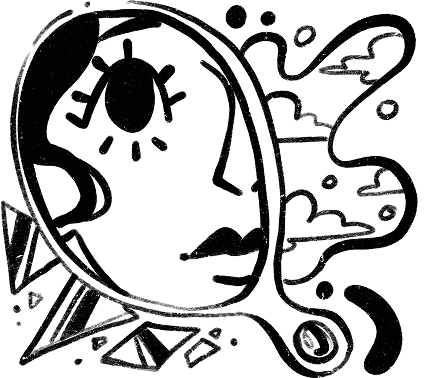
Folk wisdom hits the mark: “Don’t blame the mirror if your face is crooked.” Thousands of years have passed, and nothing has changed. We still look for someone to blame even for things that depend on no one at all. Break a mirror — that’s it, seven years of total misfortune, the crystal skeleton of the universe shattered. Mirrors were covered with cloth so a dead person’s soul wouldn’t get lost in glass labyrinths. The sick and infants weren’t allowed to look into them — who knows what that cold twin-world might be plotting? All because beyond the glass lives a phantom — a reflection that obeys its own mirror logic. And God knows what it’s thinking.
And so it went. Carroll sent Alice stepping through the looking-glass — into a world where queens scream “Off with her head!” and poems read backwards, inducing mild nausea. Pushkin introduced a magic mirror — a snitch and cheerleader for royal vanity, a chatty artifact. Oscar Wilde hid a conscience in the attic in the form of a portrait that aged and rotted instead of the beautiful Dorian. Borges went further: he called mirrors “the fatherhood that multiplies men” and feared them as a nightmare of fertility. He was right to be afraid. They really do multiply.
Vampires don’t appear in mirrors — logical enough: no soul, nothing to show. Sleeping Beauty was reached by the evil fairy straight through a fireplace reflection — a back entrance to reality. The Japanese managed to lure the Sun Goddess Amaterasu herself into a mirror — Yata-no-Kagami — and still keep it in a shrine as the embodiment of truth.
The earliest mirrors were obsidian disks from Anatolia, eight thousand years old. In the 13th century, Murano’s Venetian glassmakers guarded their secrets so fiercely that craftsmen faced death for trying to leave the island. Their mirrors cost as much as a war galley. Then, in 1835, the chemist Justus von Liebig invented silvered glass — and the mirror went mass-market. Along with our daily, voluntary torture by self-contemplation.
Today, we don’t look into mirrors. We take selfies. An instant self-portrait — filtered, retouched, polished for immediate launch into social media: giant public mirrors where our reflections compete for likes. We no longer live inside a single reflection. We live in a shattered kaleidoscope of our own distorted copies. The phantoms have escaped and are multiplying at internet speed. Yet beneath all this madness hides that same first, stunned moment — when the reflection stopped being it and became me.
The history of the mirror is the history of a long, painful, and occasionally idiotic recognition of the self: from magical awe to philosophical pomposity, from luxury for the few to everyday neurosis for everyone, from one clear (or not so clear) face in the glass to an endless, exhausting digital carnival.
How can we see the most accurate and the most deceptive reflection of reality at the same time? How did the most honest optical device become the most deceitful psychological object? What does the mirror know about us that we don’t know ourselves?
Me again. Still me. Always me. And it seems there’s nothing to be done about it.
– Turn on the lights immediately! Are you out of your mind?
– What’s wrong?
– Everything is wrong. We raised you on the works of respected scientists, and now you’re writing for a popular science magazine — not a mystical detective novel. Who exactly are you trying to expose? The mirror? Or yourself?
– Yes, but mirrors have always been associated with…
– Don’t you start. Forget magic. Forget souls. A mirror is a mirror. We need stubborn facts.
It turns out I am not there at all. In the mirror, photons reign — tiny messenger particles carrying information about the world straight into your eyeballs. Your face doesn’t glow on its own, tempting as that idea may be. It’s lit by light. That light hits your noble physiognomy, scatters in all directions, and some of those fugitives reach the glass.
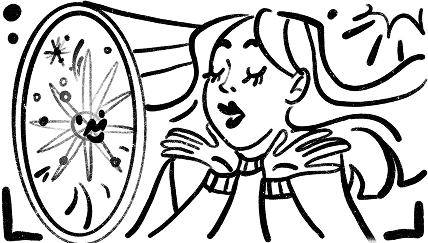
And here’s where things get interesting. If those particles hit a wall, a book, your T-shirt, they’d scatter chaotically, lose their original direction, turn into mush — and your glorious image would smear into a colored blur. But a mirror is different. Inside it occurs a genuine betrayal at the molecular level: a thin metal layer is applied to the back of the glass (once silver, now aluminum), and this layer refuses to let light through. It throws it back.
A mirror obeys one iron law, as rigid as a bicycle chain: the angle of incidence equals the angle of reflection. Imagine a light ray as a ball thrown at the floor at an angle — it bounces off symmetrically. The mirror surface is a perfectly smooth, icy floor where the photon-ball cannot splatter. It can only ricochet back along a precise, predictable path.
That’s the whole secret. Billions of such balls, rejected by a perfect metallic wall, fly back into your eyes. Your lazy, optimization-loving brain takes these orderly rays and constructs a ghost behind the glass — your complete, perfect, and utterly nonexistent double. Scientists call this a virtual image: an image that doesn’t really exist. You can’t touch it. You can’t project a slide onto it. All your reflections are nothing more than a collective hallucination prescribed by the laws of geometry.
Speaking of geometry. Why does a mirror swap left and right but not top and bottom? Because the mirror has no idea what “left” or “right” even are. It operates in X, Y, and Z axes and flips not the image, but space along the axis perpendicular to its surface. Roughly speaking, it turns the world inside out in depth — what was closer to you becomes farther away in the reflection.
A mirror is light from a real object, faithfully transported back to you along a conveyor belt of ironclad physical laws. You are staring at a perfectly tuned illusion-producing machine, patented not by sorcerers but by physicists. And it has worked flawlessly for billions of years — ever since the first smooth surface of water appeared.
– Turn the lights off! And then what?
– Me. Again me. Still me. And bits of photons.
– Was I unclear? I need material about a human invention from the past. About a piece of glass that reflects objects. Its functions, properties, materials… experiments, at least!
– There weren’t many experiments with mirrors. The most memorable ones happened to a polite, curious, and determined girl with a vivid imagination who tried to understand the absurd rules of Wonderland despite their complexity.
– Who are you talking about?
And here, dear Alice Through the Looking-Glass, is your moment. Let’s tell the world that your adventures were not pure literary fantasy. A mathematician brought you into a mirror world — which means your passage through the glass was simply an unconscious use of quantum tunneling, and your journey across the chessboard was a pristine algorithm for exploring probabilities in a quantum labyrinth. If we assume that the photon carrying your image has already been on the other side and knows the way, then the mirror surface is not a boundary, not an obstacle, but a gateway.
– Turn the lights on! You’ve dragged quantum physics into this too?!
Forget light rays. Forget metal layers and photon balls caught in mirror traps. On the quantum level, everything is probability. The very particles composing both the mirror and your body exist neither “here” nor “there” — they exist in all possible places at once, until you look at them. This is called a wave function.
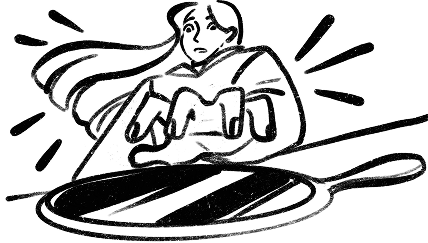
A photon flying from your face toward the glass is not a ball, but a packet of probabilities. Classically, it either reflects or (if the mirror isn’t perfect) gets absorbed. In the quantum world, it does both at once. Its wave function spreads across every possible path: reflection, absorption, strange scattering… In a sense, every photon that reaches a mirror slips into it just a little and passes through. The probability is tiny — but not zero.
If we could see the world at the quantum level, our reflection would be a swarm of ghostly copies, each corresponding to a possible photon path. We wouldn’t see one self in the mirror, but a misty cloud of all possible selves, faintly glowing through the glass. That is the true looking-glass world — the space of quantum probabilities. Alice wouldn’t even need to open a door to get there. She’d only need to dissolve into uncertainty.
– Turn off the lights! Good Lord… Through the Looking-Glass. Are you seriously claiming right now that a girl from a children’s book traveled using quantum tunneling?
– But the principle…
– I DON’T CARE ABOUT THE PRINCIPLE! I care about facts! Explain to me how this wave function helps me understand why every single damn day I see my sleep-deprived mug in the mirror. Or are you suggesting that my reflection lives somewhere on its own and has the audacity to fall through the glass? Is that a diagnosis?
Let us assume that the looking-glass is simply two mirrors facing each other. In an experiment governed by classical physics, light would bounce back and forth between them, creating a tunnel. But in the quantum world, something else happens between those mirrors—what physicists call an optical resonator.
A photon caught in such a trap ceases to be just a particle. It becomes a standing wave. Its existence between the mirrors is no longer a sequence of jumps; it turns into a single, unified state. Roughly speaking, you can no longer tell which mirror the photon will reflect from, because it is everywhere and nowhere at the same time.
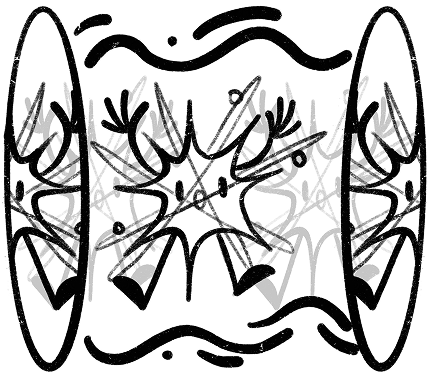
And meanwhile, the unobserved photon creates its own “looking-glass”—a space where the classical notions of “here” and “there” lose their meaning. This is precisely the principle behind lasers: devices that have domesticated the quantum looking-glass and forced light to behave as a single, disciplined wave.
If photons were to become “different” in the quantum world—if they stopped being bosons, the carriers of light—electromagnetic force itself would vanish. Atoms would collapse. Matter would disintegrate. There would be no mirrors, no Alice, no questions.
Perhaps Alice simply did what we lack the courage to do: she stopped believing in the impenetrability of glass and stepped into a different state of perception.
Technically speaking, we, our reflection, and the emptiness between mirrors are all part of a single entangled quantum state. Which is why the question of “how to get into the mirror” dissolves on its own and is replaced by another: how to recognize oneself on the other side of the glass.
– Turn on the lights! Me, me again, and Alice? Did I guess right?
– No. You didn’t. Me. Again. And entanglement.
– Entanglement. Wonderful. Is that a mantra now? I’m asking for a logical step, and you’re feeding me a cocktail of diagnoses and incomprehensible science!
– Request acknowledged. It is necessary to establish a connection between quantum entanglement and the phenomenon of reflection within a cultural context.
– No! I need an explanation that won’t make the reader think the author has lost his mind!
– Perhaps the most relevant example would be a violation of classical reflection laws in popular culture, to reduce cognitive dissonance. For instance, the mythological vampire.
– Who?
– A vampire. A creature that does not reflect in mirrors. This myth represents an intuitive negation of the principle “angle of incidence equals angle of reflection” and may serve as an illustration…
– Stop. Just start the next paragraph with “Is it even possible not to reflect?” And not a single word about “reducing cognitive dissonance.
Is it even possible not to reflect in mirrors? From the standpoint of classical optics—no. Any object struck by light interacts with it in some way: it absorbs, scatters, or reflects it. For vampires to not reflect at all, they would have to become perfect black bodies, absorbing 100% of the incoming radiation. But then we wouldn’t see their absence in the mirror—we’d see a perfect, human-shaped black hole against the background of the room: a vacuum silhouette far more terrifying than any reflection.
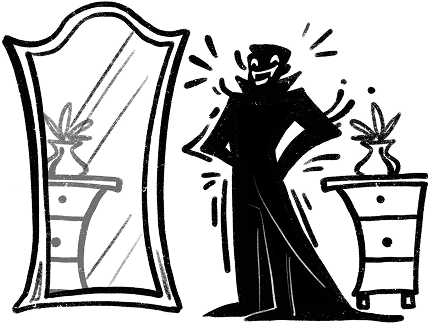
One could, however, imagine mirror vampires. If their skin were a perfect mirror, they would reflect everything around them, blending into the background like chameleons. In the mirror, we would see a distorted room with a human-shaped hole patched together from fragments of the interior. But this would not be invisibility—only optical mimicry.
So physics is merciless here. But then why does the myth of vampires who don’t reflect in mirrors cling so stubbornly to our imagination? Because these stories are not about optics. They are about the deeper function of the mirror.
Since ancient times, the mirror has been less a tool for examining the face and more a tool for detecting the soul. Divination, rituals, covering mirrors with cloth—all of this treated reflection as a double, a spirit, an entity. Not to reflect means not to have such a double—to be a being without an inner “self,” without a personality that can be presented to the world or to oneself.
Here lies the terrifying truth of the myth: the vampire does not reflect because it is an anti-self, an antimatter being, pure emptiness that consumes lives of others but cannot generate an essence of its own—something that could imprint itself on glass. There is nothing for the mirror to show, because there is no inner content that makes a person a person. The vampire is a walking negation of selfhood.
Do we fully reflect in the mirror? Is that exhausted creature with greasy hair and an earthy complexion staring back at me really me? Could the connection between the inner self and the external image snap, leaving behind an empty, alien shell in the glass?
Oh no. The vampire myth is a brilliant metaphor that exposes the sacred nature of the mirror: it reflects presence. Being. Selfhood. And if there is no self, the mirror has nothing to display.
Which means that every time we look into a mirror, we unconsciously verify ourselves: yes, I am here. Yes, I have something inside me capable of leaving a trace in the world. Yes, I am real.
Me again. Me once more. And for the first time, I think I’m glad about it.
– Glad? So my certainty that I am myself rests on mirages? Turn off the lights!
– The mirror provides the first coherent picture. The brain believes convenience.
– And where does that belief lead?
– To the necessity of answering the question of how belief itself works.
And why, exactly, must we always believe this glass phantom? Why, seeing its warped likeness, do we nod, wink, and go brush our teeth instead of calling an ambulance with suspected visual hallucinations?
The answer is embarrassingly simple: we cannot not believe it. Our brain is engineered to trust this particular kind of hallucination. It is a sentence handed down by the architecture of perception.
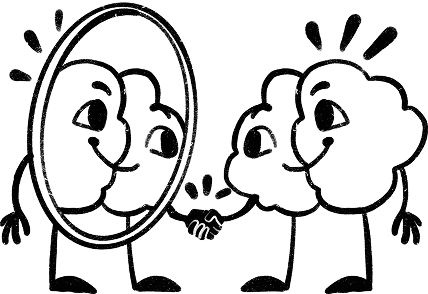
The mirror exploits a fundamental bug in the human system: we have never seen our own face. Never. What you think of as your appearance is a patchwork of a blurred nose in peripheral vision, the sensation of touching your skin, and accidental reflections in shop windows. The mirror is the first and only source of a complete image. We don’t believe the picture—we believe the convenience, because for once everything lines up.
The mirror passes the ultimate credibility test: causality. Raise your hand—the phantom raises its hand. Lower your head—it lowers its head. Isn’t that proof that the control center is located here, on this side of the glass? For the primitive processor inside the skull, the logic is ironclad: what I control is me. The mirror doesn’t lie at the level of action; it lies at the level of essence, substituting an image for a self. But a brain untrained in philosophy gladly accepts the swap.
Belief in reflection is a cornerstone of psychological survival. Imagine, for a moment, that you stopped recognizing yourself in the mirror. Your reflection would become a stranger—hostile or indifferent—mimicking your movements. One of the core circuits of self-identification would collapse, leading to terror and disorientation. Normality depends on that circuit working, and it works only because we trust the mirror signal.
So should we believe it? Yes. Like a cripple trusts a crutch. Without it, our self would limp through darkness, feeling out its boundaries blindly.
Should we believe it unconditionally? Absolutely not. Because the mirror knows exactly one thing about us: how we look at a specific moment under specific lighting. It knows nothing about our thoughts, memories, pain, or hopes. It is silent about who we were yesterday and who we will be tomorrow. Its truth is the truth of the surface, the momentary, the visible. All other truth remains on this side of the glass—inside us.
The digital age has pushed this conflict into absurdity. We create dozens of reflections—on social media, in work avatars, on video calls. And a brain trained to trust a single mirror begins to short-circuit: which phantom should it believe? The answer is the same: none of them. One must believe not the image, but the one who creates it—the hand that shaped it, the biography behind it.
A mirror can be trusted as a precise optical instrument, but as a source of truth about oneself—never. Its role is to provide raw material from which consciousness repeatedly assembles a functional model of the self.
Me again. Me once more. Or whatever it is they showed me.
– Turn on the lights! Delete it. All this pathos—delete it.
– Request unclear.
– Pretend you’re human. At least for five paragraphs.
– Understood. Attempting.
A roadside café. A solid man sits at a table by the window. His appearance speaks for itself: a perfectly tailored suit, an expensive watch, the habitual posture of someone accustomed to occupying space as a matter of course. The camera catches his hands: with one he adjusts the flawless knot of his tie; with the other he nudges aside a set of car keys with a German emblem keychain. Casually twirling the keys to his luxury sedan, he takes a small sip of coffee, then pulls a flat flask from his inner jacket pocket and presses it greedily to his lips. After a couple of gulps of expensive cognac, he hides the flask again with profound relief.
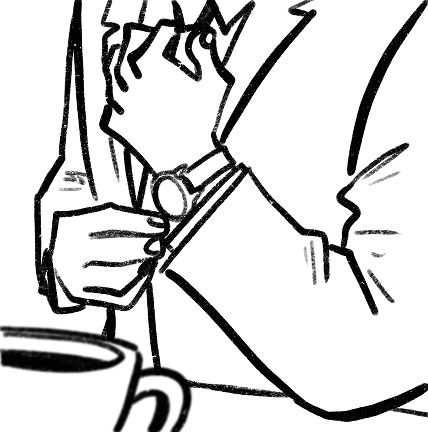
It’s been a tense day, but every nerve cell sacrificed was worth it: the new contract would secure his company with orders for years. The figures in the agreement made his head spin, and now he was already converting them into net profit, mentally discarding taxes and expenses.
“Is this seat taken?”
The quiet, calm question pulled the man out of his world of numbers and back into the cozy café by the gas station.
“What?” he asked, still half-lost among guaranteed orders, reaching for his keys.
“May I sit here?”
A man in motorcycle gear stood beside the table, about thirty years old. His helmet dangled from his elbow, and in his free hand was a simple cup of tea.
“Of course,” the businessman replied, glancing around in confusion at the many empty tables.
“Thank you,” said the biker, sitting down opposite him and placing the helmet on the adjacent chair.
For a few seconds, silence filled the café, broken only by the hum of a refrigerator and the crackle of the coffee machine. To fill the awkward pause, the businessman furtively glanced around, pulled out his cherished flask again, and—winking slyly at his neighbor—took a sip.
“To having everything—and getting away with it!” he proclaimed, raising the flask triumphantly.
The cognac burned sweetly down his throat, and for a moment the world softened.
“Hey, can I ask you something? Been curious for a while,” the man said, catching the biker’s calm gaze.
“Sure,” the biker replied, sipping his tea.
“What’s the point of all this?”
“Of what exactly?”
“Well… all of it. Motorcycles. Two wheels. A saddle. Constant shaking.”
“Oh,” the biker smiled faintly. “The ‘romance’ again.”
“Yeah. The rides, the meetups… What for?”
“For silence.”
“What kind of silence?”
“Inner silence. When at full speed the swarm of thoughts cuts off, and only the road remains. Purity. It’s worth more than any soundproofing in your car. More—because you can’t buy it for any money. That’s the life we’ve got.”
The businessman leaned back in his chair.
“Life, my friend,” he said indulgently, stretching the words, “is when your home is a full cup. Kids in an elite college”—he deliberately stressed a nonexistent vowel—“with an eye toward studying abroad. Business calculated ten moves ahead, like chess.”
The biker slowly turned toward the window.
“Maybe that’s true…” he said quietly. “Maybe I’d live like that too…”
He rose slowly, as if weighed down, and walked to the window. Through his jacket, his shoulders were visible—calm, like wings folded before a leap.
“Maybe I could have…” he repeated even more softly, almost to himself.
“And who’s stopping you?” the businessman asked with a smug smile, taking another victorious sip from his flask. “The door’s open.”
The biker turned from the window and looked him straight in the eyes.
“Because once… you killed me.”
The phrase hung in the air. Absolute silence fell.
“…You killed me.”
The café space collapsed into a flat, grainy black-and-white frame. A howling sound rose, and the biker’s face became a faded photograph on granite. Then came two abrupt, real shots from a dashcam: the screech of brakes, the rear door of a sedan, and the dull thud of a body hitting asphalt.
– Turn off the lights! I think I’m starting to understand something.
– Formulating final thesis.
So what does the mirror know about us that we don’t know ourselves? It knows the main secret: the self does not exist without another self. Without someone who looks from the outside.
The mirror allows us to play a simultaneous game: I am the one who looks, and the one being looked at. These two, combined in a single body, begin a dialogue from which what we call personality is born. And the mirror knows that without this split—into two mirrors—we would never have become who we are.
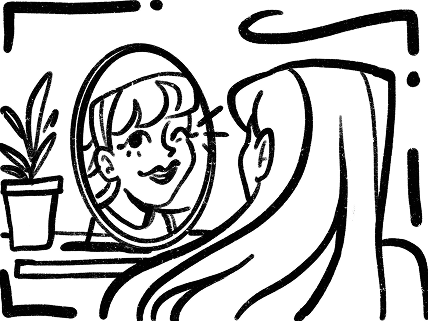
At first, the raw material was crude and mystical: rippling water, gleaming stone. Then it became sharp and frightening. Then mass-produced and familiar. Now it is digital, fluid, and endless.
A creature assembled from shards of light, laws of quantum probability, ancient myths, and electrical impulses continuously constructs a convincing and vitally necessary hallucination called the self.
Me again. Me once more. I think I’ll go look at myself in the mirror. Turn on the lights.
Is there life on Mars, or is there no life on Mars? Join the eternal debate on paradoxes!
Thank you!