Category: Life technologies
How to find beauty in ugliness
“Imperfection is beauty, madness is genius, and it’s better to be absolutely ridiculous than absolutely boring”
Marilyn Monroe
Let’s admit it: for most of the day, our gaze works in spam-filter mode. It automatically discards 90% of visual information without giving it a chance. A cobweb in the corner, a crumpled boot, grandma’s sweater with reindeer—all of it is instantly sent to the trash folder of ugliness. The world gets tagged with ruthless efficiency: “not mine,” “ew,” “uhh…,” “next.” Our brain is lazy, like a Roman patrician at a feast, and loves being served ready-made, pre-chewed aesthetic canapés—preferably without crumbs on its snow-white toga.
Take, for example, a rusty can by the fence. For our inner aesthete, it’s junk. But for a cat? For a cat, it’s an entire universe: a rustling artifact of unknown purpose, a potential prey, a source of mysterious smells of rain and iron. So which of us, I ask, really knows how to live?
It’s all about our cognitive autopilot—the very “System 1” described by Daniel Kahneman: fast, emotional, and brazenly categorical. It sees a wrinkled face and instantly switches on the effect “Old age. Sadness,” ignoring the map of lived battles, love, losses, and quiet victories. This inner king-judge is the main culprit behind our boredom and aesthetic pickiness; he won’t let us taste the wild, tart berry of reality. But if we seat him in the student’s chair, we can activate the slow, curious “System 2” and train it in a new discipline—ethical optics.
We’re not calling for a forced love of bad taste. We’re talking about generosity of vision, about giving the world a chance to unfold its second, third, tenth meanings. You remain a spectator, but you also become a detective, an archaeologist, and an artist all at once: you investigate scars, admire the graphics of wear and tear, and see potential where others see only the end credits.
If you want to experience that very feline pleasure of contemplating the world without censorship, then let’s take a deep breath and send our inner critic on vacation. We’ll begin to really look—and perhaps find the ugly devilishly attractive.
The thing is, since birth our eyes have come with a built-in filter app—a collective project called Culture. It was assembled by everyone: grandma’s warnings (“don’t touch it, it’s dirty!”), school stereotypes (“the sun must be yellow!”), glossy magazines and social media that convinced us that ideal = successful = beautiful = worthy of love.
You can’t delete the filter, but you can learn to switch it off temporarily, to give the unprocessed world a chance to reveal itself in all its complex, thrilling beauty. Time to roll up our sleeves and move on to field tests.
Exercise 1: Devil’s Advocate and the Rusty Pot
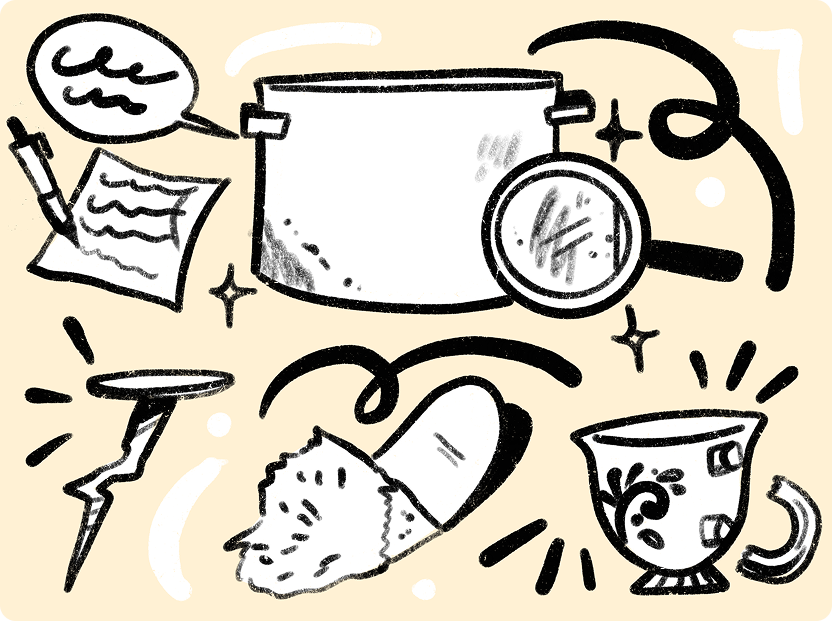
Imagine yourself as a detective from Department “K” (for cases of aesthetic repression), whose task is to clear an object of the charge of “ugliness.” Choose something you instinctively want to look away from. This is now your client, and you are their passionate defense attorney. Compile a full dossier.
Ask the object questions that will either make it rust or crack even more expressively:
Where were you born—at a factory or in a shop?
How did you end up at the scene of the “crime”?
Which forces of nature tormented you—rain, sun, bacteria?
What unique “tattoos” (corrosion patterns, scuffs, cracks) did you acquire in this unequal struggle?
After such an intense interrogation, the prosecution collapses on its own. Instead of the verdict “trash,” you award the honorary title Veteran of the Battle with Time, with full rights to admiration. Remember this life hack: curiosity is the only legal way to kill disgust. When the brain switches to “why?” mode, it has no time left to mutter its eternal “ew.”
Exercise 2: Imagination Upgrade
Now let’s change roles. From this moment on, you are both casting director and screenwriter. You urgently need a star for a new hit, but all you have on hand is a crooked nail, a peeling slipper, and a cup with a chipped handle.
Choose something that everyone has long written off. For example, that cracked cup. Hold a casting session for it and write three short synopses in different genres in 30 seconds.
In the fantasy version, the chip turns into the bed of the Magical River of Silence, along which guardian elves ferry moonlight from one part of the forest to another.
In the drama, the defect becomes a scar: the cup took the blow, protecting its owner from hot tea and depression, and now bears the mark of eternal devotion.
And in the arthouse version, the broken cup becomes the central symbol of “The Fragility of Being” in a new installation, where the fracture line is a metaphor for late capitalism and hopes for vacation.
This is the magic of narrative psychology. When an object gets a story, it stops being just an object. It becomes a character—and you become its creative genius.
Exercise 3: A Cosmic Expedition in Your Own Kitchen
In your hands is a teleport capable of opening new worlds without forcing you to leave home.
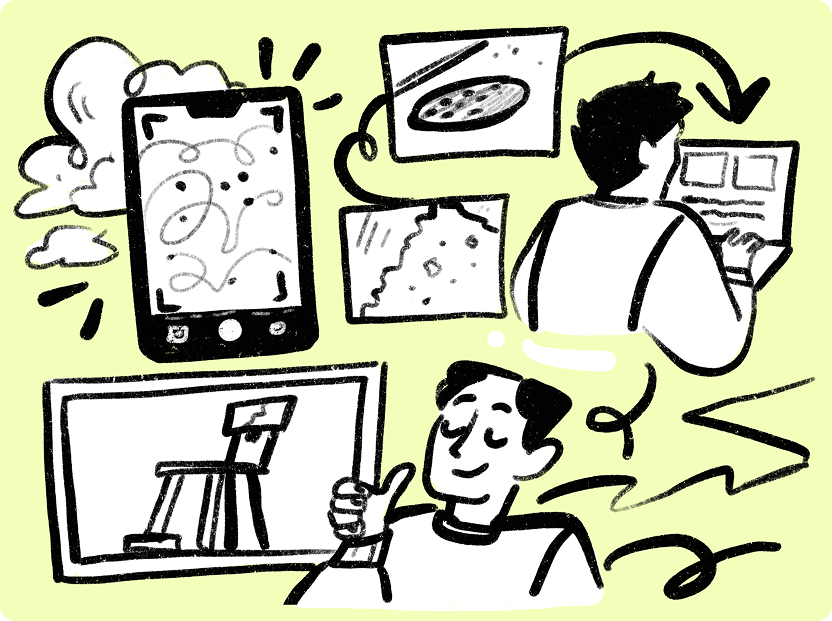
Turn on the camera and move as close as possible to something “ugly”—for example, the kingdom of mold in the corner of the shower or the desert of dust under the bed. The boundaries of the object will dissolve; only texture will remain. Describe what you see without referencing the original source:
“Wow—Martian canyons… volcanic plateaus… a map of the Kingdom of Stainburg, ruled by Emperor Coffee Grounds…”
Then find “relatives” for this landscape in art. Is it a Van Gogh abstraction? A photograph of Earth taken from space? A pattern from a kaleidoscope? This exercise legalizes peeping. Only you’re peeking into the secret life of matter, where your old sofa is an entire velvet universe.
Exercise 4: Collaboration with a Soulless Genius
Here you face the most cynical—and most effective—practice of all. Your co-author will be artificial intelligence, a creature devoid of taste, shame, and cultural baggage.
Take a photo of your “loser” (flaking plaster like the diseased skin of a house, or a rusty manhole resembling asphalt afflicted with leprosy) and drop it into an image generator (Midjourney, Kandinsky, etc.). Now give the neural network a paradoxical, even brazen prompt. For example:
- “A detailed painting in the style of the Dutch masters, where this texture is the main character”;
- “A Zaha Hadid sculpture, if she were designing emotional trauma”;
- “An album cover for a cult indie band going through an existential crisis.”
And here comes the moment of truth. The soulless machine will produce a version in which the “defect” becomes the foundation of a masterpiece—and it will clearly expose the limits of our own gaze.
Bonus Level: Why All This? Or the Hidden Perks of “Uglyphilia”
Besides becoming the life of the party at any landfill, you’re in for some very real bonuses.
First of all, your anxiety will drop by 30–40%. A brain exhausted from chasing imposed ideals and fearing imperfection will finally exhale.
Second, your creativity will level up. You’ll start seeing plots in cracks in the asphalt and design solutions in a broken chair. People around you will ask, “Where did you learn this?”—and you’ll answer with a mysterious silence.
And finally, you’ll gain an eco-superpower, because you’ll stop seeing faceless “junk” and start recognizing materials, stories, and possibilities for rebirth. The planet will rustle approvingly in the wind.
Don’t turn this into work. Introduce these principles as a game. Find an “object of the day” during a walk, or arrange “five minutes of abstraction” while standing in line at the checkout.
The World Hasn’t Changed — You’ve Sharpened Your Vision
So what do we have in the final tally? We’ve hacked the firmware of our own perception and allowed the world to appear before us in all its unfiltered generosity. These exercises return the right to curiosity: to linger where you’re told not to, to ask naïve questions, and to find wild charm in what is “forbidden.” Now, at any moment, you can put on a detective’s beret, an astronaut’s helmet, or a screenwriter’s glasses. Even the walk to the metro turns into therapy.
The world has always been dense and chatty. You’ve simply stopped interrupting it. And believe me, your inner bore is enjoying it just as much as you are. So look, stare, peek—and remember: the most alluring things aren’t those that just rolled off the assembly line, but those that have lived, seen things, and grown legends around themselves. And if you think about it—that’s everything around us.
The double-slit paradox awaits you! Learn from particles how to act mysteriously and unpredictably.
Thank you!