Category: Materialization technologies
Beauty at the Tip of a Needle
“I am the canvas of my experience; my story is etched in lines and shading, and you can read it on my body”
Kat Von D
I got my first tattoo in the army, when I was appointed squad leader and received the proud rank of sergeant. It was a scorpion, about the size of a matchbox. We found a tattoo artist in a neighboring unit and spent a long time choosing the design, because the artist couldn’t draw. Then someone brought a cassette by the band Scorpions, and the logo on the cover became a symbol of authority for three newly minted sergeants.
About a week later, while we were storming the pull-up bar in the barracks with our shirts off, the symbol caught the company commander’s eye. The dressing-down was immediate.
“Savages!” the captain shouted, amid a stream of curses and emotional interjections. “I’ll bust all three of you down in rank! Why don’t you stick nails through your noses while you’re at it? Damn Indians… What kind of fashion is this supposed to be?”
The captain was wrong. The regulations do not forbid tattoos on the body, and it was impossible to punish us for self-mutilation, since everything healed perfectly without any harm to our health. And he was even more wrong when he spoke of a new fashion for tattoos and nose piercings.
The History of Tattooing and Piercing
The urge to decorate the body has always been with humankind. Long before the advent of writing, states, and religions, people marked their skin with images, carefully cultivated scars, and proudly wore ornaments on various parts of the body.
Facts? Here you go. In 1991, a mummy was discovered in the Ötztal Alps on the border between Italy and Austria. It was immediately nicknamed the “Iceman” and given the evocative name Ötzi. This unfortunate man lived around 3300 BCE. And on Ötzi’s body, researchers counted sixty-one tattoos.
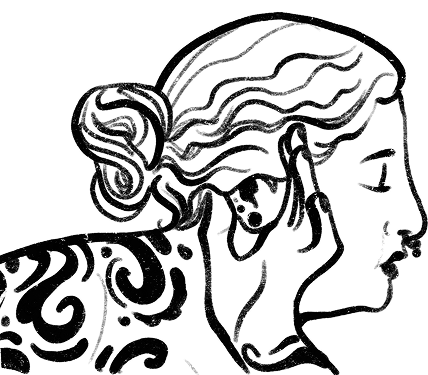
In the cultural layers of the Early Copper Age in Anatolia, Mesopotamia, and the Balkans, archaeologists find figurines with pierced ears and bone ornaments that are difficult to interpret as anything other than piercing, while mummies from Africa and South America bear clear traces of scarification.
With the emergence of states, the art of tattooing and piercing did not wither away. In ancient Egypt, the earrings in Tutankhamun’s ears were a symbol of divine origin and power, and tattoos became part of sacred cult practices. The same was true in India, where earrings signified noble birth, and nose piercing was part of a pre-childbirth ritual. Polynesians used tattoos to mark clan affiliation, record feats, and fix social status. The Maya and Olmecs pierced lips, tongues, and ears as offerings to the gods and applied tattoos as signs of warrior valor and spiritual purity. And those very “savages,” the Papuans, marked boys’ coming of age through scarification resembling crocodile scales.
Antiquity and the Middle Ages treated these ancient arts without reverence. Romans and Greeks used tattooing pragmatically—as a means of branding slaves and criminals. Christian and Muslim churches unequivocally condemned marking the skin and frowned upon piercing. The only ones they tolerated were sailors, who wore gold earrings as “burial money.” It was a different story in the East and Africa, where tattooing and piercing experienced a new flourishing, serving as a full autobiography, a marker of adulthood, and a symbol of beauty.
In the nineteenth century, tattooing and piercing returned to Europe on the shoulders of colonizers and travelers. Imitating these daring figures, the aristocracy began getting small tattoos and wearing tiny earrings. Among the tattooed were the future Russian Emperor Nicholas II and the King of the United Kingdom, Edward VII. Notably, Samuel O’Reilly assembled the first tattoo machine precisely at the end of the nineteenth century.
In the twentieth century, the needle began to dance across the skin, leaving colorful traces—first on soldiers, prisoners, and circus performers, then on bikers and punks, and by the close of the century moving on to agents of popular culture. It was a long journey from marginality and counterculture to the mainstream.
Today, between 30 and 50 percent of young people in Russia, Europe, and the United States have at least one tattoo.
…My second tattoo I got six months later, when I was given command of a platoon—this time without a new rank. The captain, as luck would have it, announced a summer sports festival. I had no desire to show him my bandaged shoulder, so I hid behind paperwork in the office of Senior Lieutenant Skripochka. He was a very timid man. He stared at the fresh tattoo with wide eyes, caught between horror and admiration, and kept asking, “Why?”
Why? Meanings and functions
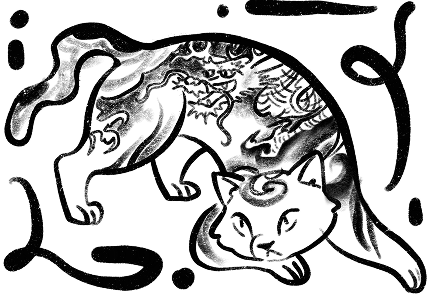
There is no single answer to this question. A history spanning millennia and a vast geography suggest countless answers, but they can be grouped.
Ritual and social purposes — this group includes rites accompanying coming of age, marriage, and initiation, as well as signs of connection with ancestors, gods, and the spirit world. In this capacity, tattoos, piercing, and scarification are still alive in parts of Asia and Africa.
Social and identity-related purposes — symbols of belonging to a tribe, caste, clan, subculture, or status; markers of nobility, martial valor, or authority. A vivid example is the tattoos of the Yakuza.
Therapeutic and protective purposes — in this case, tattoos, piercings, and scars function as amulets, protecting against the evil eye, illness, death, and malevolent spirits. Remember Ötzi? All of his tattoos were placed in areas typical of chronic ailments—a kind of prehistoric medicine.
Personal and psychological purposes — this group neatly includes tattoos, piercings, and scars made in memory of the dead, as a sign of victory over psychological trauma, in the search for self-affirmation, as an act of overcoming pain in the pursuit of strength, as reminders of a goal, and other amorous foolishness.
Aesthetic and artistic purposes — the simplest and noblest goal: beauty. In this case, the body becomes the canvas, and the needle the painter’s brush.
…It is impossible to hide a tattoo in the army for long, so I did eventually end up on the captain’s carpet. He studied my shoulder for a long time, menacingly working his eyebrows and grinding his teeth. But by then he had only one experienced sergeant left, so there was no sense in picking a fight with me. The captain merely asked whether I understood all the consequences of my decision.
Consequences, drawbacks, and risks
This time, my captain’s point of view had a solid foundation. Body modification can have dangerous consequences.
It is critically important to observe hygiene and to approach the process with the utmost seriousness from a medical standpoint. You don’t want infections, allergies, hepatitis, or HIV, do you? Therefore, sterility and responsible aftercare during rehabilitation are mandatory.
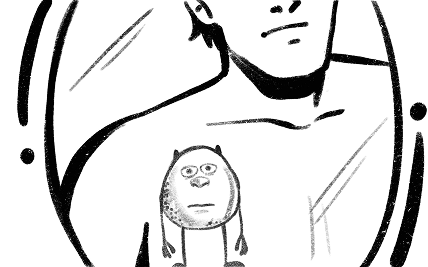
My captain, alas, is not alone in his rigidity, and his allies in the conservative wing of society may engage in large-scale bullying. And certain marks on the skin of an uninformed person—for example, the patterns of the aforementioned Japanese mafia—can lead to serious trouble.
And you yourself may, over time, regret an impulsive decision to get a tattoo, looking in the mirror at a faded, blurred image. Alas, this is inevitable due to the natural processes of skin aging and environmental exposure.
Once the needle, having pierced the epidermis, deposits pigment in the dermis, active work by macrophages begins around it. Immune cells, sparing neither themselves nor their kin, attempt to remove the foreign particles, but with little success. A significant portion of the pigment settles permanently in the structural cells of the dermis.
Over time, some of the pigment migrates deeper or sideways through the dermal tissues. If the artist’s hand slipped and the tattoo was applied too deeply or unevenly, this unfortunate migration will proceed faster. In addition, pigment breaks down under the influence of ultraviolet radiation. Yes, you understood correctly—sunbathing accelerates the loss of clarity and brightness of a tattoo.
And now you find yourself growing sad and contemplating a visit to a cosmetologist, because without a laser it is impossible to get rid of a tattoo or scars. In this respect, piercing is far more harmless: once you remove the jewelry, the body quickly closes up the unnecessary holes.
Don’t like the idea of tattoo removal? Then a visit to a tattoo studio awaits you—to refresh the design or cover it with a new one. Be careful: sometimes this turns into an addiction to tattoos.
Whether self-expression, personal empowerment and self-esteem, artistic value, and a message to oneself are worth all these risks is for you to decide. And only you.
…It is unpleasant to admit, but regarding my second tattoo the captain turned out to be right. Over time, its design began to seem questionable to me, so five years later a beautiful and symbolic Cheshire Cat bloomed over the fake tiger. “We’re all mad here, and that’s okay”—a kind of motto. And a few years later, my personal gallery was enriched with a turtle, reminding me: “Be persistent. Don’t give up. Move toward your goal.” My tattoos are more than just drawings.
Cultural and Philosophical Significance
Today, tattoos, piercing, and scarification no longer cause surprise—unless, of course, a person is covered with them from head to toe. This is a language through which we speak with ourselves and with society, a symbolic link to our ancestors, and a philosophical statement.
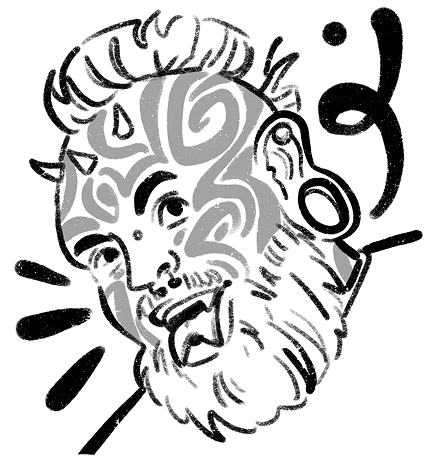
Any tattoo, piercing, or scar today is a material bearer of personal history, an accent that emphasizes individuality, a way to stand out and to remind oneself of what matters. It is an opportunity to turn one’s body into a statement, firmly stitched to memory and flesh by the artist’s needle. A tattoo session is a kind of initiation rite, in which beauty is born through pain, through a test of endurance, concentration, and trust.
Any puncture is a symbol of overcoming fear—an adult decision that will stay with you for a long time, if not forever. The pain of tattooing is an anchor that allows one to feel real, alive, and to make significance through emotion.
You choose what you want to say to the world before the tip of the needle touches the skin.
The needle itself has its own philosophical concept—one of the most ancient archetypes of humanity. It penetrates but does not destroy, wounds yet heals. In the context of piercing, scarification, and tattooing, the needle is a conduit that translates manifestations of the inner world outward. Its contact with the skin is fleeting, but the trace it leaves remains for many years, both physically and spiritually.
At the needle’s point are concentrated trust between artist and client, the pain of beauty’s birth, and the connection between past and future.
In psychoanalytic and body-oriented psychology, the body is the bearer of the boundaries of the “I,” and the needle is the object that violates those boundaries. But this is a temporary, controlled invasion—a way to regain and affirm control over the body, emotions, and life.
…My next tattoo will be a matching one. Its time has not yet come due to certain life circumstances, but I already anticipate the cutting pain of the needle, on whose tip a beautiful symbol of love will be born. It will not be large or bright, but its inner meaning will contain two entire universes, hidden behind a fragile human shell.
The history of tattooing, piercing, and scarification reaches back to the earliest days of humanity. Over thousands of years, they have traveled a long path—from magical attributes to art. And today, beauty can begin at the tip of a needle, provided you are aware of all the risks and ready to accept the consequences.
Your thought is a big bang of ideas. Our journal is its source.
Thank you!