Category: Cognitive technologies
The Age of Genius: the manifesto of a good parent or how not to become a compromiser
“In the eyes of a child, there are not seven wonders of the world. There are seven million”
Walt Streitiff
Ladies and gentlemen! I declare with full responsibility: “Your attitude towards children is inhuman!” You there in the front row. Yes, you! Do you remember your child in its first moments? What concerned you at that time? I am willing to bet that in this tremulous moment, when a new human being saw the white light for the first time, when it was still completely helpless but was already striving for happiness with all its heart, you were already expecting something from it!
In the first minutes, you greedily asked the doctor about the Apgar score. And you were indignant because your child didn’t get a perfect twenty. You object? Ah, an international standard, and you are showing concern for health this way. And your endless grumbling because your child prefers to eat for longer and less than the children of other young mothers? Or, on the contrary, eats indecently quickly and a lot? And the eternal competition among conscientious parents: who will walk earlier, talk faster, master the spoon sooner, and learn to fall asleep without a nightlight — is that also care? Or is it still ambition, forcing a small person to learn strange and unnecessary things: to speak eight languages by the age of six, to read by four, and to add three-digit numbers in their head by two?
Come to your senses! Reread the WHO developmental norms: a child should learn to walk between 8 and 18 months, speak in phrases of 2-3 words by the age of two, and by six, know their first name, surname, and address. Don’t rush them; they will manage on their own, gradually. And please, don’t demand anything extra from the little one.
Says the little kitten: “Meow,
Come on, pet me right now,
And in return, I vow,
I’ll sing you a purr-meow.”
All children are geniuses! This is a very beautiful slogan, but you misinterpret it and ruin everything by turning the time intended for exploring the world into an endless arms race of knowledge.
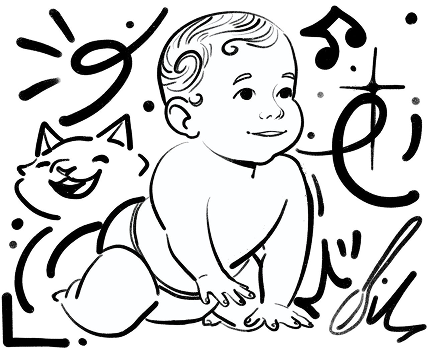
Yes, in the early stages, your child’s brain turns any experience into new connections between neurons. Everything—from a cat’s purring to hopelessly broken toys—adds to the synaptic abundance. Your child is learning about the world: it’s important for them to know that a spoon falls on the floor with a loud sound, that soap tastes bad, and that snow is cold. And they absolutely do not need a scientific explanation for all of this, because logic and self-control will come later. In childhood, experience is what matters; joys and little tragedies are what matter. What difference does it make what two times two equals if Barbie’s dress is torn?
But you do not listen to children! You talk about neuroplasticity, about the age of genius in which one must accomplish so much. “So what if my daughter is crying over a quantum physics book now? Later, the girl will thank you.” She will not. Do you hear me? I repeat: she will not!
Enough chatter about windows of opportunity, sensitive periods, and the peak of genius. This is not Everest; it is a mountain range. One peak is followed by another; they coexist and cast long shadows on each other. In just five short years, a small human can develop perfect pitch, learn several languages, and acquire the flexibility of a future athlete. And that’s not counting reading, writing, and the basics of mathematics. Poor, poor little one. With all these tasks, they will have no time left to play. Because you, parents, lack a sense of harmony! You have forgotten that your task is to guide and support, not to force and demand! By scattering efforts in all directions at once, you may end up with nothing.
You say: you can choose one direction. You can, but what if you are wrong? A musician does not need fast feet (at least, a good musician doesn’t), and a sportsman has no use for musical notation. Remember: the choice is not yours to make. If you want to realize a sensitive period—give your child freedom. Support their choice, help them, empathize with them.
The hedgehog runs in the forest, prickly like a fir tree,
But I still want to be his friend, even though he’s covered in needles!
Can he drink milk from a saucer with the cat, just the same?
I told my mom and brother, but they just laugh at my claim.
Oh, I hear the lady in the third row exclaiming that her child is a wunderkind and requires a different approach. A phenomenally… foolish statement. This is statistically untrue with a 97% probability, but even if you were unlucky enough to fall into the remaining 3%, nothing changes. On the contrary, a child who, even before the age of 10, can rival adult experts in knowledge needs twenty times more support and help.
Seriously, do you know how many truly prodigiously gifted children there are in the world? Only about one in 5 to 10 million. And you are sure yours is one of them? Is it because he walked at seven months? Or learned to turn on cartoons before he could talk?
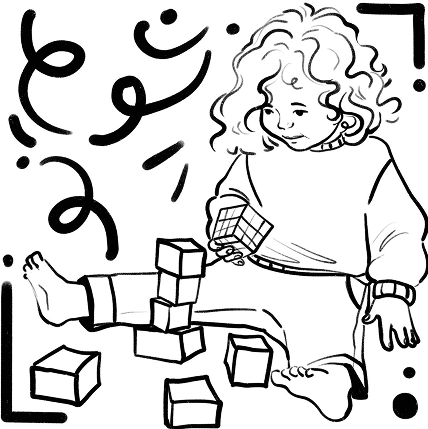
Parents have a tendency to exaggerate. And if your child truly is a genius, there is no need to turn him into a circus monkey, parading him for public viewing at every opportunity. He is already doomed to experience all the difficulties of asynchronous development: his emotions and physical abilities cannot keep up with his mighty intellect, he finds it hard to communicate with peers, he may not understand social norms. Your task is to smooth out the rough edges—to do everything possible and impossible to ensure his harmonious development. And you certainly should not bask in the glow of fame and recognition for your pedagogical genius. If your child is a wunderkind, you are only indirectly responsible for it, as it is largely a matter of genetics.
If, however, you have manufactured a “genius” with your own hands, you deserve to be whipped for child cruelty. And also for shortsightedness and outright stupidity.
The neuroplasticity of a child’s brain, its receptiveness to everything new, has its limits. From birth until death, our brain strives for maximum efficiency: it prunes away everything it deems unnecessary—a process called synaptic pruning. In children, this process is especially active around ages 4–5 and 10–13.
Let’s suppose your talent as a “trainer” is great enough to drag a “counterfeit genius” through the grind of educational institutions and secure him a university diploma by age 12. What then? How long, in your opinion, will the useless knowledge, crammed into the child’s head through moral—and sometimes physical—pressure, last? Not long. At such a tender age, your child cannot begin a professional career, which means all the neural connections created by your “pedagogical talent” will be deemed redundant and pruned away.
The problem is that other, very important connections, will be fewer than needed. Your success will be momentary and, in all likelihood, will result in nervous exhaustion, social helplessness, and mental health problems.
You think you are an educator, but in reality, you are picking up the banner of the medieval comprachicos. Think carefully: is it really worth it?
The rain falls like a wall upon the street,
My puppy in his kennel gets wet.
I will let him into the house,
So he can dry off.
I understand your pain! You are good people and want only the best for your children. But chasing after “windows of opportunity” is a poor solution. Don’t be afraid of missing out on something—these windows never close completely; they will be slamming their shutters your entire life. A child’s development continues uninterrupted: after the age of 9, they are no longer striving for the conventional breadth of interests but are delving into an equally conventional depth. The time comes for abstract thinking, motivation, and emotional intelligence. They no longer throw objects on the floor to understand how gravity works, but instead, they purposefully read about it. They are ready to learn, but only consciously, slowly, and in accordance with their age.
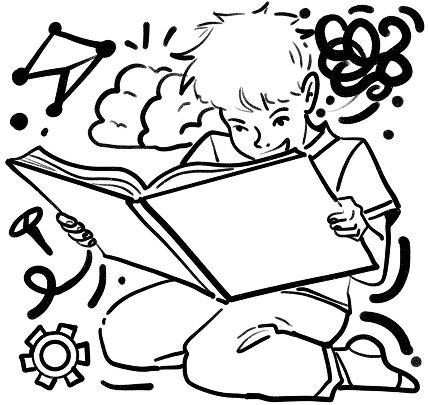
Instead of a dozen different fields, the child focuses on those that are interesting and important to them. These neural connections will expand; they are protected from pruning and will most likely persist even into adulthood.
Raise your hands, those who believe it is important for a child to engage in activities beyond the school curriculum. Wow, there are so many of you. That’s correct—numerous independent studies show that diverse activities outside of school are critically important for the full development of children and adolescents. But you still must not impose views and activities that the child dislikes. Accept it, this must never be done. That is, if you truly want to raise a strong, self-sufficient individual.
The choice of extracurricular activities should be based on the child’s interests, and to accurately guess what will appeal to them, you must definitely try different things. And one more crucial rule: do not dare overload the child. Two, or maybe three, extracurricular activities are enough.
Under the willow bush,
The little bunny puffs himself up:
“I am not afraid of meeting a lion,
They don’t live around here!”
With child prodigies, everything is much more complicated. Their intellectual development is like an explosion: you cannot stop it or control it in any meaningful way. It simply exists. And at the same time, it evokes rapturous delight in the adults around them and irritation in other children.
And yet, the child prodigy is very active and talkative, they are impulsive, prone to arguing with teachers and failing to find understanding among their peers. They can spend hours studying what interests them and completely disregard everything else. Does it sound like symptoms of ADHD? Sometimes it not only resembles it but is also a medical diagnosis, alongside autism spectrum disorders. This is a true trial for the parents. And for the child, incidentally, no less of one.
Childhood is the most dangerous time for child prodigies. Parents, teachers, journalists—in fact, everyone—accustoms them to the idea that they are special and raises expectations for their future. It seems endlessly and brilliantly promising.
But time is relentless in its desire to put everything in its place. And soon, the “ordinary” children grow up and are hot on their heels. Talent alone is no longer enough; what is needed is purpose, originality, risk, and provocation, and with this, most “wonder-children” encounter significant problems. Their brains know how to learn, solve problems, compile things based on what they’ve learned, but not how to create something new. They need to readjust, find new paths for development, and get used to the competitive struggle that others were mastering back in the sandbox. The predictable result is an identity crisis.
Whether your child will be able to overcome it depends on you, parents. And only on you. Only 10% of child prodigies occupy an important place in their field in adult life. 30% suffer from anxiety disorders, and 40–60% are afflicted by imposter syndrome.
Is it frightening? I am glad if I have managed to convince you to listen to your children. And now, a spoonful of honey in this barrel of tar: the majority of gifted children cope with their crises and become educated and successful adults. Provided that, back in childhood, their parents taught the child to separate feelings from logic, taught them flexibility, tolerance, and the ability to listen, fostered independence and responsibility in them, allowed them to make mistakes, and helped them find the answer to the question: what is the purpose of their talent.
Help your own little rascal to embark on this path! If you leave them alone with their gift, the years will turn that gift into a heavy burden.
Cat, oh cat, with ginger tail so bright,
With perky ears upon your head.
My love for you reaches the stars at night,
You’re my best friend, it must be said!
I can see in your eyes that many of you are still convinced a child is like clay, from which you can mold anything you desire. You are mistaken. And please, don’t point to the neighbor’s child who, by age ten, mastered the violin, equestrian sports, and the basics of programming. Who knows, perhaps your child, in the same timeframe, will master cross-stitch embroidery and learn to dance hip-hop. Does that make them any less?
Albert Einstein said: “Everybody is a genius. But if you judge a fish by its ability to climb a tree, it will live its whole life believing that it is stupid.”
Children are born different: each has their own temperament, their own levels of attention, impulsivity, and anxiety, their own inclinations towards music, sports, creativity, or science. The core of personality is present from birth; you can nurture it, but you cannot change it without traumatic consequences. You cannot grow a rose bush from a tulip bulb, can you? So, accept your child for who they are.
A child will choose what interests them, not you, on all fronts: toys, friends, books, movies, and even topics of conversation. This is a genetically conditioned interaction with their environment, and it begins in the first months of life. Do not fight against it.
Fight with yourself. Your task is to show love and care, to listen and to hear, to offer attention and respect, so that the potential inherent in each of us can unfold to its fullest 100%, and so that the so-called “age of genius” does not pass by in vain.
Scientists have decoded the human genome. We’ve decoded the genome of interest. Only pure science and facts.
Thank you!