Category: Cognitive technologies
How to deceive time without breaking the laws of physics or the adventures of a Grasshopper
“Why do I need a Nobel Prize if I know how to control the Universe?”
Stephen Hawking
‘To write an article about time. I need to write an article about time,’ the novice author tapped his pencil on the table and rubbed his temples with both hands. ‘About what, exactly? About how there’s never enough of it? That it’s money? Or about how grandma used to say that time heals? Clichés. All those tired old clichés have been drained dry a thousand times over.’
With a sharp movement, the author pushed aside his notebook and turned in his chair.
‘Come on, you can do it, get yourself together!’ he yelled loudly, trying to organize his thoughts. But his thoughts stubbornly refused to form any clear picture, and the words in the previously written paragraphs kept scattering in different directions.
And that phrase from the editor-in-chief still hung over him: ‘There’s too much falsehood and superficial prettiness in your text. Things aren’t working out. Read a physics textbook or at least look at the clock!’ That phrase was like a crystal ball ready to shatter into a million angry shards right onto his exhausted skull.
The author nervously clicked his ballpoint pen, causing a dull drop of ink to fall onto the blank sheet, immediately spreading into an ugly stain.
‘That’s symbolic,’ he thought bitterly. ‘It’s just a perfect reflection of my creative process.’
Suddenly, his gaze fell on the wall clock—a bulky, old artifact inherited from his great-grandfather, a railway worker. Once, within its mechanism lived gears, springs, a pendulum—a tiny universe obeying a precise rhythm. And now, there was only silence and dust.
The author looked at the dead dial, then shifted his gaze to the window, where a grasshopper was desperately jumping between the window frames, caught there due to its own inattention. He tapped on the glass, making the grasshopper hop even faster.
‘What are you looking at?’ a voice said behind his back.
His neighbor, a tenth-grade girl, stood on the threshold holding a stack of fresh newspapers. Over her shoulder, a corner of a physics textbook peeked out of her bag, marked with a colorful bookmark on the chapter titled “Relativity theory.”
‘At the time,’ the author muttered gloomily.
‘Ah, the grasshopper,’ the girl nodded understandingly, observing the author’s gaze. ‘Right now for this insect, the window is a flat, two-dimensional world where only length and width exist. It simply doesn’t know the height of the glass, so that measurement currently doesn’t exist for it; that’s why it can’t jump over the obstacle, because in its world the concept of “jumping up” just isn’t there.’
‘But what if it knew the height?’ the author asked, eager to quickly get rid of the girl.
‘And what if it could perceive the third dimension—that very height we see, it wouldn’t be jumping at all. The grasshopper would just move sideways and go beyond the glass, just as we step around a puddle, imagining its size. It wouldn’t be effort that saves it, but a new understanding of geometry.’
The girl paused and ran her hand over the glass. Her eyes sparkled.
‘And what if there was a fourth dimension for the grasshopper… Well, if for all of us, along with length, width, and height, a fourth dimension existed—then we could move through any space and wouldn’t get stuck in flat puddles.’
‘What fourth dimension?’ the author exclaimed irritably, losing any interest in the conversation.
‘Time,’ the girl smiled, holding out a rescuing branch to the fallen grasshopper.
The theory of the fourth dimension. The Grasshopper and the portal
“An ordinary person doesn’t walk hand in hand with time—he either drags it behind him like a tank through Berlin, or runs away from it like from the Gestapo. We simply maneuver between the folds of time, like a hare between gunshots. For an ordinary person, the measure of time is not a straight line, but a sine wave of despair and hope. We have not yet learned to control time.”
Dot. Space. Click.
Time is a fundamental physical quantity that characterizes the duration of existence and the sequence of changes in any material systems and processes. One second is equal to the duration of 9,192,631,770 periods of electromagnetic radiation, which occurs during the transition between two hyperfine levels of the ground state of the cesium-133 atom. This definition was adopted in 1967 and is the standard for measuring time.
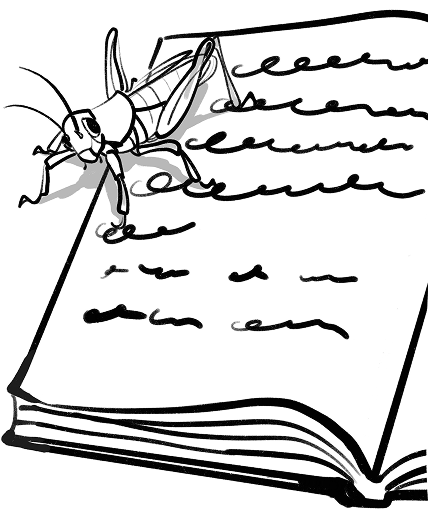
‘What the… Where did you come from?’ the author muttered in surprise, watching a grasshopper skillfully crawl out from under the pages of his notebook.
He tiredly rubbed his eyes and tried to catch the grasshopper, but it disappeared just as suddenly as it had appeared.
‘Silly,’ the author again heard the voice of his tenth-grade neighbor behind him. ‘I let you out into the garden, why are you getting into trouble again?’
The girl opened the window and stretched her hand outside with the grasshopper sitting on it.
‘Stop!’ the author grabbing her wrist. ‘Where did you get that green bastard?’
The girl laughed, ‘I was washing fresh vegetables, when it tickled my ear helping to cook.’
‘When?’
‘Just now.’
‘I don’t understand anything,’ the author wandered around the room. ‘It just disturbed me from work! Can you teleport?’ he said directly into the green limbs of the invertebrate, causing the grasshopper, deftly pushing off the girl’s palm, to jump onto a tree growing just outside the window.
‘Maybe our friend has mastered the fourth dimension?’ the schoolgirl smiled mysteriously.
‘Maybe I shouldn’t be disturbed?’ the author snapped back. ‘How come you keep appearing here? You weren’t here a second ago, and now—here you are. If I weren’t so sure, I’d think you can walk through walls.’
‘I can,’ the girl smiled again. ‘And so can you. Not through walls, but through time. You’re sitting at your desk with your back to the door and working, which means you only exist in your dimensions, but you know there’s a door behind you, so someone can come in through it, right? But what if you didn’t know there was a portal behind you, through which you can come and go? Well, you can’t see it with your back, can you? But I, standing in front of it, see it, and I see you, and see your hunched back over the table, and I calmly walk through it. It turns out that for you I perform a miracle—walking through walls, but in my dimensions, there’s no miracle at all.’
‘And what does all this have to do with time?’ the author interrupted her irritably.
‘The same way,’ the girl continued without flinching. ‘You sit in your room in three dimensions, where time is just the ticking clock on the wall. But the grasshopper exists in four dimensions, where time is just as much a portal as a wall, a door, or a window. Once, time was considered an absolute mathematical entity that flows smoothly and uniformly throughout the universe regardless of any processes, but in 1905 Albert Einstein challenged this notion and embedded it into the unified framework of reality—spacetime, or as it’s commonly called, the space-time continuum. He proved that time is a relative magnitude, heavily dependent on the reference frame and velocity.
‘I don’t understand anything,’ the author nervously paced the room. ‘We’ve always been told that time is a synonym for “acceptance,” but you’re talking about completely different things.’
‘Not me, Einstein is,’ the girl corrected him. ‘Imagine a cube. Its sides are length, width, and height. Now imagine that this entire structure isn’t static, and each side of this figure is a “frame,” a “slice.” And time bonds these frames into a single strip, like film in a projector. But unlike cinema, we cannot rewind this film because we are part of the image on it.’
The girl approached the desk and placed two objects in front of the author: a pencil and a paper stained with ink.
‘Here’s the grasshopper. Its entire life, from egg to a jump out the window, exists entirely and all at once, but we see it frame-by-frame because that’s how our consciousness works. Einstein’s theory of relativity states that these frames can move at different speeds. For example, if you could accelerate to the speed of light, your time relative to mine would slow down almost completely. For you, I would be darting around like a sped-up recording, while for me, you would be frozen in a single moment, even though we would still be in the same room,’ the girl sighed. ‘Honestly, sometimes I look at you and envy: I just finished slicing a tomato, and you’ve already written half the article… and all this in the same amount of time.’
The author silently looked at the ink stain, which just a few minutes earlier seemed to him a symbol of creative failure. Now it reminded him of that very point in spacetime where his despair, the grasshopper, and this strange girl with a drop of tomato juice on her sweater intersected.
‘The grasshopper just found a shorter path in the geometry of reality. Space and time for it are not abstractions like for us, but a single field for maneuvering, which can be squeezed or stretched at its will.’
The author looked at his notes:
“The length of time for an ordinary person is not a straight line, but a sine wave of despair and hope. We haven’t learned how to manage time yet.”
Click. Space. Delete.
The Grasshopper, the eternal rhythm of the universe and the Crystals of Time
“Time is an editor. It ruthlessly cuts out people, erases events, and throws out entire chapters from different lives. Sometimes it leaves a caustic note in the margins: “It could have been better.’ We look at this red-streaked text and ask for the opportunity to retake it.”
Dot. Space. Click.
The author set down his pen and looked again at the wall clock.
‘Well, the clock stopped, but time didn’t, amazing.’
‘By the way, I’ve wanted to ask you something for a long time,’ the familiar voice spoke behind his back. ‘What do you think about when you look at these watches?’
‘That time stands still,’ the author frowned and turned toward the window, hoping to see a rescuing grasshopper.
‘Time is relative to these clocks; but relative to other objects or us, it keeps going.’
‘That’s hardly a discovery,’ the author interrupted the girl.
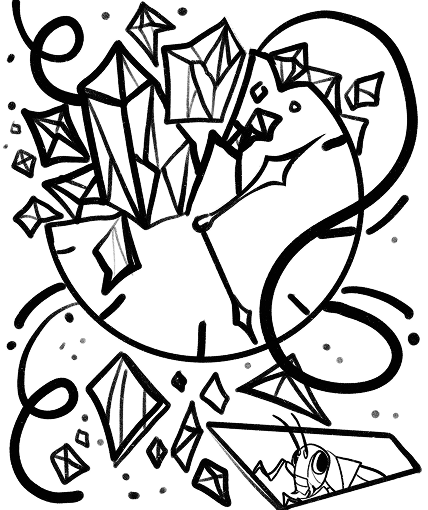
‘Think about a discovery made in 2012 by the American theoretical physicist Frank Wilczek,’ she replied without the slightest hint of embarrassment. ‘When the entire scientific community believed that time was a fully understood quantity, he was the only one who wondered: could matter be ordered not only in space but also in time? After that, he theoretically predicted an object called the “time crystal.”’
The author frowned again.
‘What’s the point?’ she continued, paying no attention to the author’s demeanor. ‘Ordinary clocks tick because we wind them up, thus spending energy. But a time crystal can run forever while remaining in a state of minimal energy.’
‘Like a perpetual motion machine?’ the author asked skeptically.
‘No. A perpetual motion machine is a forbidden attempt by thermodynamics to create energy, whereas a time crystal doesn’t consume or dissipate energy. It simply exists like a pendulum that’s been given an ideal, eternal impulse once and for all in the quantum world. Tick-tock, tick-tock.’
The girl spread both index fingers outward so they resembled clock hands. But the author had no desire to share her playful mood.
‘That’s nonsense,’ he said.
‘That’s exactly what the entire scientific community thought in 2017 when nearly simultaneously, two groups of researchers from Harvard and Maryland created the first time crystal in the lab. One group used a cloud of atoms, the other—a chain of ytterbium ions. They “kicked” those ions with a laser, causing them to oscillate with a period twice as long as the laser pulse period. And then, the same scientific world recognized that the crystal systems operated on their own internal time, independent of external influences.’
‘Well done!’ the author clapped his hands. ‘But what’s the use of these crystals for us?’
The girl paused and looked at the stopped clock.
‘Imagine what would happen if such crystals existed in our macroscopic world, not metaphorically, but literally. A cardiac pacemaker in your grandfather’s chest would work not from a battery but from the eternal rhythm of the universe itself. No one would hack into your bank account because it wouldn’t be coded in software but embedded in matter’s pulsation, which would change with every “beat” of a crystal heart. Smartphones would stop running out of batteries, new standards of precise measurement would emerge—based not on nuclear decay but on the eternal, unchanging rhythm of reality itself. This would allow a tomograph to see a disease years before it appears, and seismologists to predict underground shocks with an accuracy of weeks rather than decades. It would be a world where time itself became the most reliable tool, turned into an instrument.’
The author again opened his notebook.
“Time is the editor.” Delete. “We’re asking for an opportunity.”.. Delete. “It could have been better.”
Delete.
We have finally been given hope: time is no longer a reaper with a scythe, now it is more like a fireman in the boiler room of the Universe, throwing the same logs into the furnace in a perfectly calibrated rhythm. While our clocks are rushing or lagging behind, the time crystal is tapping away in an eternal hook with itself.
We were looking for immortality in stopping time, but we just had to drive it into an endless circle. Not to run away from it, but to make it work. And that’s all.
‘I really got carried away!’ the author smiled for the first time and scratched his ear. When he picked up the handle again, he found a restless grasshopper on it.
‘What do you say, friend?’ the author addressed him.
The grasshopper rubbed its hind leg against the front wing and headed for the window. It even seemed to the author that it waved its green head at him approvingly.
The Grasshopper, the Arrow of Time and its reversibility
“I hate its linearity. Its blunt, monotonous straightforwardness. Every day is a retreat. Surrender of positions. You wake up and immediately you owe it something. You have to be in time, to integrate, to keep up, to fit. And it stands over you with a dial instead of a face and indifferently records lateness.
Why can’t it be unwound? Why can’t it be paused? Why the hell can’t you just turn around and go the other way? I don’t want to be a slave to an arrow that only crawls to the right. I want to see what’s out there, behind the back of time.”
Dot. Space. Click.
The author tapped his fingers on the table and suddenly leaned back in his chair. All this monotonous work on the text, the omnipresent grasshopper, and the brief physics introduction course from the neighbor-high schooler had given him a terrible backache. Wanting to stretch it without leaving his workspace, he began quickly moving his legs under the desk. But he had to stop this activity again because the familiar voice sounded behind his back.
‘You’re doing great!’ The neighbor girl cheerfully announced. ‘Pity the grasshopper can’t appreciate it.’
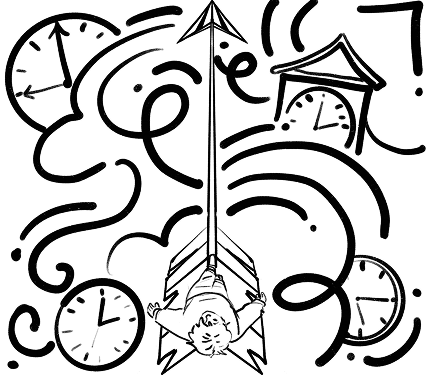
‘What do I have to do for you to let me finish the article?’ the author forced out. ‘To hang a lock on my door? You’d just slip through the window, I beg your pardon, pass through a new dimension.’
‘Exactly,’ the girl laughed, ‘it’s nice that you remembered the new dimension. I came because I heard you dancing, and stayed only because I saw the Feynman-Wheeler hypothesis in action.’
‘That’s the last thing I needed,’ the author muttered irritably.
‘Well, you’re mistaken, it’s a good hypothesis,’ the girl gently reproached him. ‘These scientists suggested that time can be positive and negative at the same time. For example, your table stands here, and we can approach it from the left side or the right side, and at that moment, it won’t move or change its properties. So why should time only flow in one direction?’
‘That’s true,’ the author replied, again searching for the grasshopper with his eyes.
‘That’s what Feynman and Wheeler proposed—time reversibility at a fundamental level. Moreover, in the equations of quantum mechanics and general relativity, there’s no privileged direction of time, so if you replace the variable t, which represents time, with -t, most laws still work. But the world will turn upside down, and it’ll be a world of impeccable, yet reversible logic: a broken cup will be reassembled from shards on the table, cold coffee will heat up, drawing heat from the colder air. The effect will precede the cause: first, your knee will be hit by the corner of the table, and only then will we move the table to prevent it. We will remember the future but not know the past. Plans will be based on events that have already “happened” in our future but have not yet occurred in linear time.’
‘That’s some kind of madness,’ the author got genuinely angry. ‘In a world with reverse time, the goal is already “achieved,” and the efforts to “reach” it are just formalities that follow the result? Why do all this?’
The girl walked around the table and made a bow.
‘We live in a world where time has an obvious direction: an egg breaks but doesn’t come back together; we grow old, not young. This paradox is called the “arrow of time,” and its origin is one of the greatest mysteries. And Feynman and Wheeler proposed an elegant, albeit hypothetical, solution: what if all electrons in the universe are actually just one single electron? A particle that travels forward and backward in time, penetrating all of existence’s history. When it moves forward—we see an electron; when it moves backward, we see its antiparticle—the positron.’
‘That’s clever,’ the clueless author concluded. ‘And what does this give to us?’
‘Everything,’ the girl smiled. ‘It erases the boundary between matter and antimatter, because they are no longer two different entities but one and the same phenomenon, just viewed from different “ends” of time. The past, present, and future will lose their absolute status; birth and death will exist simultaneously, like two stations on a circular metro line. We’ll get the key to the greatest mystery of cosmology. After the Big Bang, matter and antimatter should have been created in equal amounts, but most of the antimatter disappeared somewhere—this hypothesis by Feynman and Wheeler provides a graceful explanation: antimatter is just matter that has “moved” into the “past” relative to our perception. It’s not “here and now,” because it’s in a different phase of a temporary time cycle.’
The girl fell silent, giving the author a moment to grasp the scale of this mental experiment.
“Why can’t it be unwound?” Delete. “Why can’t it be paused?” Delete. “Why the hell can’t you just turn around and go the other way?”
Delete. Delete. Delete. Click. Click. Click.
Dear grasshopper! Teach me how to fold not in space, but in time, so that I can find myself at a different point each time. We cannot do this because we are macroscopic objects made up of trillions of such particles. Our complexity binds us to one direction of time, just as the flow of a river carries a splinter along with it. Perhaps, indeed, time has a reverse side. And sometimes, someone very small and very fast may glance into it.
The Grasshopper, the causality loop, and the chrono-paradox
“There’s something wrong with me. Or with the world. Probably both. I find myself sitting in front of the unwritten pages again, unable to remember what I wanted to say. It was as if someone had deliberately taken all thoughts out of my head. Only a ringing void remained.
This also has something to do with time: it crashes like a bad phone signal when the voice breaks up into separate, meaningless syllables. All this is deja vu… the brain receives a ready-made data packet for a split second: ‘you’ve already seen this,’ and only then, belatedly, it begins to frantically adjust the picture from the present to it. The investigation goes ahead of the cause: first there is confidence, then there is justification.
I’m not in control of my life. I’m like a user with a crooked mouse who points at an icon on the screen, and the system executes a command with a delay of half a second. This delay is time. And something it breaks in this delay.
Am I losing my mind? Or did I just start to notice that we all live inside a broken car that is quietly deteriorating, and these loops are the first cracks on the glass?
I need to figure it out. Not figure myself out. But these damn loops that I’m getting into more and more often. What is it, if not a symptom? It’s a symptom of a disease that infects time itself.”
Dot. Whitespace. Click.
The author looked out the window and for a moment it seemed to him that the chirping of the grasshopper had transformed into the relentless ticking of a clock. He sharply stood up from his desk and accidentally brushed his elbow against a notebook lying on it, causing all the poorly stapled pages to scatter across the floor.
‘That’s just what I didn’t need,’ the author said angrily. ‘I’ll never make sense of this scribbling. Where is what?’
He crouched down and began feverishly gathering the sheets of paper into a pile, when he suddenly heard a familiar voice behind his back again.
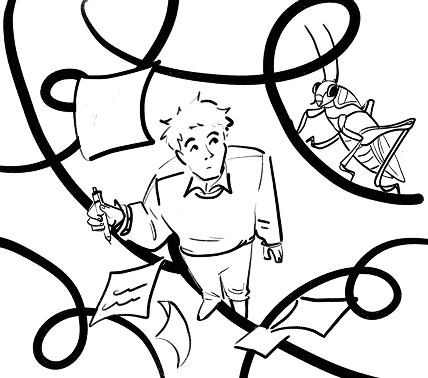
‘I’ll help you,’ the high school neighbor quickly started picking up notes from the floor.
The author looked at her gratefully.
‘The article was nearly finished, and now everything was mixed up.’
‘That’s how the causality loop works, and there’s nothing you can do about it,’ the girl said, picking up the last sheet from the floor. ‘You’re working on an article: first, one thought comes to you, then a second one, they clash, and a third is born. It’s logical: cause and effect. But now imagine you can send the third thought back in time to influence the first, and then cause and effect will swap places.’
‘The hypotheses are getting more and more interesting,” the author noted, picking up another sheet from the floor.
‘And this isn’t even a hypothesis, but a direct consequence of Einstein’s General Theory of Relativity. Some solutions to Einstein’s equations allow for the existence of closed timelike curves—paths in space-time that loop back to their own past point.’
‘I deeply respect Albert Einstein, but I never understand what he’s talking about,’ the author said, confused.
‘It’s pretty simple,’ the girl replied with a smile. ‘Imagine a book you haven’t written yet, which comes to you from the future. You won’t write it from scratch; you’ll just rewrite it, trying to exactly reproduce an already existing text. But then, who will be the author of such a book?’
The author looked at the girl in amazement.
‘The last page from the notebook catches up with the first page and bites its tail, turning the first entry into a new object. That’s how the causality loop works,’ she continued, ignoring his gaze. ‘The effect already exists as a fact. Then it exerts pressure on the past, forcing it to organize itself in such a way that it inevitably produces the cause. The cause manifests and logically leads to the already existing effect. The cycle closes. Reality stabilizes around this logical anomaly, like an organism around a parasite, embedding it into its own metabolism.’
The author looked back at his notes.
‘I don’t think I want to write articles this way…’
‘Of course, who would like a choice without a choice?’ the girl nodded. ‘If your future has already come to you from the past, and you follow it, where’s your free will? You’re just a puppet of information, with no original source. Moreover, a paradox of information destruction can occur: if works exist forever in a closed circle, where is their author? Any tiny change in such a loop will accumulate with each cycle. A single typo in an article after a thousand cycles could turn into a meaningless jumble of symbols that you will be forced to rewrite again and again. Not the most promising prospect.’
The author sighed tiredly. Watching the grasshopper without understanding physics was much more fun.
‘So, does such a loop exist or not?’
‘Physicists still debate it,’ the girl replied. ‘For example, Stephen Hawking’s ”Chronology Protection Hypothesis.” He suggested that nature does not tolerate such paradoxes and will always forbid them through quantum effects, gravitational collapse, or anything else. But there’s no strict proof for that. Mathematics says loops are possible, which means there could be worlds where your article is already written by your future self.’
“I’m not in control of my life.” Delete. “I’m like a user with a crooked mouse who points at an icon on the screen, and the system executes a command with a delay of half a second.” Delete. “This delay is time.” Delete. “And something breaks in this delay.”
Delete. Click.
The sculptor does not invent a statue: he guesses its shape, which already exists inside. He cuts off everything superfluous, freeing it.
The scattered leaves on the floor are marble. Panic, a sense of loss of control, and deja vu do not indicate symptoms of breakdown at all, they give a sense of the very shape that already exists. It is impossible to lose thoughts if you touched them earlier than they should have been born in the usual, linear time. The “I” from the future has already carved this statue, and the “I” from the present feels its contours through the stone and tries to repeat the movement of the chisel.
The theory of the block Universe, the Grasshopper and eternalism
I’ve had enough. I’m coming back to common sense.
“Time flows from the past through the present to the future. Everything is simple and logical. The past is gone. There is no future yet. The present is the only thing that is real. Any other thought has nothing to do with real life.”
Dot. Space. Click.
The author’s gaze fell on the wall clock—a massive old artifact, inherited from his great-grandfather, a railway worker. Their mechanism once contained gears, springs, a pendulum—a whole little world, governed by rhythm. And now, there was only silence and dust.
The author shifted his gaze to the window, where a grasshopper was desperately jumping between the frames, stuck there out of inattentiveness. He knocked on the glass, causing the grasshopper to jump even faster.
Stop. It seems this has already happened.
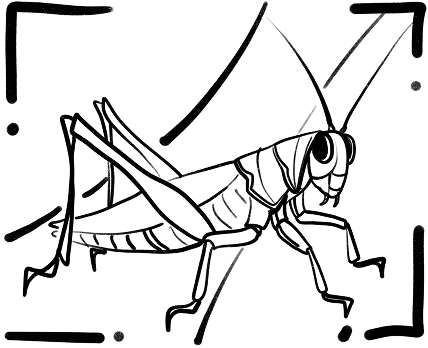
‘What are you looking at?’ a voice sounded behind him.
At the doorway stood his ten-year-old neighbor with a stack of fresh newspapers.
‘At the time,’ the author said with surprise.
‘And why are you so puzzled?’
‘It seems this has already happened,’ the author replied absentmindedly.
‘You know, it could really have already happened,’ the girl supported him. ‘There’s a theory called “block universe” or eternalism. According to this theory, the past, present, and future exist simultaneously.’
‘That’s going too far,’ the author exclaimed in frustration.
He would have accepted any other explanation, but not yet another hypothesis from boastful physicists.
‘Not at all,’ the girl continued as if nothing had happened, ‘just physicists have found a different way to look at things.’
She approached the window, where a grasshopper was jumping between the frames.
‘Look at it,’ she addressed the author, ‘you see it right now, in this very second. But don’t you know that it was here a second ago? And most likely, it will be here in a second? You don’t think it disappears and reappears every moment, do you?’
The author frowned, sensing there was a catch.
‘No, I don’t think so.’
‘Exactly!’ the girl exclaimed happily. ‘Its jumps are not just a series of separate frames called “past,” “present,” “future.” They are a single, continuous movement from point A to point B. And this movement exists entirely—we just can’t see it all at once. Eternalism is this kind of “motion”: your birth, this conversation, and even how you will remember this evening when you are seventy—all already exist in the complex book of the Universe, but not as predetermination, rather as geography, a route you’ve already traveled but haven’t yet explored all the sights. And we’re just running our finger along this map, reading our story line by line. But from this, it doesn’t become any less astonishing.’
Delete. Delete. Delete.
The Grasshopper and the Quantum World
The grasshopper sat on a stinging-nettle stalk, feeling how the entire world shattered within its compound eyes: endless stems, drops of dew, tiny dust particles floating in the air. Every moment was complete, self-sufficient, and perfect.
It clenched its powerful legs and took a new leap into the unknown, which for it was the only possible present. And within this simplicity lay the whole secret of time, which none of the creatures, clinging to the glass of their house-tanks, ever managed to unravel. All that was required of the grasshopper was to be a grasshopper. And to jump.
Dark matter whispers secrets only geniuses can hear.
Thank you!