Category: Life technologies
How to find your tribe in someone else's time
“We don’t choose the times.
We can only decide how to live in the times that have chosen us”
John Ronald Reuel Tolkien, The Lord of the Rings
Recently, I told my friends that I would like to exchange letters with them. Not electronic messages, which fail to capture the mood and feelings of the interlocutor, but real, handwritten letters where each crooked line literally breathes with genuine emotions. My friends laughed at me and said that all of this sounded like nonsense. Then I told them that I would gladly watch some old black-and-white arthouse film in the evening instead of yet another flashy Marvel release. I was again misunderstood and they wagged their fingers at me. When I said I loved listening to classical music and reading paper books, I was even called a lunatic. That made me think: what is wrong with me? Maybe I should have been born in a different era, where real things conveyed the breath and warmth of human hands.
If you have noticed yourself somewhere between the lines and wondered why you were lucky enough to be born today, and not, for example, during the Renaissance, the Musketeers’ era, or the Middle Ages, this article is definitely for you. We’ve gathered several ways to enjoy life in the present when your soul constantly longs for the past.
There are no clear explanations why some people feel as if they were born in the wrong era, but it’s believed to be a form of chrononeurosis—the fear of time slipping away irretrievably. The modern world lives at an incredibly high pace, and it increasingly seems as if the hours in the day are shortening each year, and months fly by like a single day. We want to slow down, stop, take a breath, and return to a time when life moved at very different speeds. This explains the craving for paper books, handwritten letters, and music on vinyl records. They demand attention, focus, don’t tolerate haste, and force a pause in the unceasing digital hurricane of events. Nostalgia for the past is comparable to an excruciating sensation, as if your internal code is incompatible with the modern operating system. It’s not odd, a whim, or an attempt to be “different from everyone else.” Your brain simply operates on analog frequencies while the rest of the world has long since switched to digital.
Cultural first aid
There are several options for rescue: some will help partially relieve the overwhelming sense of loneliness in a crowd, others will help you find a way to heal yourself and your soul. What do people usually suggest when they hear about someone’s longing for another era? Visiting a themed exhibition or going to an art gallery. Besides the Louvre, Hermitage, and British Museum, the world has been flooded with intimate exhibitions and research projects. They don’t show “everything at once,” but instead immerse you in one era, a fashion from bygone decades, or technologies that once seemed like magic. For example, if you are a big fan of the Italian High Renaissance, the Leonardo da Vinci National Science and Technology Museum in Milan offers interesting tours through themed halls, where you can see replicas of inventions based on the sketches and plans of the great Italian artist and scientist. Here, you can see ancient flying machines, cars, coach-draws, locomotives, watermills, and rockets—touch them and even climb inside. Additionally, visitors can admire Leonardo da Vinci’s paintings, which are given a special place in the museum.
Dinosaurs enthusiasts will enjoy the American Museum of Natural History in New York, which holds over 33 million animals, plants, fossils, minerals, stones, meteorites, and artifacts, as well as 45 permanent exhibits, research laboratories, a planetarium, and a library. For lovers of nature and antiquity, historical gardens and parks like the Gardens of Versailles in France, Peterhof in Russia, and Park Güell in Spain will do.
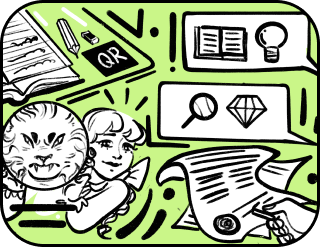
For a deeper immersion into the past, you can sign up for a historical quest-reconstruction. For example, a walking quest through Lisbon “The Secret of the Marquis of Pombal’s Crypt” takes place in Portugal. The quest occurs in the beautiful historic neighborhood of Baixa Alta, where 18th-century architecture is preserved. Participants are invited to study real memoirs of the Marquis of Pombal and, over two and a half hours, solve various puzzles to get a password and unlock the mysterious crypto-mechanical puzzle safe. The entertainment center “Escapology” in Orlando offers different “escape room” adventures where visitors can immerse themselves for 60 minutes in the Renaissance era, solve the mystery of the Mona Lisa’s portrait, become Sherlock Holmes, and uncover a series of crimes from Victorian-era England.
Tea or Coffee, and Maybe a Dance?
For those wishing to immerse themselves in the atmosphere of another era and find a suitable outfit for it, balls and modern cosplay festivals with a historical focus are perfect. The Vienna Opera Ball is held annually in Austria on the last Thursday before Lent. The grand hall of the State Opera is decorated with flowers from the famous Salzburg greenhouses, and the ball begins with a mass dance featuring young men in classic black suits and women in long ball gowns, set to the music of the great Wolfgang Amadeus Mozart. Debutantes at the Vienna Opera Ball have a special dress code—a lavish white gown, a diadem or small crown, and a bouquet of flowers. The event features waiters in tailcoats, as well as a shoe master and a tailor.
In Germany, you can attend the traditional Dresden Ball, held in January. Throughout the event, an orchestra from the famous Zemper Opera plays for the guests. Attendees’ costumes are expected to adhere to the best ball traditions: evening gowns, long gloves, and formal suits.
Historical costume festivals follow their own rules: they can be timed to specific historical dates and turn into large-scale shows where every detail matters—from the cut of the dress to combat techniques. For example, in the Russian city of Smolensk, a festival of historical costumes called “Revival of Eras” took place in September this year, gathering enthusiasts of different historical periods from all over Russia.
Time Stopper
Artificial immersion into the past—balls, exhibitions, festivals—is a placebo, a temporary remedy for the exhausted soul of modernity. This method is suitable for those whose longing for days gone by is more of a trend than a genuine need. For those who truly feel like strangers among their peers, something stronger is necessary. For example, reconstructing the past in the present, manually slowing down time contrary to natural and physical laws. Tea ceremonies, journaling, hand mending, baking pies, developing film, sorting through attic belongings—these rituals bring us back to real time, measured not by deadlines but by processes.
The point of these activities is to reconnect with time as a flow rather than a resource through tactile sensations and a sequence of actions. When this happens, these activities cease to be just “retro-attrations” and become practices of mindfulness.
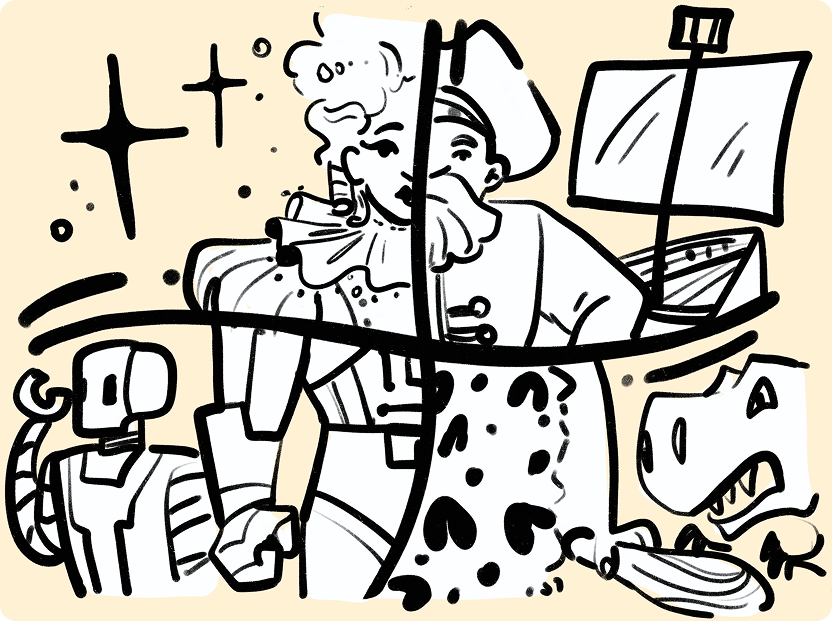
The internet is a child of the digital age. It has brought us unprecedented progress but at a cost: replacing human interactions with mechanical ones. We’ve grown apart from the value of face-to-face meetings, warm touches, and the magic of a chance glance. Digital spaces offer only an illusion of closeness, providing a pill for loneliness but not healing the longing for real connection.
Virtual Unreality
Computer games abound with stories from different times and eras, allowing players to try on various roles and images. Multiplayer shooters like War Thunder and World of Tanks immerse players in tank and aviation battles; Enlisted allows you to lead a squad from World War II; Holdfast: Nations at War transports users to the Napoleonic Wars era. The MMORPG Wild West Online is inspired by the Wild West with survival elements; strategy games like Civilization VI and Age of Empires IV give players the opportunity to build their civilization from antiquity to modern times; and medieval strategy Stronghold Kingdoms turns the player into a noble of ancient times, managing the economy and politics of their own state.
Games with Cyborgs
There are quite a few text-based thematic role-playing games online with live people or AI bots, which are currently extremely popular worldwide. Want to create your own fantasy and play it with a neural network? The StoryForge platform is a next-generation DND: you invent the universe, and AI brings it to life for you. Users have the opportunity to fully immerse themselves in any text adventure inspired by their favorite movie, series, game, or specific historical epoch. The player can set any parameters: the number of characters, their descriptions, plot, relationships between characters, their personalities, and even specific locations, and then act out any events within given boundaries together with the AI bot.
Today, many such platforms are available for PC and mobile devices, for example, HiWaifu, Character.AI, NovelAI, AI Dungeon, Janitor AI, Crushon AI, and many others. If artificial intelligence cannot fully meet all your needs, you can always find a live roleplayer online on specialized forums and social media communities.
Yes, all these virtual worlds are just a crutch; they can’t replace the thrill in a friend’s voice when they tell a story or that look that says more than a thousand emojis. The internet can imitate communication, but it cannot convey its warmth.
But what if we use it not as a refuge but as a tool for discovery?
You don’t have to break the system. Your goal is not to go through the same pre-made storylines repeatedly but to find people online who, just like you, are looking for that very “analog” contact. Someone tired of masks and craving a conversation that leaves a real taste behind.
Gather your club of “out-of-time” people. Arrange meetings in parks, chat via voice calls. Turn the internet from a source of problems into a map that leads you to real people.
Where do kindred spirits dwell?
On services like Interpals and PenPal World, you can find pen pals from all over the world and specify in your profile that you’re interested in exchanging handwritten letters, prefer corsets, and love sword fights. Find your people and switch to paper: handwritten letters, postage stamps, envelopes.
The paid club Letter Writers Alliance offers unlimited correspondence with friends worldwide using real paper letters and postcards. Watching old movies or listening to classical music can also be a shared experience with like-minded people from anywhere on Earth. For this, apps like RAVE, Watch2Gether, and WPARTY are helpful—they provide access to joint viewing of YouTube videos, movies, series, and playlist listening. Video call platforms like Google Meet, Discord, Skype, and Zoom allow you to see the person no matter where they are and pass the time until a live, personal meeting, which can always be proposed and arranged.
In short, if you feel you were born in the wrong era—you are not alone. You don’t need to adapt to a boring world; your task is to find like-minded individuals, create your own rules, your own gatherings, your own formats. Don’t chase after time; make it work for you.
Perhaps your stubbornness will become the last bastion between human eras and the digital future, between living memory and a dump in the cloud, between warm chaos and sterile order.
Don’t change. Find your people. And set your conditions.
“None of us like this era. We’re born too late! But dying is probably also bad, so we choose the life as it is”
Joseph Brodsky

A navigator determines the current location of a person on Earth. We’re mapping new routes in your consciousness.
Thank you!