Chrono-Game “The Moment”
Do you still check your watch to make sure time is moving? The editorial team of “The Global Technology” magazine has decided to give you a gift: we have specially crafted a clock that will never stop. But be careful: the clock might stop you.
Twelve marks on the dial. Twelve memory cells, twelve instants. Twelve doors beyond which time flows differently: it freezes, loops, or rushes forward. This chrono-game has no familiar values, but it has questions that turn everything upside down. One wrong decision—and you might find yourself in a loop of the same day, repeated hundreds of times. One wrong step—and your fate could be rewritten.
Assemble the puzzle of disparate times so that the final picture makes sense. Rewind, pause, and restart key moments, finding hidden connections and alternative paths.
Your task is to stop telling time by the clock’s hands and learn to lead time by the nose. Relax. There’s no need to rush here.
Riddle:
«One twin brother flew to the stars, the other stayed on Earth. Who will be older when they meet?»
According to Einstein's theory of relativity: the faster you move, the slower time flows for you.
The brother who flew to the stars was traveling through space at an incredible speed, almost all of his 'time energy' was spent in motion across space. His clock ticked slower than his brother's on Earth. While he was traveling, decades passed on Earth.
And his brother on Earth was almost not moving relative to the planet. All his "time energy" was spent in motion through time, so his clock ticked faster, and he aged more.
Simply put, speed is an elixir of youth. The one rushing forward is falling behind in time compared to those standing still.
Your "now" isn't absolute. It depends on how fast you're moving. While you were reading this, your time was flowing slightly slower than the time of someone simply looking out the window.
Riddle: «Which came first: the chicken or the egg?»
Yes, yes! The causality loop creates the very time paradox where the effect becomes the cause of itself. The first chicken came from the first egg, which was laid by the first chicken. There's no starting point here, only an eternal cycle where past and future determine each other. It's not a paradox but proof that some things exist outside the law of "causality." They simply exist in an endless cycle where past and future define each other.
Your "today" is the egg from which your "tomorrow" will hatch. And guessing who will be the chicken that will lay it is not difficult.
Riddle: «What time does the carriage turn into a pumpkin?».
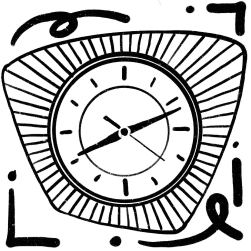
Riddle: «Broken clocks show the correct time twice a day. How many times do the hands of working clocks coincide in 24 hours?»
Why? It's all about the speed. The hour hand moves slowly, and the minute hand races. The minute hand must catch up with the hour hand, doing so repeatedly. In 12 hours, the minute hand completes 11 full laps around the dial, and each time it catches the hour hand, the hands coincide. So, in 12 hours, they meet 11 times.
Calculation: In 12 hours, the minute hand overtakes the hour hand 11 times. Therefore, in a full 24-hour day, they meet 11 × 2 = 22 times.
Interesting fact: Between 11:00 and 1:00, the hands meet only once—exactly at 12:00. Due to this asymmetry, there are not 24 but 22 coincidences.
So, you've fixed the clock and uncovered the hidden rhythm of time. Congratulations!
Riddle:
«How much does one second of your life cost?»
Riddle:
«What devours time but itself becomes bigger?»
According to cosmology, the cosmic vacuum (empty space) consumes time. Near massive objects with strong gravity, time slows down (general relativity). But in the endless emptiness of intergalactic space, where gravitational potential approaches zero, time "stretches" and flows at its maximum speed. The more the universe expands, the more such "devouring" emptiness appears, making its influence on cosmic time more significant.
And of course, indecisiveness is the classic time-eater. The longer you hesitate, analyze, and postpone, the more time you lose, and the bigger the problem in your mind becomes, conjuring new fears and difficulties.
This is the only paradox where "food" (time) doesn't diminish but actually increases the "eater" (indecision).
Your move: Recognizing this invisible enemy already halves its power. The rest is just a matter of technique.
Riddle:
«I'm always ahead, but I cannot be caught. What am I?»
The future always remains at a distance of one day from us, like the horizon that we cannot approach. The more we try to "catch" it—by making plans, worrying, waiting for it to arrive—the more we destroy "today."
The only way to "catch" the future is to stop chasing it and fully immerse yourself in the present action. Don't stand at the door waiting for tomorrow—start building it right now, brick by brick.
Task:
Here are key events in front of you. Choose and arrange them in an order that creates your ideal day.
You have just created the architecture of your attention. Time is not a line but a landscape. Its value is determined not by the order of events but by the depth of your presence in each of them.
If you started the day with a spontaneous act, it will be built on connection. If with solitude—the day will be constructed on meaning and efficiency. If you chose to help a stranger—the day will be based on mindfulness. It doesn't matter in which order the events occur; what matters is that each becomes an anchor, holding you in the present moment.
The Chrono-Labyrinth is completed.
Task:
You have three variables.
(X) Your attention
(Y) The depth of the present moment
(Z) The legacy (your ideas, actions, influence on others)
Choose the correct cycle that transforms them into a formula of meaningful time:
Eternity is a closed system with positive feedback, where the value of time is not measured by its length but by the density of the meaning you put into it. Based on this, the algorithm of eternity is more like a cycle than an equation.
Your attention is the fuel you burn in the present moment. This burning leaves a mark—your legacy. In turn, the legacy influences the quality of your attention.
Now you've launched your algorithm. Now you can fill all variables with values.
Riddle:
«Where do the brightest memories reside?»
The brightest memories hide in the gaps—in that very silence that remains after a phrase is spoken, in the pause between a question and an answer, in the aftertaste, in an unfinished melody someone once hummed nearby.
To hear the footprints of presence, you need to turn off your inner dialogue and allow silence to begin its story. It is exactly there, in the stillness, that the past ceases to be a collection of facts and becomes a living sensation.
You just didn't find the archive. Now you can close your eyes and listen.
Riddle:
«What do you have that does not belong to you?»
The key is in your hands. Don't try to own time; master the art of managing it. The most valuable things in life are those we've truly felt. So let your life never be a list of spent hours, but instead a collection of fleeting moments stolen from eternity.
"Time spent with you is my wealth."
— Oscar Wilde
Congratulations on your victory. Yours, The Global Technology.
